A fishing apparel supplier who sounds reliable in a WeChat pitch is not the same as one who is reliable. You find that out fast when your Q4 order lands late, faded, and 30 GSM lighter than the sample.
Fishing apparel has its own set of risks. The gap between a vendor's promises and their real production capabilities can damage your brand season after season. Sublimation consistency, UPF fabric credibility, functional design execution — these are the areas where things fall apart.
This guide skips the generic checklist. What you get instead is a battle-tested evaluation framework built around the exact pressure points that separate a long-term manufacturing partner from an expensive mistake:
Quantifiable scoring benchmarks to measure suppliers objectively
Red-flag patterns that experienced buyers spot and act on
Stage-by-stage strategies for managing supplier relationships as your brand grows
Quantifiable Supplier Evaluation Dimensions with Scoring Benchmarks

Most fishing apparel supplier disasters are predictable. The pattern is nearly the same every time: a buyer trusted gut feel, a slick catalog, and a confident sales rep — and skipped the part where numbers get compared against numbers.
Here's the fix. Build a scorecard around 8 concrete, measurable KPIs — each with defined scoring anchors. This turns a vague gut-check into a clear, defensible procurement decision. The goal isn't bureaucracy. It's clarity. In fishing apparel, a washed-out sublimation print or a fake UPF claim can kill a product launch. Clarity pays for itself.
Use a 0–10 scale per KPI . Assign category weights based on your business priorities. Then calculate a weighted total. Treat certain criteria — UPF certification, for example — as binary pass/fail gates . A supplier who fails a gate is out. It doesn't matter how well they score everywhere else.
The 8 KPIs That Separate Good Suppliers from Risky Ones
1. Defect Rate (Quality)
Score it in PPM (parts per million). A score of 10 means ≤500 PPM. Above 2,000 PPM earns a 3. Simple. No negotiation.
2. QC Architecture (Fishing Apparel-Specific)
A fishing apparel wholesaler running the full IQC → IPQC → FQC → OQC pipeline, with AQL 2.5/4.0 documented and a CAPA log on hand = 10 pts . Final inspection only = 5 pts . Ad-hoc visual checks with no AQL standard = 2 pts .
This dimension matters more in fishing apparel than in fashion basics. Inline checkpoints catch functional failures early — things like misaligned rod holder loops or gaping seam allowances on stretch panels. You want those caught before they ship, not after.
3. Sample Lead Time & Prototyping Cycle
Tech pack to confirmed sample in ≤15 days , with one free revision round = 10 pts . Over 25 days, or a supplier who charges for every revision = 3 pts .
A slow or expensive sampling process is not a vendor quirk. It tells you how they'll handle your Q4 rush — and that answer is: badly.
4. On-Time Delivery Rate (OTD)
≥95% on-time in full over the trailing 12 months, backed by shipment logs = 10 pts . Below 85%, or a pattern of "capacity overcommitment" excuses = 3 pts .
Ask for the logs. No logs? That's your answer right there.
5. MOQ Flexibility & Pilot Terms
For growing fishing brands, this dimension can be the deciding factor. A supplier who accepts 100–200 pcs pilot orders with size/color mixing and waived tooling fees on reorders = 10 pts . Fixed MOQ ≥800 pcs with no pilot option = 2 pts .
A supplier who won't let you test the relationship at small scale doesn't want a partnership. They want a transaction.
6. UPF Certification & Fabric Compliance (Non-Negotiable Gate)
Third-party lab report from SGS, TÜV, or Intertek confirming UPF 50+ , with fabric mill traceability = 10 pts . In-house testing only, no independent validation = 5 pts . Marketing claims without documentation = 0 pts — and immediate disqualification.
This isn't a nice-to-have. It's a legal and brand liability issue. Full stop.
7. Bulk Color Consistency & Sublimation Stability
Set your benchmark at Delta E ≤1.5 across size runs and reorders. Add sublimation dye penetration ≥95% on polyester blends. No cracking after 20 commercial washes (AATCC 61, Grade 4+) = 10 pts . Delta E >2.5 or visible banding = 3 pts .
Color drift between your sample and your bulk order is one of the most common failures in performance fishing wear production. It's also one of the most expensive to fix after the fact.
8. Communication SLA & Documentation Standards
≤3-hour response during business hours, bilingual documentation, and inline photo/video updates every 3–5 days on active orders = 10 pts . WeChat-only replies with no formal spec sheets = 2 pts .
You're not just buying garments. You're buying operational transparency. A supplier who can't document clearly will cost you more in back-and-forth than they save you on unit price.
How to Calculate and Use the Score
Assign weights based on your current business priorities. A suggested starting split:
Dimension | Weight |
|---|---|
Quality (Defect Rate + QC Architecture) | 30% |
Compliance (UPF + Certifications) | 20% |
Delivery (OTD + Lead Time) | 20% |
Commercial Terms (MOQ + Cost Stability) | 15% |
Service (Communication + Flexibility) | 15% |
Total Score = Σ (KPI Score × Weight) ÷ 100
A fishing apparel manufacturer scoring below 65 deserves serious reconsideration. Below 50 — regardless of price — is a risk your brand budget shouldn't carry.
Keep your KPI set tight: 8–10 metrics maximum . Too many metrics blur the picture. They distract from the one question that matters most: Would you give this supplier more of your business next season?
Five Industry Collaboration Traps and Red Flag Identification
Every fishing apparel supplier looks reasonable before the first real order. The red flags don't wave — they hide. Inside vague quotes. Borrowed certificates. Confident answers to questions you didn't know to ask.
Here are the five traps that cost fishing apparel buyers the most. Not in theory. In real orders, real dollars, real damage.
Trap 1: The Sample-to-Production Switchout
Your proto sample arrives perfect. The bulk order doesn't. The fabric feels lighter. The seams shift. The sublimation banding you never saw on the sample shows up at 500 units.
Here's what happened: the supplier used premium material for the sample, then swapped in a cheaper fabric batch for production. Stitch density drops. Fabric GSM falls short. You feel it in your hand — not on a spec sheet.
Red flags to catch it early:
- No sealed TOP (top-of-production) sample in the workflow
- No written seam tolerance ranges in the tech pack (you want ±0.5 cm on key seams, documented)
- Bulk fabric batch codes that don't match your approved swatches
How to protect yourself: Require a signed pre-production sample sign-off. Lock it in writing. Cross-check bulk batch codes against the swatches you approved. A supplier who hesitates at any of these steps is giving you your answer right there.
Trap 2: The Peak-Season Priority Shuffle
Your fishing line gets pushed down the queue in Q3. A larger client dropped a bigger blanket order. Your August delivery shifts to September — then turns into a "we're doing our best" non-answer in October.
Red flags:
- No dedicated outdoor or fishing apparel production line — just a shared floor
- Delivery history they can't or won't produce
- Capacity commitments that stay vague no matter how many times you ask
Request 12 months of on-time delivery logs before signing anything. Ask about their rush-order policy. Ask whether capacity reservation is available in writing. A supplier who can't give a straight answer on those points hasn't considered your business continuity. They've considered their own.
Trap 3: The Hidden Surcharge Accumulation
The pilot order quote looks competitive. Then the pattern setup fee appears. Then an embroidery digitization charge. Then a "low-MOQ adjustment." By the time you've placed your third order, you've paid for the same tooling three times.
Red flags:
- Quotes that bundle sampling and production without line-item transparency
- No written terms for tooling amortization on reorders
- Setup costs that reset every order, regardless of reorder history
Fix it before it starts: Demand a full itemized BOM and processing-cost breakdown before the sampling stage. Nail down tooling amortization terms upfront — a fair benchmark is full amortization after three consecutive reorders. Lock payment terms in writing before a single sample is cut.
Trap 4: Certification Laundering
This one is more common — and more dangerous — than most buyers expect.
A reliable fishing apparel factory shares a UPF 50+ certificate. It looks official. It has a lab name on it. What it doesn't show you: the certificate is two years old, covers a single fabric SKU from a different product line, and can't be found in any external database.
That's certification laundering. In fishing apparel, UPF claims carry real consumer safety and legal liability weight. This trap can damage your brand long after the season ends.
Red flags:
- Certificate numbers that return no results in the issuing authority's database
- Test scope covering one fabric only, presented as if it covers your entire line
- No mill traceability, no dye-house documentation, no raw material invoices
What to demand instead: Check every certificate ID in the SGS, TÜV, or Intertek database yourself. Require batch-specific UPF and colorfastness test results — tied to the actual fabric lot you're buying — before bulk release. A supplier who can't produce mill invoices or dye-house environmental permits has a gap in their certification story.
Trap 5: Functional Claims Without Lab Evidence
"Rapid-dry technology." "Anti-salt protection." "UV-blocking fabric." These phrases are cheap to print on a spec sheet. Without a test method behind them, they mean nothing.
Here's a real failure scenario: a buyer launches a performance fishing shirt line with moisture-wicking claims front and center on the product page. Returns roll in after summer. Customers say the shirts feel heavy and slow-drying in humid conditions. There's no independent MVTR data. No standardized test on file. Just a marketing bullet point someone typed.
Red flags:
- Performance claims with no referenced test standard (AATCC, ISO, or equivalent)
- Results that shift across sizes within the same SKU
- Marketing language that runs ahead of any actual documentation
The standard to hold suppliers to: Require independent 10-cycle salt spray and UV exposure tests on actual pilot garments — not fabric swatches alone. For moisture management, ask for MVTR and hydrostatic head reports aligned to ISO 811/11092 or equivalent AATCC methods. A supplier who can't produce those before bulk release loses the claim — it stays off your product page.
The First Due Diligence Call: What to Ask Before You Get to the Traps
Before you send a tech pack, use your first fishing apparel supplier call to surface what a polished catalog won't show. Ask straight out:
Have you had product defects or recalls in the last 24 months? How did you handle them?
Do you subcontract any part of production? If so, which processes, and to whom?
Can I schedule a facility visit — remote or in person?
Can you walk me through your QC process, step by step, with documentation?
A supplier who answers these questions without deflection is showing you something worth more than a low unit price: they run a transparent operation. A supplier who turns evasive, vague, or suddenly too busy to answer? That's the trap — right there, before you've placed a single order.
Reusable Supplier Comparison Matrix and Scoring Template
Gut feelings don't scale. A scoring matrix does.
Run two or three fishing clothing supplier evaluations back-to-back and something becomes clear fast. A reusable comparison template kills the "this vendor felt better in the meeting" problem. It replaces vague impressions with documented, weighted evidence. Here's how to build one you'll keep using — plus what the numbers look like with real fishing apparel suppliers plugged in.
The Structure: What Your Matrix Needs
Every column earns its place. A working fishing apparel supplier comparison matrix for fishing apparel should carry these fields:
Evaluation Dimension — the specific KPI being scored
Weight (%) — how much this dimension matters to your business; all weights sum to 100%
Supplier Score (1–10) — 10 is best, defined ahead of time with fixed anchors per row
Weighted Score — Score × (Weight ÷ 100), calculated per cell
Evidence / Document Link — the SGS report, shipment log, signed pilot agreement, or CAPA record that backs the score
Risk Notes — qualitative flags, gating failures, or conditions to revisit
Run three suppliers side by side. Adding a column for Supplier C costs nothing. It can save you an entire sourcing cycle.
The Scoring Template: Populated with Real Numbers
Below is a filled example using eight dimensions weighted to 100%. These are the same criteria that matter most in performance fishing wear production — not hypothetical ones.
Dimension | Weight | Supplier A | Supplier B | Wtd. Score A | Wtd. Score B | Evidence | Risk Notes |
|---|---|---|---|---|---|---|---|
Lead Time & Prototyping | 12% | 9 | 7 | 1.08 | 0.84 | SGS delivery log – Q3 | A: 14-day avg. B: 21-day avg + weekend surcharge |
UPF & Fabric Compliance | 15% | 10 | 6 | 1.50 | 0.90 | SGS Report #2024-UPF-8841 | A: UPF 50+ third-party verified. B: in-house only, pending |
QC Architecture & AQL | 14% | 9 | 8 | 1.26 | 1.12 | IPQC checklist + CAPA log | A: full inline tracking. B: final inspection only |
MOQ & Pilot Flexibility | 10% | 10 | 7 | 1.00 | 0.70 | Signed pilot agreement | A: 150 pcs, mixed sizes. B: 300 pcs minimum per colorway |
Communication SLA | 9% | 8 | 9 | 0.72 | 0.81 | SLA email thread | A: ≤2hr avg. B: next-day batch replies — slower but consistent |
Delivery History (OTD) | 15% | 10 | 6 | 1.50 | 0.90 | 12-month OTIF log | A: 97% OTD. B: 88% OTD, recurring seasonal backlog |
Certifications & ESG | 10% | 9 | 10 | 0.90 | 1.00 | ISO/OEKO-TEX/BSCI PDFs | A: all current and verified. B: BSCI expired — social audit risk |
Functional Lab Data | 15% | 8 | 7 | 1.20 | 1.05 | AATCC/ISO lab results | A: MVTR 8,200 g/m²/24h. B: MVTR 5,500 g/m²/24h |
TOTAL | 100% | 9.16 | 7.32 |
To normalize to a 0–100 scale, multiply each total by 10: Supplier A = 91.6. Supplier B = 73.2.
That 18-point gap is not just a number. It reflects months of potential production risk — and the kind of brand damage that doesn't surface until customer returns start climbing.
What to Do with the Score
The number alone doesn't make the decision. The threshold does.
≥ 85 — Proceed to contract. Standard QC terms and payment milestones apply.
70–84 — Conditional pilot. Place a small order. Tighten the AQL, use milestone-based or LC payment terms, and attach a corrective action plan to the lowest-scoring rows.
< 70 — High-risk vendor. Ask for a documented remediation plan with a firm timeline — 3–6 months is standard. No clear commitment? Limit them to non-critical spot buys or remove them from contention.
One critical point: gating criteria override the total score. A supplier scoring 88 overall but failing UPF certification with no third-party documentation does not pass. The gate closes. It doesn't matter what the rest of the matrix shows.
Making It Reusable
Build this in Excel or Google Sheets with locked formulas. Set scoring anchors for every dimension before you talk to any supplier. Pin down what a 10 looks like, what a 5 looks like, what a 3 looks like. Pre-set anchors stop two evaluators on your team from scoring the same vendor in opposite directions after a strong sales call.
Require evidence for every score. Not impressions. Not memories from a factory visit. Reports, trackers, signed agreements — link them straight into the matrix. Six months later, you'll know exactly where to pick up the review.
Partnership Lifecycle Management Strategies
Signing a supplier contract is not the beginning of a partnership. It's the end of the easy part.
What comes next — managing a supplier relationship across months, seasons, and product launches — is where most fishing apparel brands lose money, margin, and time. Not in dramatic failures. In slow drift. Promises that held in Q1 that nobody enforced by Q3. Payment terms that were never written down. A production calendar that lived in one sales rep's head and disappeared when she left.
The fix is structure. A three-phase lifecycle model that deepens your governance, financial controls, and joint planning as trust is earned — not assumed.
Phase 1: Trial (Days 0–90)
The first 90 days are a controlled experiment. Your job is not to build a relationship. Your job is to collect evidence about whether a relationship is worth building.
Run a 30-day value test first. Before committing to a full pilot run, place a small qualifying order — under 500 pcs — built to stress-test execution. Watch for on-time delivery, inline communication, and whether the bulk garments match your sealed TOP sample. What you see in 30 days tells you more than six months of sales calls.
Lock the payment structure from day one. For new vendors, a 30/40/30 split is the right structure:
- 30% at PO confirmation and raw material purchase
- 40% at around 80% production completion, post inline inspection
- 30% after third-party AQL inspection passes, before shipment release
Never release that final 30% on paperwork alone. Require a third-party inspection report confirming AQL 2.5 for major defects and AQL 4.0 for minor defects. Your payment is your leverage — use it with intention.
Build your inspection cadence early. For trial-phase orders, schedule third-party inspections at two points. First, around 30% completion to catch systemic issues before they grow. Second, at 80–100% completion before final packing. Finding a sublimation banding problem at 30% completion costs you a conversation. Finding it at final inspection costs you a season.
Track these four metrics through every trial order:
- On-time delivery rate
- First-pass yield at final inspection
- Defect rate by category — seams, fabric, print, trims
- Communication SLA adherence (% of queries answered within 24 hours)
At the end of one or two pilot cycles, run a formal scorecard review. The question is simple: review, renew, or rotate?
Phase 2: Stable Partnership (Months 3–12)
A supplier who survived your trial phase has earned one thing: a longer runway. Not unconditional trust. A longer runway.
The stable phase is where you shift from transaction management to operational integration. The governance rhythm changes to match:
Weekly production status sync — short call or shared dashboard
Monthly operating review covering quality and delivery KPIs
Quarterly business review (QBR) to reset volume targets and address recurring issues
Move toward tiered pricing. Ad-hoc quotes are a tax on your procurement time. Once you've built consistent volume, negotiate structured price brackets. A working model for fishing shirt manufacturing:
Volume Tier | Pricing |
|---|---|
1,000 units | Base price |
3,000 units | 2–4% reduction |
5,000+ units | 5–8% reduction |
Tie these tiers to seasonal planning, not just raw unit counts. A supplier who builds fishing tournament cycles and Q4 e-commerce peaks into their line loading gives you better pricing and better capacity reliability.
Set up rolling 60-day demand forecasts shared via a live spreadsheet or basic PLM portal. Update it every two to four weeks. Include style, color, and size breakdown. Add firm versus flexible quantities and planned ex-factory windows. A supplier who can see your demand curve plans better. A supplier flying blind guesses — and guesses wrong at the worst possible moments.
After two or three clean cycles, renegotiate payment terms. A 30/40/30 split made sense when you were strangers. A supplier with a documented 97% OTD rate and solid AQL performance has earned a conversation about NET-30 or a 50/50 structure. Run a basic credit review first — past 12-month payment history, bank reference, trade credit report — before extending terms.
Phase 3: Strategic Partnership (Month 12+)
Most fishing apparel brands never reach this phase with a supplier. That's not a failure of ambition. It's a failure of discipline in phases one and two. Strategic partnership is not a reward you give. It's a status you verify — every quarter, with data.
At this level, the relationship stops being transactional and becomes structural.
Reserve dedicated production capacity. For your most critical SKUs, negotiate a minimum annual volume commitment per production line — 150,000 to 200,000 shirts per year, depending on SMV complexity. Attach penalty clauses for unauthorized rebooking of reserved lines to other customers, and for failure to prioritize your orders during peak season. Standard penalty structure: 0.5–1.0% of PO value per day of delay, or a forced credit note on future orders.
Co-develop proprietary fishing apparel constructions. This is where strategic suppliers earn their status. Work together on high-stretch, moisture-wicking knits with locked GSM and UPF ratings built for your line. Develop salt-resistant hardware — coated snaps, anti-corrosion zippers — that competitors can't replicate fast. Spell out IP and exclusivity terms in plain language: who owns the fabric spec, how long the exclusivity window runs (two to three years by region is standard), and how R&D costs are split. A fair split is 60% brand, 40% factory.
Formalize capacity planning around your fishing calendar. Run joint planning sessions at least twice a year — once before tournament season, once before Q4 e-commerce peaks. In these sessions, lock capacity blocks by month. Align promotional calendars with fabric booking and dyehouse schedules. Model both best-case and worst-case volume scenarios. A supplier who doesn't know when the Bassmaster Classic happens is not a strategic fishing apparel partner. They're a general garment factory that happens to sew your shirts.
Run annual ESG compliance audits together. Strategic tier status stays contingent on maintained certifications — ISO 9001, ISO 14001, BSCI, or SMETA where applicable — plus documented progress on chemical management (ZDHC compliance), labor practices, and waste metrics. This isn't idealism. Retailer compliance requirements and consumer scrutiny of outdoor brands have turned ESG documentation into a commercial requirement, not an optional extra.
The Honest Timeline
Strategic partnerships take 12 to 18 months to generate real ROI. There's no shortcut. Every quarter, run a checkpoint: joint product pipeline status, capability development progress, integration milestones. KPIs are met and your partner is pushing new ideas — renew and expand scope. Performance has plateaued — resize your allocation and push a corrective roadmap with a fixed deadline. Underperformance continues after that — execute a controlled exit that protects your production continuity and customer experience.
The suppliers worth keeping are not the ones who never have problems. They're the ones who treat problems as data — document them, own them, fix them, and show you the evidence.
That's the difference between a vendor and a partner. In fishing apparel, a bad season shows up in returns, chargebacks, and brand reviews. That difference is worth more than the lowest unit price sitting in your inbox.
Differentiated Sourcing Priorities for Scale and Growth Stage
The supplier that works perfectly for your first 200-unit tournament jersey run will become your biggest operational headache the moment you're chasing 5,000 units across three colorways with a 45-day window. Scale changes everything — the questions you ask, the terms you demand, the technical standards you can enforce.
Your growth stage should shape how you evaluate and engage suppliers. Here's how that breaks down across three distinct stages.
Startup Stage: Flexibility Beats Everything Else
Low volume, evolving designs — rigid suppliers will drain you faster than bad unit economics.
The commercial minimums that matter here:
MOQ of ≤50–100 pcs per design , with a seasonal aggregate under 500 pcs — achievable through digital sublimation workflows, not rotary screen lines
Prototype turnaround of 10–14 calendar days from tech pack handoff; artwork-to-sewn-sample in 7–10 days for digital sublimation
Per-piece pricing with gradual breaks at 50 / 100 / 250 / 500 units — no cliff-edge MOQ jumps
Ex-factory targets for custom sublimated performance fishing tops: US$9–13/pc (short-sleeve) and US$13–18/pc (long-sleeve hooded) at 50–100 pcs
On the technical side , require 100% digital sublimation — no screen setup fees, no color separation minimums. A supplier who runs name/number personalization in the same production run at ≤US$2–3 upcharge is built for your stage. One who can't is built for someone else's.
Communication matters more than most startups admit. WhatsApp order follow-up, approval photos via chat, Google Sheets for order tracking — these aren't unprofessional workarounds. They work for non-enterprise buyers. A supplier who insists on strict ERP portal access for 150-unit orders is telling you where their attention lives. It's not with you.
Growth Stage: Tighten the Technical Standards
You're running consistent seasonal volume. Your brand's reputation is starting to travel. At this point, "good enough" sublimation and verbal color approvals become real liabilities.
This is the stage where you put in writing what you previously handled on trust.
Color and print consistency gets a hard specification:
- ΔE ≤1.5 (CIEDE2000) against your approved lab standard, measured under D65 light / 10° observer, with signed L*a*b* data sheets before every bulk release
- The supplier maintains ICC profiles per printer/ink/fabric combination and recalibrates sublimation printers at minimum weekly during heavy production
UPF fabric traceability gets batch-level rigor:
- Require batch-specific UPF 50+ test reports — not a single certificate covering a broad fabric category — tied to lot ID, GSM, composition, test date, and lab name
- Roll-level or lot-level barcoding that isolates defects down to ≤500 finished garments by fabric lot
Production standards worth locking in writing at this stage:
- CNC/marker-based automatic cutting for runs >500 pcs, with marker efficiency benchmarks of ≥82–85%
- Standardized SPI (10–12 for flatlock/overlock in stretch jerseys), thread type (100% polyester, Tex 18–27), and seam strength targets (≥80% of fabric breaking strength)
- Inline QC metrics tracked per run: first-pass yield, color pass rate, seam defects per 100 pcs
Tech pack discipline pays off here. A standardized one-page template — graded measurements, stitch/seam specs, Pantone-referenced colorways, trim and label layout — cuts your sample revision cycles from 3–4 rounds down to 1–2 . Target ≤30 days from initial brief to production-ready sample.
Enterprise Stage: Structure the Relationship, Not Just the Order
At scale, depending on a single factory is a strategic vulnerability. The enterprise sourcing posture looks different by design.
Build a multi-factory network:
- Maintain 2–3 qualified factories per core style, with no single site exceeding 60–70% of volume for any critical SKU
- Spread geography across at least two regions — Southeast Asia plus Latin America or a nearshore option — to hedge port and geopolitical risk
- All qualified factories run the same fabric platform, color standards, QC criteria, and documentation format
Capacity reservation shifts from request to contract:
- Negotiate formal agreements that specify reserved line output — for example, 50,000 pieces/quarter across key styles — with defined penalties for failure to deliver
- Share 12–18 month rolling demand forecasts with frozen commitment windows of 8–12 weeks for final PO lock
- For peak fishing months (tournament season, Q4 e-commerce), lock in priority dye-house slots and fixed reorder lead times of ≤45 days from PO to ex-factory on repeat styles
Compliance becomes non-negotiable infrastructure:
- ISO 14001 at facility level, OEKO-TEX STANDARD 100 or bluesign-approved fabrics, valid social audits (SMETA/Amfori) with documented corrective action timelines
- A live Restricted Substance List (RSL) program, not a one-time checkbox
The KPIs shift from cost-per-unit to system performance:
- Defect rate <1.5% at final AQL inspection
- On-time delivery ≥95% against agreed ex-factory date
- Chargeback/return rate ≤1% of shipped units due to quality failures
- >95% of POs transmitted via EDI; >90% of product data pulled from PLM master — not re-keyed by hand
The progression across these three stages isn't accidental. Each phase earns you the right to demand more — more traceability, more capacity commitment, more co-development investment. A supplier who grows with you through all three isn't just a vendor. They're a structural advantage your competitors have to build from scratch.
Conclusion
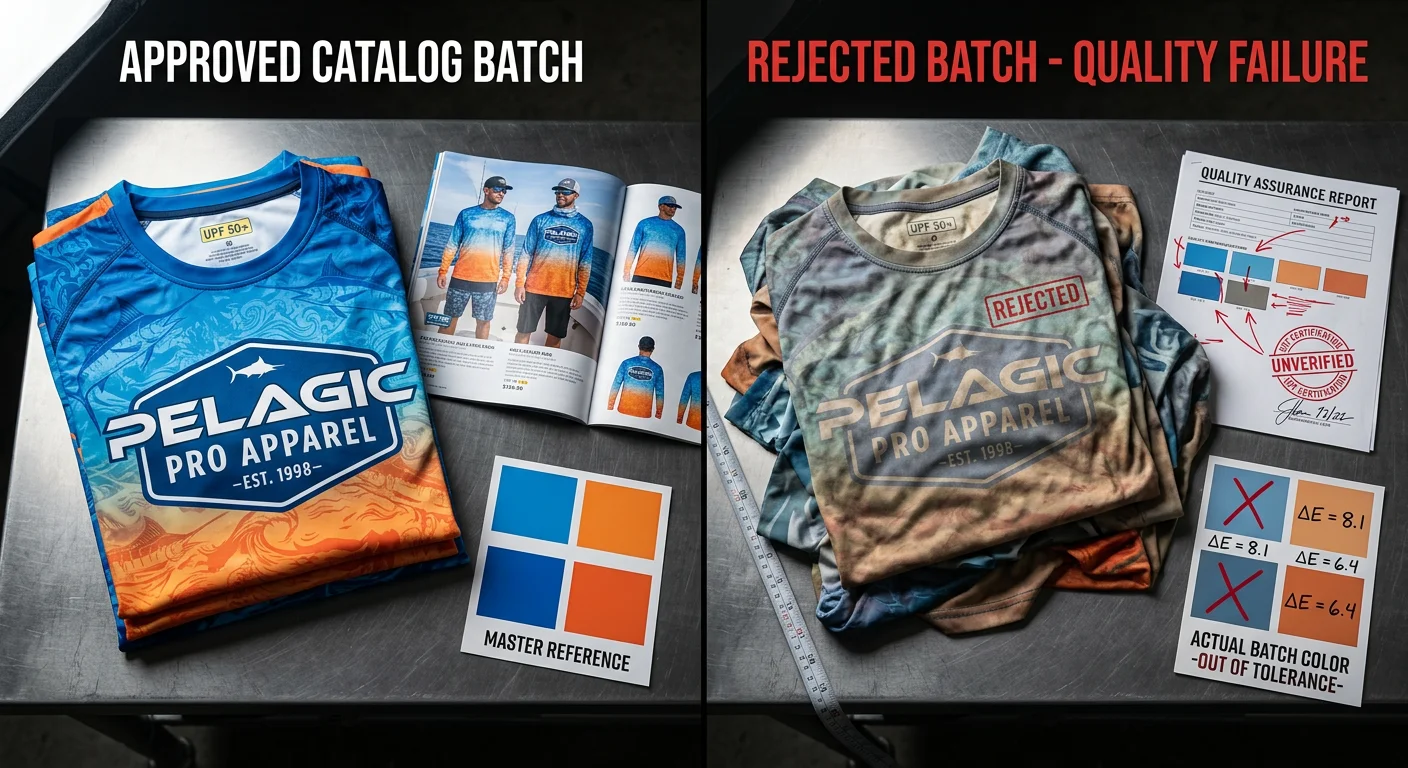
Your next fishing apparel supplier won't tell you they're unreliable. They'll show up with a polished catalog, competitive pricing, and just enough responsiveness to win your first purchase order. Then the cracks appear. Wrong Delta E on a sublimation run. A UPF certification that turns out to be a factory's self-declaration. Samples that look nothing like bulk production once MOQ pressure kicks in.
That's why the framework in this guide matters.
Reliable fishing apparel supplier partnerships don't happen by accident. You build them through deliberate evaluation. Use the scoring matrix. Run the red-flag checklist before you sign anything. Apply sharper scrutiny at each stage — what you need from a trial-order vendor is not the same as what a strategic partner must deliver.
The right fishing apparel supplier does more than manufacture your product. They protect your brand's reputation every time a customer pulls on that shirt and steps into the sun.
Start evaluating with more discipline. Your supply chain — and your customers — deserve that level of care.