You've searched the basics already — sublimation locks color into the fiber, DTF lays a film on top, screen printing builds ink layer by layer. But those generic breakdowns skip the real question: how does each method hold up after a full tournament season? We're talking saltwater spray, brutal sun, and twice-weekly washes.
Pick the wrong print method for your custom polyester fishing shirt and it's not just a budget problem. You'll watch your sponsor logo crack and fade mid-season. Or you'll peel a full-color fish graphic off the back of your jersey after twelve washes.
This guide focuses on what matters for on-water apparel:
Fabric bonding — does the print actually stick to polyester?
UV resistance — will the colors survive a full season of sun exposure?
All-over print capability — can the method cover the whole jersey?
Real cost per fishing jersey — across single pieces, team orders, and commercial runs
By the end, you'll know which method fits your needs — no guessing needed.
Fabric Compatibility: Bonding Mechanism with Polyester & Functional Blends
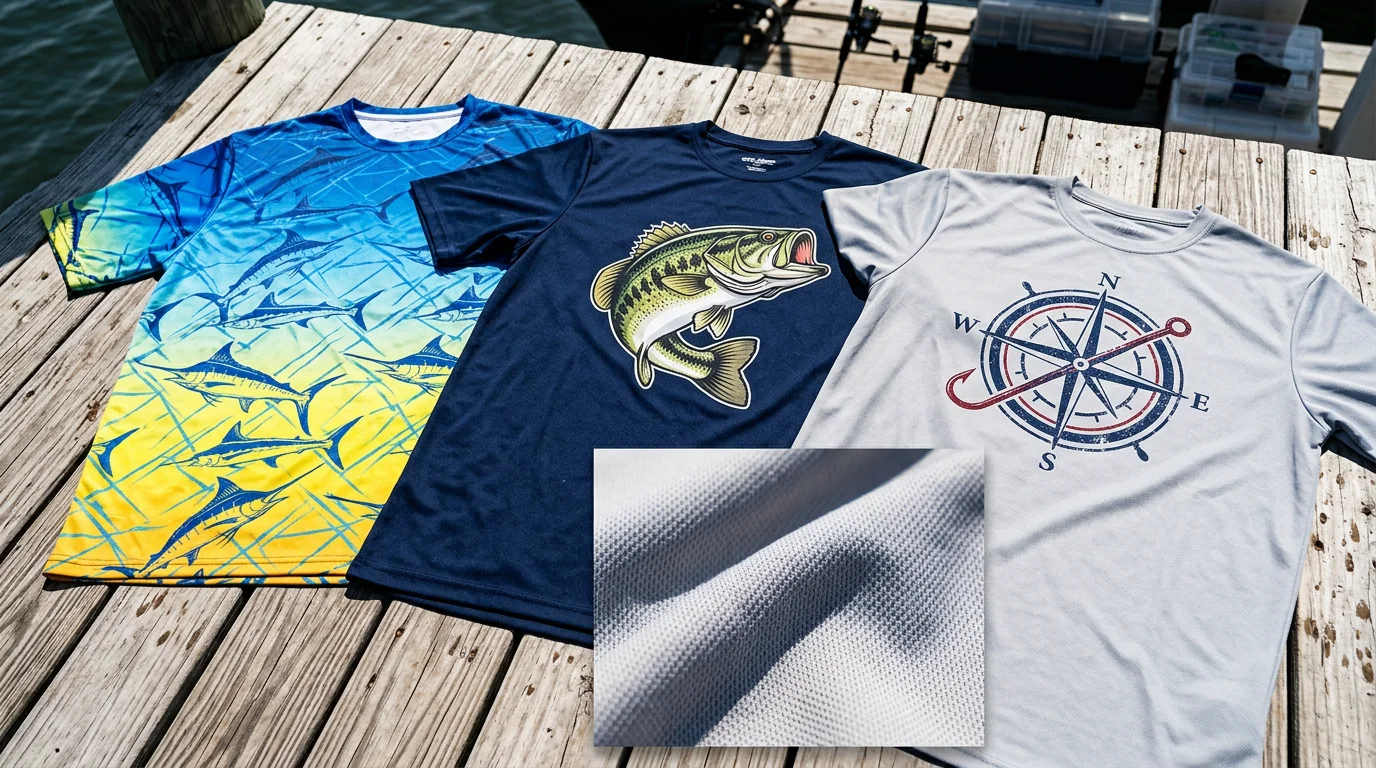
Here's what spec sheets won't tell you: the fabric itself is the deciding factor — not the artwork, not the order size, not even the custom fishing jersey price.
Fishing jerseys are built from 100% polyester or high-polyester blends . These fabrics are lightweight, hydrophobic, and engineered for moisture-wicking and UPF protection. That material reality cuts out certain printing options before you've opened a quote request.
How Each Method Bonds to Polyester
Dye sublimation works inside the fiber. Heat (180–210°C) and pressure push disperse dye vapor into the PET chains at a molecular level. It's not a surface coating — it's a bond inside the fiber itself. The result? Zero added hand feel. Zero interference with wicking or UPF finishes. The print becomes part of the fabric.
There's one firm constraint: sublimation works on light or white polyester only (≥75% PET content works best). The inks are transparent. They can't mask a dark or heathered base — the fabric color bleeds through and kills saturation.
DTF takes a different approach. It lays down a pigmented film — white underbase included — held in place by a heat-activated polyurethane adhesive powder. That powder melts at 140–160°C and bonds to the fabric surface. The adhesive layer drives adhesion, not fiber chemistry. So DTF works on dark polyester, poly-cotton, poly-spandex, and nylon blends without any modification needed.
That lower press temperature is a real advantage on performance fabrics. Many fishing jersey constructions use copolyester binders and coatings that start softening around 140–180°C. DTF's processing window stays within that range and protects those functional finishes rather than burning through them.
Screen printing creates the most friction on performance polyester. Traditional plastisol inks are built for cotton — porous, hydrophilic, forgiving. On 100% polyester microfiber, cure temperatures (160–170°C) risk shrinkage, coating delamination, and dye migration. That's where disperse dyes already in the fabric bleed upward into the wet ink layer. To stop that, you need low-cure anti-sublimation inks (130–150°C). That adds cost and complexity — and still doesn't fix the adhesion limits on smooth, hydrophobic yarns.
The Compatibility Matrix at a Glance
Fabric Type | Best Method | Why |
|---|---|---|
White/light polyester (≥75%) | Sublimation | Molecular dye–fiber bond; preserves wicking/UPF |
Dark polyester (100% or blends) | DTF | White underbase; adhesive film; safe press temp |
Poly-spandex / nylon-spandex | DTF | Flexible adhesive powders designed for stretch |
Cotton-rich or heavy jersey | Screen printing | Mechanical anchoring; cost-efficient at volume |
Dark poly + large run | Screen (low-cure) | Works with anti-migration inks only; test first |
For most polyester fishing shirts — particularly the lightweight 120–160 gsm knits used in tournament jerseys — the bonding decision comes down to one question: what color is the base fabric?
Light base → sublimation wins on every technical measure. Dark base or mixed construction → DTF is the one method that handles opacity, functional finishes, and thermal safety without compromise.
Color Fidelity & Full-Coverage Limits for Complex Fish Graphics
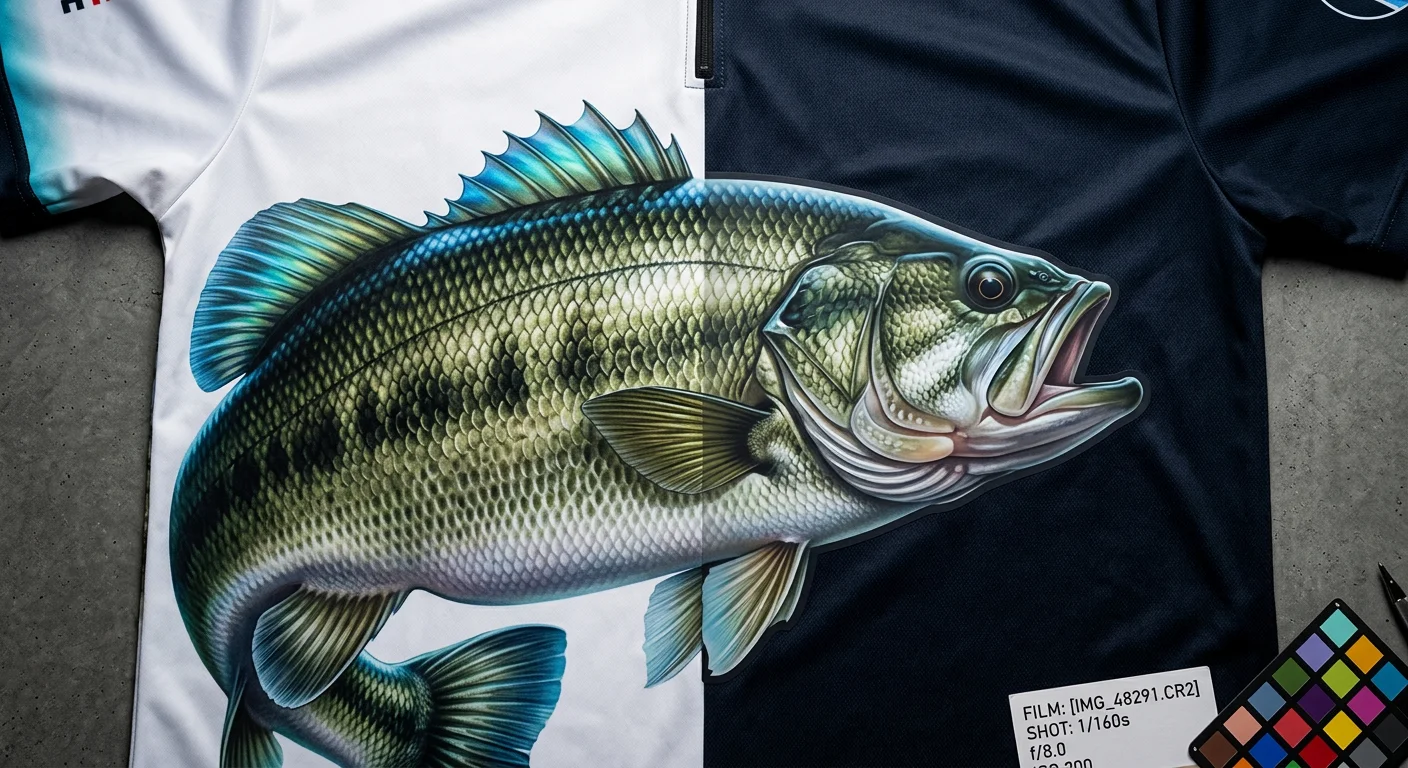
Take a largemouth bass rendered in photo-realistic gradient blues and greens — fins catching refracted light, scales shifting from olive to silver. That design puts every print method under pressure. Not every process can carry that level of detail across a full jersey without breaking down somewhere.
Here's where each method delivers — and where it doesn't.
Sublimation: The All-Over Champion With One Blind Spot
For full-body wrap fish graphics , sublimation has no real competition. Panels print flat before cutting and sewing. Your design runs across every piece — front, back, sleeves — with no transfer edges, no registration breaks, and zero added stiffness at 100% coverage . That's a big deal on a lightweight 130 gsm tournament jersey. A stiff print layer traps heat and kills moisture management fast.
Color output is strong across most fish art. Bright oranges, saturated reds, vivid mid-tone blues — sublimation handles all of it with real richness. The weak spot shows in deep underwater scenes . Ink transparency means near-blacks can drift toward dark navy. The deepest blues sometimes compress a bit because of polyester's optical brighteners.
The fix is straightforward:
- Run your artwork through a sublimation-specific ICC profile
- Output test gradient bars from shallow to deep-water blues
- Adjust curves before committing to a full run
Totally fixable. Just don't skip that step.
DTF: Unlimited Colors, Real Coverage Ceiling
DTF is the top pick for photo-realistic fish art on dark jerseys — and the reason is clear. CMYK plus a white underbase layer lets your sponsor's neon orange logo and a midnight-blue underwater background sit together on the same black polyester jersey. Sharp fins, high-saturation scales, complex gradients — all handled in a single pass with unlimited colors and no per-color cost.
The limitation is physical, not optical. Every square inch of DTF coverage adds a layer of melted polyurethane adhesive film . Push past 50–70% garment surface coverage and the cumulative effect becomes a real problem:
- The jersey stiffens up
- Drape suffers
- Multiple large transfers placed side by side leave visible panel edges where they meet
Anglers call it the "plastic shell" effect. It's a common complaint from those wearing full-coverage DTF jerseys on hot tournament days.
The practical fix: position your complex fish art across the main visual zones — front chest, full back panel, side accents — and target 30–60% total coverage . Leave underarm panels and side seams unprinted. You keep the visual impact without ruining wearability.
For artwork setup, get these four parameters right:
- 300 dpi at final print size
- CMYK color mode
- ICC profile matched to your specific printer and ink set
- White underbase included in file or RIP
Nail those four and your jersey looks like a tournament winner. Miss them and it looks like a budget iron-on.
Screen Printing: Bold Graphics Only
Screen printing's color ceiling for fish art comes down to mesh and halftone physics. At standard apparel mesh counts of 110–200 , smooth tonal transitions — the kind that make fish scales and water reflections pop — break into visible dot patterns. Photo-realistic gradients lose their softness. Fine detail in fin edges and scale texture gets coarsened.
Add the 6–8 color cap that most apparel shops enforce, and complex multi-sponsor jerseys with photographic backgrounds stop working at standard run economics.
Screen printing does shine in specific territory:
- Bold fish silhouettes
- Solid team color fields
- Simplified 2–3 step gradients
- Clean sponsor logos in spot colors
Your design fits that territory? Screen printing is cost-efficient at volume. Your artwork has gradients blending across a fish's body or a photo-quality underwater scene? Screen printing flattens that detail into something that looks more like a sticker than a painting.
Decision Matrix: Design Complexity vs. Method
Design Type | Sublimation | DTF | Screen Print |
|---|---|---|---|
Photo/gradient fish art | ★★★★☆ Excellent; tune profiles for deep blues | ★★★★★ Best; white underbase on dark jerseys | ★★☆☆☆ Halftone limits kill fine detail |
Full-body wrap coverage | ★★★★★ True all-over; no stiffness | ★★☆☆☆ Adhesive stiffens above 60–70% coverage | ★☆☆☆☆ Impractical on stretch jerseys |
Multi-sponsor logo layout | ★★★★★ All logos integrated; no per-color cost | ★★★★☆ Flexible; avoid over-covering | ★★★☆☆ Viable at ≤6 solid-color sponsors |
The breakdown is clear. For full color fishing jerseys with complex fish graphics: sublimation owns all-over coverage on light polyester. DTF owns color fidelity on dark and mixed fabrics. Screen printing earns its spot where design stays simple and order volume runs high.
Real-World Durability: 50 Washes & 200 Hours UV/Salt Exposure Test
Fifty washes. Two hundred hours of UV and salt. That's one full tournament season — and this is where the differences between these three print methods get real.
The benchmark follows ISO 105-C06 and ISO 4892-3 testing protocols: 40°C machine wash cycles with neutral detergent, plus accelerated UV aging (UV-A/UV-B, black panel temp 50–65°C) and saltwater exposure every 50 hours. The failure threshold is clear: below 70% performance retention is a fail. Any polyester fishing shirt claiming true outdoor-grade durability needs to clear 80% retention after the full combined stress.
Here's what each method delivers when you put it through that gauntlet.
Sublimation: The One That Doesn't Flinch
The dye lives inside the polyester fiber — not on top of it. UV radiation and salt water have no adhesive layer to attack. There's nothing to peel, crack, or delaminate. High-quality sublimation on a UV-resistant fishing apparel construction holds color retention in the gray-scale Grade 4–5 range (ΔE* below 1–2, around 90–95% color density preserved) after 50 washes and 200 hours of UV exposure.
The moisture-wicking structure stays intact too. No surface film means no interference with the knit's breathability — even after repeated saltwater rinse cycles.
One practical caveat : tumble drying at 60°C is the enemy of longevity for any high-performance jersey, no matter the print method. Data shows tumble drying across 50 wash cycles degrades bond integrity by 22.3% . Air drying drops that to just 5.1% . Air dry your sublimated fishing tournament team jerseys and the effective lifespan stretches well past 65 equivalent wash cycles.
DTF: Strong Out of the Box, But Salt Water Has a Say
DTF's durability story is more complicated — and more honest than most vendors admit. The polyurethane adhesive film makes DTF versatile on dark polyester and blended fabrics. That same film is also its structural weak point under combined UV and saltwater stress.
Here's the core issue: salt residue and moisture break down the polyurethane adhesive over time. Micro-fractures form in the adhesive layer. After 150–200 hours of combined UV and salt exposure — the kind a fishing jersey absorbs across a tournament season — you can expect:
Bond strength reduction of 20–40% (measured against baseline peel strength)
Edge lifting and localized brittleness , especially on larger transfers placed near seam lines
Visible stiffening in high-coverage zones
In wash testing, direct to film printing quality holds well through the first 20–25 washes at Grade 4 color retention. By wash 40–50, prints without a premium PU adhesive formulation drift toward Grade 3. That's the zone where color loss becomes visible to the naked eye (80–90% retention) and the film layer starts to feel rigid rather than supple.
The fix is straightforward: skip tumble drying , keep wash temperatures at or below 40°C, and use neutral detergent. With those care steps, a quality DTF transfer on a moisture-wicking jersey reaches the 50-wash threshold with acceptable performance. There's a bigger issue though — coverage. The more garment surface DTF film covers, the more adhesive breakdown builds up across the same stress cycles.
Screen Printing: Durable Within Its Lane
Screen printing's durability profile is the most misread of the three. On performance polyester, the weak point isn't color fading — it's adhesion at the fabric interface . Standard plastisol on 100% polyester microfiber doesn't grip the way it does on cotton. Over repeated wash cycles, that mechanical grip loosens. Cracking tends to show up at flex points — collar edges, underarm seams, chest logo corners — by the 30–40 wash range on standard plastisol.
Low-cure anti-migration inks built for polyester perform better. With proper cure and anti-sublimation chemistry, you can hold Grade 4 colorfastness through 50 washes on simplified designs. That performance window narrows fast once UV and salt enter the picture. Plastisol ink layers — even specialty formulations — sit on the fabric surface. UV exposure breaks down the plasticizer chemistry over time. After 200 hours of combined UV and salt exposure , standard screen print on polyester fishing jerseys tends to show visible chalking or color shift on bright pigments — especially reds and yellows.
Bottom line for fishing use : screen printing is solid for bold, limited-color designs on jerseys used in freshwater environments with moderate sun. It's less reliable as a UV-resistant fishing apparel printing solution for saltwater tournament anglers.
Durability Comparison at a Glance
Test Condition | Sublimation | DTF | Screen Print (low-cure) |
|---|---|---|---|
50 washes (40°C, air dry) | ★★★★★ ≥90% color retention; Grade 4–5 | ★★★★☆ Grade 4 through ~40 washes; Grade 3 risk at 50 | ★★★☆☆ Grade 4 on simple designs; cracking at flex points |
200h UV + salt exposure | ★★★★★ No adhesive layer to degrade | ★★★☆☆ 20–40% bond strength loss; edge lift risk | ★★★☆☆ Plasticizer oxidation; bright pigment shift |
Tumble dry impact | Low (air dry still recommended) | High — accelerates adhesive micro-fracture | Moderate — cure integrity affected |
Combined season durability | Best overall | Good with care protocols | Adequate for low-UV freshwater use |
The data points to one clear answer. For any all over print fishing shirt facing a full season of sun, salt, and washing, sublimation is the one method that has no limitations to manage . DTF holds up well with strict care habits. Screen printing earns its durability rating — but only on simple designs and in low-UV, freshwater conditions.
Order Volume Cost Breakdown: 1, 25, and 100+ Jerseys
Your order quantity drives the final price more than anything else. What's affordable for a 100-piece custom fishing tournament team jerseys order can blow up the budget on a single custom fishing jersey. That math shifts across sublimation, DTF, and screen printing — and most vendors skip over the details.
Here's the full cost picture, broken down by order size.
1 Jersey: The Single-Piece Reality
DTF wins this tier without argument.
No setup fees. No minimum order. You pay for the transfer and the blank — that's it. For a single full color fishing jersey , expect to land around $8–$15 per piece (blank + DTF transfer + labor margin). Transfer materials alone run $1.05–$1.95 for a medium full-color design. The rest is shop margin and garment cost.
Sublimation at single-piece volume runs $18–$25 . That extra cost comes from individual press calibration, color profiling, and heat transfer paper waste on a one-off job. It's manageable — but the fishing shirts wholesale price is noticeably higher than DTF.
Screen printing a single jersey doesn't make financial sense. Screen setup alone runs $25–$75 per color . A 3–4 color sponsor logo layout adds $70–$140+ in setup fees before the jersey is even touched. The all-in cost for one screen-printed jersey hits $45–$60+ . That's not a print cost — it's a penalty for ordering one.
25 Jerseys: The Team Order Sweet Spot
At 25 pieces, sublimation starts earning its reputation for fishing tournament team jerseys .
With consistent sizing and a single team design, sublimation drops to $14–$18 per jersey . You get all-over graphics, no edge limitations, and no per-color charge. For a full-panel fish graphic wrapping front, back, and sleeves, that per-jersey number is tough to match on quality-adjusted terms.
DTF at 25 pieces lands around $10–$13 per jersey for full-service orders. It handles mixed sizes and individual name additions without reprinting screens. That's a real advantage for club orders where each angler wants something a bit different.
Screen printing at 25 pieces splits into two very different scenarios:
1–2 colors, simple logo : setup costs spread across 25 units bring the fishing apparel price down to $7–$12 per jersey — genuinely competitive
Multi-color complex design : setup costs across just 25 units push the per-jersey figure to $22–$30
Your team design includes a photo-realistic bass graphic and four sponsor logos? Screen printing at 25 pieces becomes the most expensive option and the weakest on color reproduction. That's hard to justify.
100+ Jerseys: Where Screen Printing Earns Its Place Back
Volume is screen printing's natural habitat — but this only holds under specific design conditions.
At 100+ jerseys with 1–2 solid colors and a clean logo , screen printing delivers $7–$10 per jersey all-in. Setup costs ( $110–$200 total for screens and labor) spread thin across the full run. Variable ink cost per shirt drops to $0.40–$0.80 . For large fishing club orders, branded team uniforms, or retail runs with consistent designs, that's the most cost-efficient print available.
Sublimation at 100+ pieces runs $9–$12 per jersey — close to screen printing's price point while keeping full-color, all-over capability. For a commercial run of all over print fishing shirts with complex graphics, sublimation at this volume delivers value most buyers don't expect.
DTF at 100+ jerseys settles around $11–$14 per jersey . Material costs — film, adhesive powder, curing energy — don't compress the same way screen printing's ink economics do. The per-unit cost doesn't drop much at high volume. DTF still makes sense at this tier for dark or blended fabrics. On straight cost alone, though, both sublimation and screen printing outcompete it once you pass 75–100 units.
Cost Summary Table
Volume | Sublimation | DTF | Screen Print |
|---|---|---|---|
1 jersey | $18–$25 | $8–$15 ✓ | $45–$60+ |
25 jerseys | $14–$18 ✓ | $10–$13 | $7–$12 (simple) / $22–$30 (complex) |
100+ jerseys | $9–$12 ✓ | $11–$14 | $7–$10 (≤2 colors only) |
These numbers don't tell the full story. Screen printing carries real hidden overhead in screen reclaiming, emulsion, and color-match labor. DTF adds powder curing energy and film waste. Sublimation's hidden costs sit in color profiling and paper waste management. Factor all of that in before locking your decision to the lowest headline number.
On-Water Comfort: Breathability, Hand Feel & Moisture Wicking Impact
Six hours on the water in August. PFD strapped tight. Sun hammering down. Arms burning through a hundred casts. At that point, the print on your jersey stops being a design choice. It becomes a physical experience.
That experience comes down to one thing: how much physical material the print method adds to your fabric surface . More material means less airflow, slower drying, and more friction against your skin. Here's what each method adds — and what it costs you in comfort.
Sublimation: Zero Surface Build-Up, Zero Comfort Penalty
Sublimation adds nothing measurable to the fabric surface . The dye bonds inside the polyester fiber at a molecular level. Print thickness: 0 mm. Hand feel: none.
That matters more than it sounds. On a 130–160 gsm performance polyester jersey, sublimation leaves every fabric pore open. Moisture-wicking channels stay intact. UPF properties stay the same. You cast, sweat, and paddle in a sublimated jersey the same way you would in a blank one. The fabric is the same garment.
No raised edges. No friction hotspots at collar points, shoulder seams, or underarms. Nothing digging into your skin under a PFD harness during a long offshore session.
DTF: Functional in Patches, Problematic at Full Coverage
DTF transfers lay down a flexible polymer film of 0.10–0.25 mm , bonded by polyurethane adhesive. Modern soft-hand formulations feel smooth and stretch with the garment. But it's still a film layer. You can feel it. Your skin notices it.
The breathability impact is localized but real. Covered zones lose an estimated 15–30% of airflow performance . Sweat can't wick through the film. It moves around it, pools underneath, and slows evaporation. Under a PFD or chest harness, those zones run warmer and stay wetter longer.
Two practical fixes:
- Use mesh-style perforated DTF film on large coverage areas — these have air holes built in to restore ventilation
- Keep underarm panels, side torso sections, and waistband zones unprinted — these are the highest-flex, highest-sweat zones on a fishing jersey
Smart placement keeps the comfort your performance fabric was built to deliver.
Screen Printing: The Comfort Trade-Off Nobody Warns You About
Standard plastisol deposits run 0.3–0.8 mm thick on athletic apparel. On a lightweight fishing jersey, that's a rigid patch. It restricts stretch, blocks capillary wicking channels, and creates a sealed surface where sweat sits instead of evaporates.
Vendor guidance is blunt: "Standard plastisol screen printing is not compatible with performance cooling fabrics." On polyester microfiber knits, plastisol creates a non-porous seal right over the surface engineering that makes the fabric work.
Under physical load — repeated casting, paddling, poling a flats boat — large screen-printed areas act like stiff plates against your body. Under PFD straps, those areas become thermal and moisture islands . They run warmer, feel stickier, and dry far slower than the surrounding fabric.
The problem gets worse as prints age. Micro-cracks form in the plastisol. Water traps in those fracture channels. Drying time compounds — especially in humid saltwater conditions.
Quick Reference: Comfort Impact by Print Method
Comfort Factor | Sublimation | DTF | Screen Print |
|---|---|---|---|
Added print thickness | ~0 mm | 0.10–0.25 mm | 0.30–0.80 mm |
Hand feel | Undetectable | Film present; detectable | Raised, rubbery |
Breathability impact | None | 15–30% loss over covered zones | Blocks wicking pores |
Stretch behavior | Full retention | Functional; avoid over-stretch zones | Restricts movement in dense areas |
PFD/harness friction | None | Low (if coverage managed) | High — hot spots and chafing |
For a moisture-wicking fishing jersey that performs on water, the choice is clear. Sublimation is the one method that adds zero comfort penalty. DTF works — as long as you manage coverage with care. Screen printing on performance polyester creates wearability problems that show up by hour three of a tournament day. Not in the product photo.
Direct Recommendation: Match Your Print Method to Fishing Scenarios
Four sections of data. One decision point: your fabric color and order size determine your method . Not your design preferences. Not your brand vision. The fabric in your hand right now.
Here's the match, direct and final.
Solo Angler or Custom One-Off (1–5 Jerseys)
DTF is your method. No setup fees. No minimum run. No negotiating with a shop that demands 24-piece commitments. A single full-color fishing jersey with your boat name, a sponsor patch, and a localized logo runs $8–$15 all-in . Dark navy polyester sun shirt? DTF handles it. Cotton-blend hoodie you want branded for the boat? DTF handles that too. No other method stays this affordable at low volume. Every other option hits you with setup costs that make small runs painful.
Tournament Team (20–50 Jerseys, Light Polyester)
Sublimation wins here — by a clear margin. Your jerseys are 100% white or light polyester. Your design covers the full body: gradient water scene across the back, sponsor wall on the chest, sleeve accents. That's sublimation's home territory. Per-jersey cost drops to $14–$18 . Color runs edge-to-edge with zero stiffness. The print survives a full tournament season with no special care needed.
One hard limit to know: dark base fabrics cut out sublimation as an option. Half your team wants charcoal jerseys? Switch to DTF for that run.
Charter Fleet or Retail Line (100–500 Pieces)
This tier splits by design complexity.
Simple 1–3 color logo on consistent fabric → Screen printing at 500+ units drops to $7–$10 per jersey . Lowest cost per unit available, full stop.
Multi-color graphics, mixed fabric types, or dark garments → DTF at 100–300 units stays competitive at $11–$14 . You keep full-color flexibility that screen printing can't deliver.
All-over performance jerseys on light poly → Sublimation at $9–$12 beats both on quality-to-price value.
Quick-Decision Matrix
Your Situation | Recommended Method |
|---|---|
1–5 jerseys, any fabric, any design | DTF |
20–50 jerseys, light/white polyester, all-over design | Sublimation |
Dark or blended fabric, any volume | DTF |
500+ jerseys, simple logo, one design | Screen Printing |
100+ jerseys, full-color performance brand | Sublimation (jerseys) + DTF (cotton merch) |
The hierarchy is simple. Sublimation is the performance standard for polyester fishing jerseys built to last a full season in UV and salt. DTF is the go-to backup — it works on dark fabrics, mixed orders, small quantities, and personalized names. Screen printing fills one role: massive runs, minimal colors, locked design.
Know your fabric. Know your quantity. The method picks itself.
Conclusion
After hours on the water — sun beating down, salt spray, sweat-soaked fabric — your jersey doesn't get to be decorative. It has to perform .
Here's the decision that matters: ordering full-color, all-over-print fishing tournament team jerseys on 100% polyester? Dye sublimation wins. No question. The color becomes the fabric. It's not a layer sitting on top — it bonds into the material itself. For smaller runs or dark/blended fabrics where sublimation won't work, DTF is your next best choice. It's flexible, vibrant, and built to hold up through real washing cycles.
Screen printing? Save it for bulk orders. It works best with simple, bold graphics — and only if you have the pre-treatment budget to back it up.
Stop second-guessing. You have the cost breakdown. You have the durability data. You have the fabric compatibility answers. Pick the method that fits your order size and your fishing conditions. Then get those jerseys made.
The tournament schedule isn't waiting.