You've got three Custom Fishing Apparel supplier quotes open in different tabs, and the per-unit price swings by $4 depending on whether you order 100 or 500 units. But none of them explain why. Is that jump from a heavier moisture-wicking blend, a sublimation setup fee spread across more shirts, or the supplier padding their margin because they know you're in a hurry?
We'll answer that by tearing apart real supplier quotes line by line, showing what you pay at each volume tier, and giving you a three-step formula for pricing custom fishing apparel margins. The formula guarantees at least 30% net profit, so you won't need to guess or panic when the invoice hits your inbox.
The Real Cost Breakdown Behind Every Supplier Quote

A quote sheet with one number per column tells you almost nothing. Every custom fishing jersey cost breakdown hides seven separate cost buckets, and most suppliers only show you the total after they've already baked in their margin.
The unit price breaks down into these components.
Fabric grade: UPF 50+ sun-protection blends cost more than basic polyester. This is the single biggest swing factor between quotes.
Print method: Screen printing vs sublimation cost for fishing apparel isn't apples-to-apples. Screen printing has cheap per-unit ink costs but a flat setup fee that gets crushed at high volume. Sublimation prints edge-to-edge (great for camo/scale patterns) but the base fabric and dye-sub paper cost more per yard.
Labor and factory overhead: Cutting, sewing, and quality checks often lumped together so you can't see which one is inflating the price.
Tooling/setup: Screens, dye-sub templates, digitizing fees. These get amortized differently depending on your minimum order quantity for fishing shirts.
Packaging and logistics: Polybags, cartons, and freight frequently quoted separately from the unit price, which makes side-by-side comparisons misleading.
Supplier margin: Their SG&A and profit, buried last.
Quotes often leave out scrap/yield loss on cut fabric, defect allowances (many sourcing models default to an 8% defect rate, applying a 1.08 multiplier to unit cost), and compliance/customs fees if your custom performance fishing shirt manufacturer is overseas.
The fix is building a "should-cost" model instead of trusting the sticker price. Add up true landed cost custom apparel components — unit price + freight + packaging + tooling amortization + defect allowance + customs — and you get the real per-unit number. A common benchmarking rule is to pull quotes from at least three sublimated fishing shirt supplier pricing sheets, compare your last ten orders, and convert everything to per-unit true cost before ranking anyone.
Volume Tiers: What You Actually Pay at 50, 100, 200, 500, and 1,000+ Units
Volume Tiers: What You Pay at 50, 100, 200, 500, and 1,000+ Units
Numbers don't lie, but supplier quote sheets sure like to hide them. I pulled together a composite pricing table from the actual quote structures suppliers use for sublimated fishing shirts. The pattern holds up consistently once you strip away the marketing language.
A UPF 50+ sublimated performance fishing shirt with a full front/back print follows a predictable pricing schedule. Between 1 and 99 units, you pay $12.00 per unit with no discount. By 100 units the price drops to $11.25, about 6% off. The 250-unit threshold brings it to $10.75, roughly 10% off. At 500 units you hit the floor price of $10.00, about 17% off the base rate.
Run your order through the volume discount structure and the totals shake out like this. 50 shirts cost $600 total, still at the undiscounted $12.00 each. 100 shirts drop to $1,125 total ($11.25 each). 200 shirts stay in the same bracket as 100, so you pay $2,250 total. 500 shirts cost $5,000 total, and 1,000 shirts cost $10,000. Beyond 500 units there are no further discounts; the $10.00 rate is the floor.
Jumping from 50 to 100 units saves you 6.25%. Jumping from 100 to 200 units saves you nothing extra. That's the trap. Many fishing tournament team uniform pricing quotes are structured so the sweet spot sits right at the edge of a tier. Ordering 249 shirts instead of 250 costs you nearly 5% more per unit for the same production run.
This is where the minimum order quantity becomes a negotiating lever. If your quote shows 300 units at $10.75 but the next tier starts at 250, you're leaving margin on the table by not asking the fishing shirts supplier to round your order down or split it into two smaller batches at the lower bracket's price. Always ask for the exact threshold number before you commit to a quantity.
Three-Step Pricing Formula: From Landed Cost to Retail Price (With 30%+ Net Profit Guaranteed)
Most apparel sellers price backward, then wonder why they're broke at the end of the season. They take the supplier's per-unit number, slap on a markup that "feels right," and call it a day. That's how you end up covering freight and defects out of your own pocket. The fix is a formula: Retail Price = Landed Cost ÷ (1 − Target Gross Margin) .
This isn't the same as unit cost plus markup. Markup and margin get confused constantly, and that confusion is where profit leaks out. If your landed cost on a sublimated fishing shirt is $10.75 (the 250-unit tier from earlier) and you want a 30% gross margin, you don't multiply by 1.30. You divide by 0.70. That gives you $15.36 as your retail floor, not $13.98.
Step 1: Lock In Your Landed Cost
This has to be the all-in number — unit price, freight, packaging, duties, defect allowance, brokerage fees. Not the ex-factory quote your supplier emailed you. Skip this step and every margin calculation downstream is fiction.
Step 2: Pick Your Target Margin — Then Pad It
Most pricing guides tell you to target 30% and stop there. But 30% gross margin is a bare floor, not a comfortable operating number. Once you factor in payment processing fees, marketplace commissions, returns, and the inevitable end-of-season promo, that 30% shrinks fast. A safer working target for fishing apparel brands is 40–50% gross margin , especially if you run tournament discounts or seasonal markdowns.
Use these multipliers to skip the math each time:
- 30% margin = 1.43× landed cost
- 40% margin = 1.67× landed cost
- 50% margin = 2.00× landed cost
- 60% margin = 2.50× landed cost
Step 3: Solve for Retail, Then Pressure-Test
Run the formula, then check your number against what tournament anglers are actually paying for team jerseys at comparable retailers. If you're 30% above the market, either your cost inputs are off or you need a cheaper fabric grade.
Before you finalize anything, run the promo stress test: Retail × 0.80 ÷ Landed Cost > 1.30 . If a 20% discount code still keeps you above the 30% floor, you're safe. If it doesn't, you priced yourself into a corner before the sale even started.
Live Pricing Calculator Framework (Copy This Table Into Your Spreadsheet)
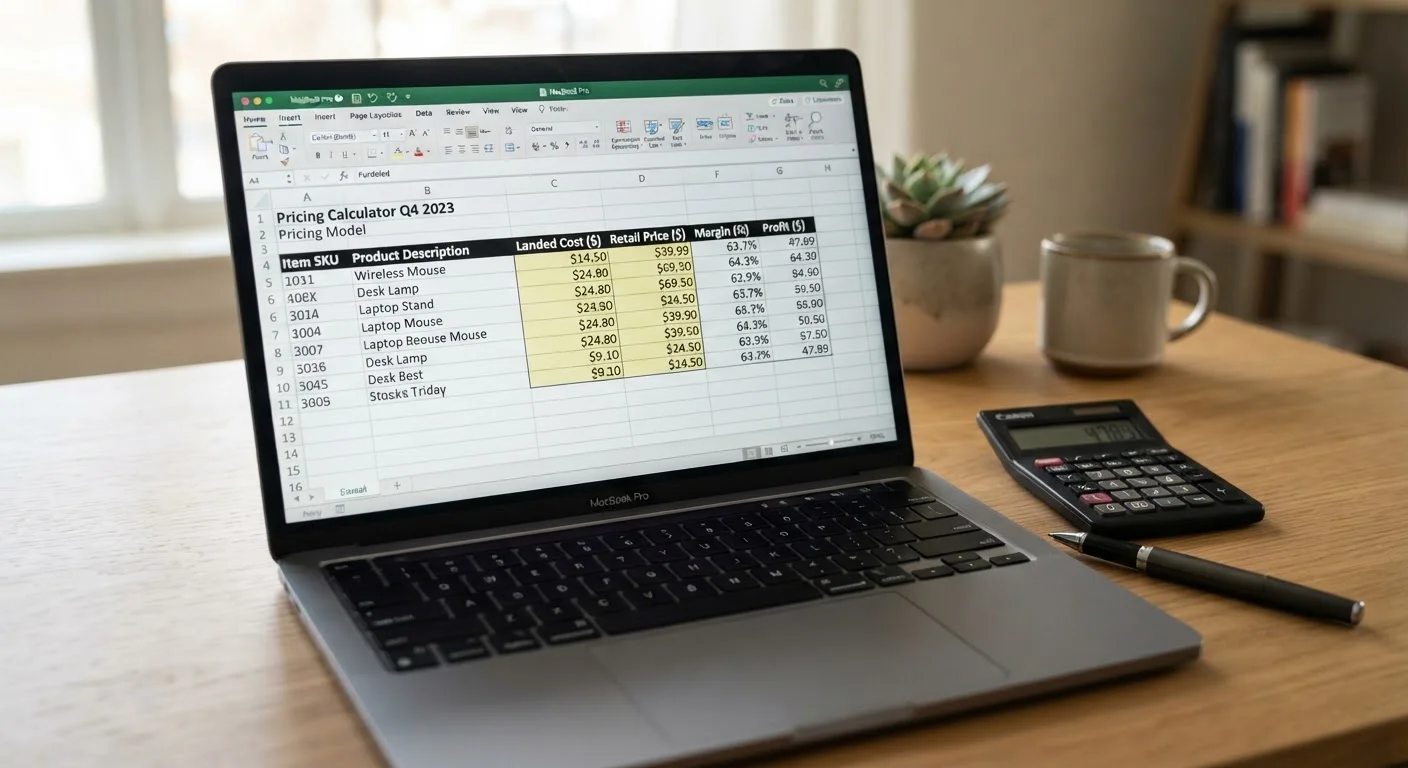
Napkin math works for your first order. After that, build this spreadsheet once and every future supplier quote goes through the same machine instead of a fresh mental calculation. Copy the structure below as one row per SKU. Yellow cells are what you type in. Everything else calculates itself.
Your input columns:
- Item name, batch size, base materials cost per batch
- Direct labor hours × hourly rate
- Equipment/overhead per batch, packaging/shipping/other variable costs
- Fixed overhead allocation (rent, software, admin share)
- Desired profit margin %, tax rate %, quantity sold
The formulas that do the heavy lifting:
- Total labor cost = hours × rate
- Fully loaded cost per batch = materials + labor + overhead + fixed allocation
- Unit cost = fully loaded cost ÷ batch size
- Retail price = unit cost ÷ (1 − target margin)
- Total gross profit = (retail price × quantity) − (unit cost × quantity)
- Effective margin % = gross profit ÷ total revenue
Once you're set up, changing your target margin from 30% to 45% updates every downstream number instantly. No more re-doing math on every quote that lands in your inbox.
How Printing Method Choice Changes Your P&L at Every Volume
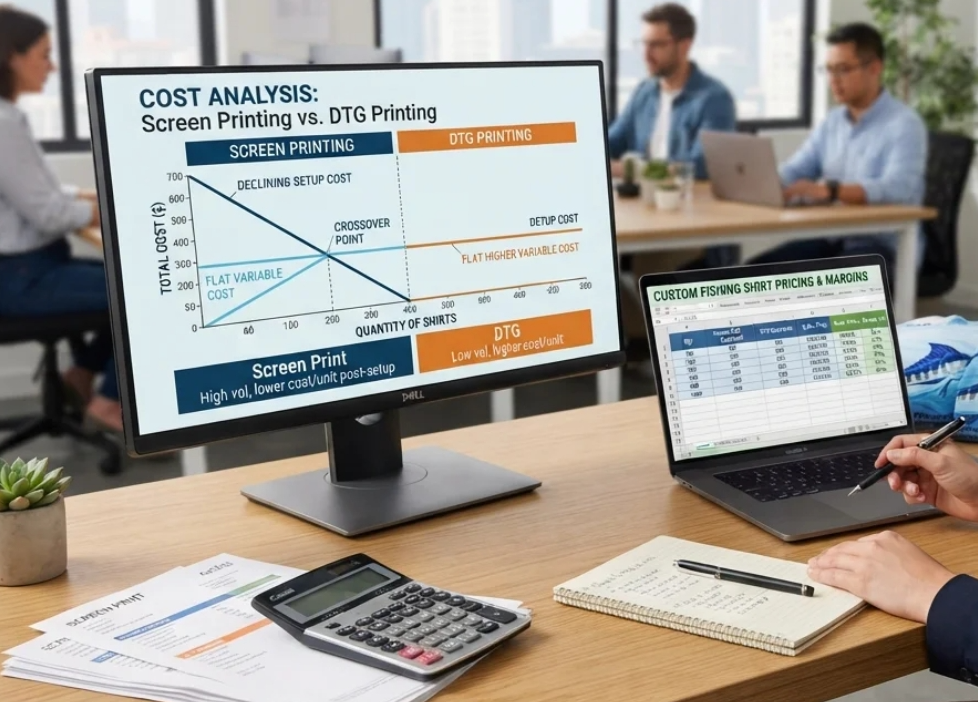
Every print method has a hidden crossover point, and that point decides who wins your margin battle at 50 units versus 500. The math behind it is simple: Cost Per Unit = (Fixed Cost ÷ Quantity) + Variable Cost. Fixed cost covers screens, digitizing, and setup fees. Variable cost covers ink, dye-sub paper, and labor per shirt. Below the crossover volume, low-setup methods win. Above it, methods with higher setup but cheaper per-unit variable cost take over.
For fishing apparel specifically, DTG (direct-to-garment) has almost no setup fee, so cost per shirt stays flat around $4–5 no matter how many you order. Screen printing flips that. A screen setup runs $50–75 per color, but that cost gets crushed as volume rises. At 50 shirts, screen printing might land at $6/shirt once setup is baked in. By 500 shirts, that same setup amortizes down to $0.15/shirt, dropping your total unit cost to $4 or less.
That crossover typically sits between 150–200 units for fishing tournament team uniform pricing. Below it, DTG protects your margin. Above it, screen printing beats DTG by $1–2 per shirt. On a 500-unit order, that's $500–1,000 in extra gross profit you'd otherwise leave on the table.
Sublimation behaves differently again. There's no screen setup, but the fabric and dye-sub paper cost $0.80–1.20 more per yard, so unit cost stays relatively flat across volumes. It only pays off when you need full-bleed camo or scale patterns that screen printing can't replicate cleanly. Heat transfer/vinyl, meanwhile, is the right call for names and numbers on a 12-jersey club order, but it's the wrong call once you're pricing 300+ units. The per-unit cost barely drops, and it quietly erodes your apparel markup percentage retail.
Landed Cost Includes Hidden Items That Kill Margin
Most buyers calculate landed cost for custom apparel by adding factory price, freight, and duty. That formula is wrong, and it quietly erodes 8–40% of your actual margin before you notice.
Here's a real example. A supplier quotes $5.00 per unit, freight and duty run $1.00, so you call your landed cost $6.00. You sell at $8.00 and pencil in a 25% gross margin. Except that math skips every fee that never shows up on the invoice.
Wire transfers often carry a 3% fee, plus another 0.5–1.5% hidden in the exchange rate spread. On a $5.00 unit, that's roughly $0.15. The Harbor Maintenance Fee is 0.125% of cargo value on ocean imports. The Merchandise Processing Fee ranges from $29.66 to $575.35 per entry, hitting hard on small consolidated shipments. Broker charges, bond premiums, and demurrage alone push costs 8–15% above your original estimate. Inland transport and unloading often adds $100–300 per container, easily a few cents per unit. Repeated $150 sample shipments during fabric or print iterations add up fast. Inspection, admin overhead, and inventory carrying costs are rarely tracked but always real.
Add these up and that $6.00 "landed cost" is closer to $6.85–$7.10. Your 25% margin just dropped to 11–14%. One discount code or FX swing, and you're at break-even without knowing it.
fishingapparel factory.com — Dedicated B2B Fishing Apparel Manufacturer
Runfish Apparel runs this site out of Guangzhou. The whole setup is built for small brands that want to test demand without committing to 10,000 units. Your first order runs 50–300 pieces , ships in 12–20 days , and once you've proven a design sells you can move to a 200-piece private-label tier. They handle tech-pack development, UPF50+ certified quick-dry shirts, tournament jerseys, and shipping to 30+ countries under FOB, CIF, or DDP terms. You get a 24-hour response window through WhatsApp at +86 177 0272 7677.
Quick‑Decision Benchmarks: What Your Margin Looks Like at Each Volume Tier
Here's the number that matters most: apparel brands under $5M in revenue typically run 55–68% gross margin but only 2–7% net margin — meaning most small fishing apparel sellers are barely profitable even when their markup looks healthy on paper. That gap between gross and net is where volume tiers quietly decide your fate.
Fast benchmarks by scale:
- Under $5M (most readers here): Gross margin 55–60%, net margin 2–5%. If you're below 50% gross on a batch of tournament jerseys, don't expect it to scale into real profit later.
- $5–10M: Gross margin holds at 55–65%, but net margin should climb to 5–10% as fixed costs spread across bigger orders.
- $10–50M: Expect gross margin compression to 50–62% from discounting and SKU expansion; net margin sits at 3–8%.
Fashion/apparel broadly runs 40–65% gross margin industry-wide — use the low end as your floor, not your target. If your apparel markup percentage retail lands under 40% gross at any volume, fix pricing before you fix volume.
Conclusion
The number on a Custom Fishing Apparel supplier's quote sheet for custom fishing apparel means nothing until you run it through your own landed cost math. Every quote hides the same variables — fabric grade, print method, freight — and those variables are exactly what separate a 12% margin from a 35% one at the same minimum order quantity for fishing shirts.
Break down the real cost, apply the three-step markup formula, and check it against volume tiers before you commit to 50, 200, or 500 units.
Don't sign the next PO on gut feeling. Pull up your calculator, plug in your actual numbers, and see where you land. If the math doesn't clear 30%, you're not pricing — you're gambling. Fix that today, before the invoice does it for you.