Guess wrong on quantities when stocking bulk fishing apparel, and you're staring at $3,000 in dead-stock hoodies by August. Guess right, and that same rack becomes your highest-margin category, outperforming rod and reel sales two-to-one.
Most independent store owners skip straight to browsing Stocking Bulk Fishing Apparel supplier catalogs for moisture wicking fishing shirts wholesale, without first running the math on their actual foot traffic or seasonal sell-through rate. That's how overstock happens.
This guide flips the order. You'll walk through the exact formula for calculating your first order quantity, the fabric and certification specs that separate a UPF shirt worth reordering from one that fades in six washes, and the five questions that expose a supplier's real MOQ flexibility before you sign a PO — all backed by a real cost breakdown from a Midwest lake-town tackle shop.
Why Store-Branded or Private-Label Inventory Delivers Higher Margins Than Reselling National Brands
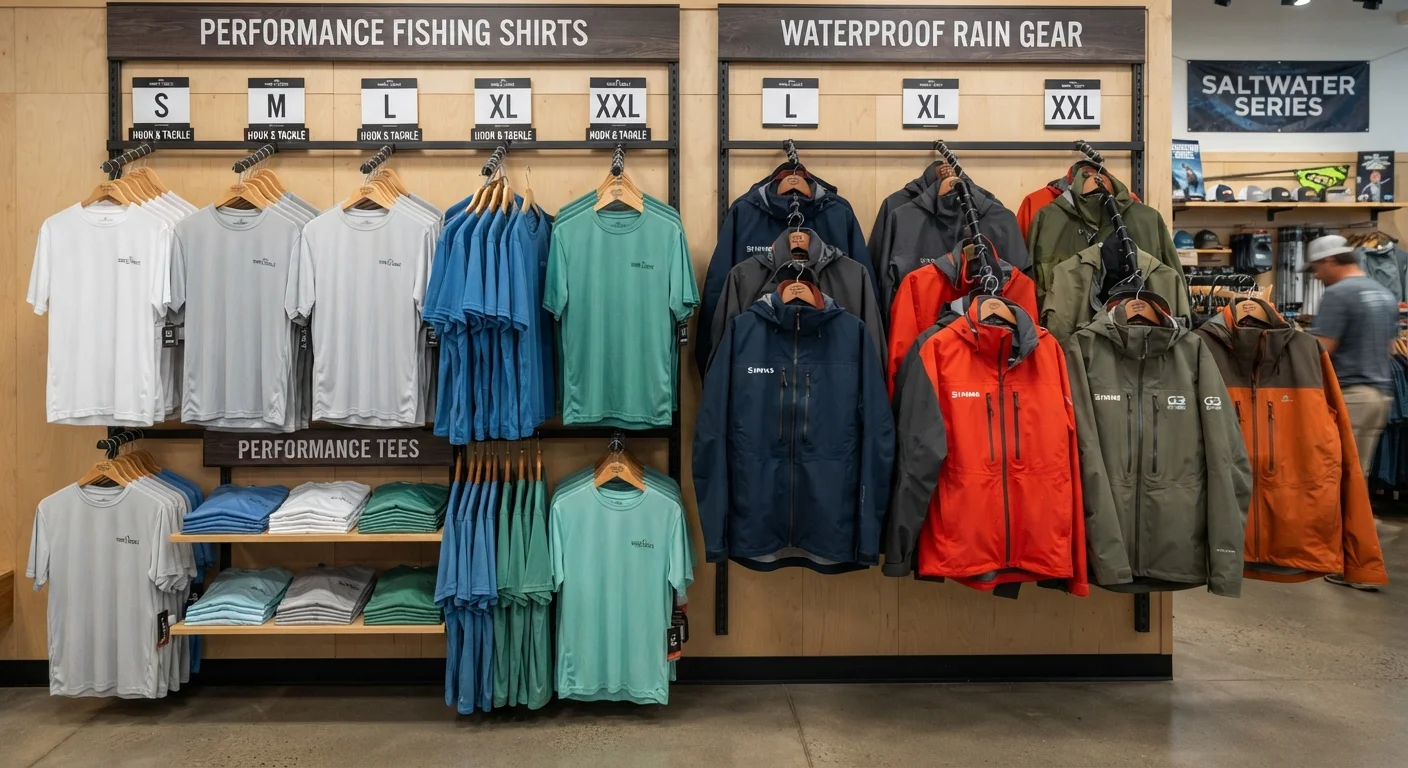
Here's the number that changes how most shop owners think about their apparel rack: national brands typically hand you a 10–25% gross margin, while private label fishing clothing runs 35–50%, sometimes higher. That's not a rounding error — it's often close to double the margin on the exact same shelf space.
The math works because you're cutting out a layer of cost you never see on the invoice. When you resell a national brand, that price already includes the brand owner's margin, their advertising spend (typically 15–20% of costs), and trade promotion fees that can eat another 20–25% of revenue. You're paying for someone else's marketing budget before you ever mark up the shirt.
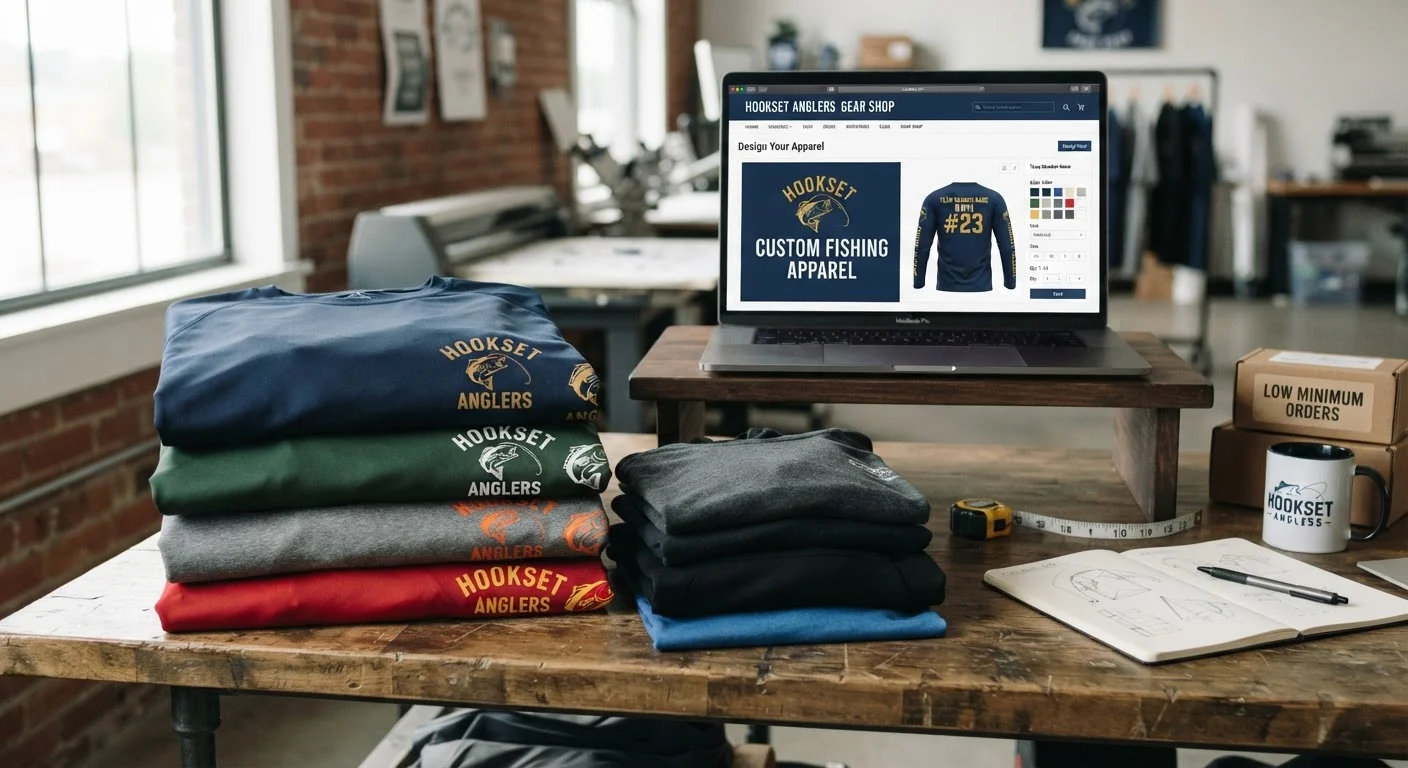
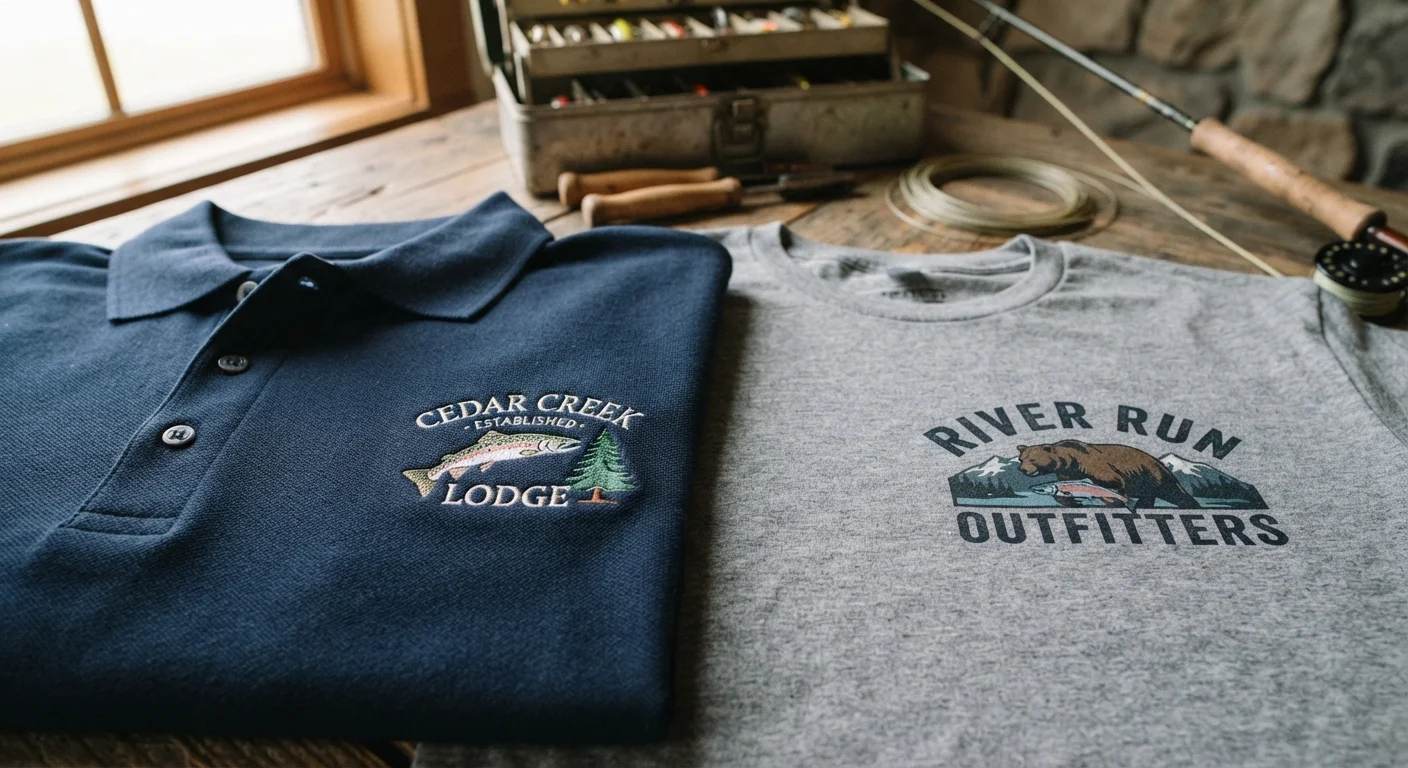
Go the private-label route with a custom fishing apparel manufacturer , and you buy closer to actual production cost. You skip the brand tax entirely.
Here's what that looks like in real dollars:
National brand UPF shirt: retail $30, your cost $22.50 (25% margin) → $7.50 profit
Private label UPF shirt: retail $28, your cost $16.80 (40% margin) → $11.20 profit
You're pricing below the national brand and still walking away with nearly 50% more profit per unit.
The tradeoff is control, not risk you can't manage. Private label means you're setting your own SRP, choosing your own fabric tier, and locking in exclusivity so customers can't price-check you against a big-box store carrying the same logo. That exclusivity alone protects your margin from the race-to-the-bottom pricing wars that hit branded inventory every clearance season.
The catch is that most outdoor apparel wholesale distributors won't quote private-label pricing of fishing apparel until you clear a minimum order threshold. That's exactly why you need to nail your MOQ fishing clothing wholesale calculation before committing to a manufacturer relationship.
How to Calculate Your First Order Quantity Using Foot Traffic and Seasonality
Skip the gut-feel ordering. Here's the formula that turns your foot traffic data into an actual number:
First Order Qty = Seasonal daily demand × (Lead time + Review period) + Safety stock
Start by tracking average daily visitors by month. A lake-town shop might see 200 visitors/day in January and 400/day in June. Average that across the year — say it lands at 300/day — then divide each month by that average to get your seasonality index . June (400/300) gives you 1.33. January (200/300) gives you 0.67.
Next, estimate conversion. If you expect 1.5% of visitors to buy a UPF shirt, and your baseline demand is 4.5 units/day, multiply by the seasonality index. June demand = 4.5 × 1.33 ≈ 6 units/day . That's your seasonal daily demand.
Now factor in lead time — the days between placing your PO and unboxing inventory. Most outdoor apparel wholesale distributors quote 60–90 days for custom or private-label runs. At 6 units/day × 90 days, your lead time demand is 540 units .
Add safety stock. For a brand-new SKU with no sales history, use 50–70% of lead time demand — higher end if your foot traffic swings hard between seasons. At 60%, that's 324 units.
540 + 324 = 864 units — your first order quantity for peak season.
Run the same math for off-season (3 units/day × 90 days = 270, plus 162 safety stock = 432 units), and you've got both numbers to cross-check against supplier MOQs before you commit.
Anchor Category #1: UPF Fishing Shirts and Sun Hoodies: Fabric Specifications to Evaluate Before Ordering
Not all UPF fishing shirts wholesale listings are built the same, even when they look identical in a catalog photo. The label "UPF 50+" can mean a shirt that blocks 98% of UV rays for 50 washes, or one that drops to UPF 20 after a single season. The fabric spec sheet reveals the real difference.
Fiber Composition and Weight
Value-tier shirts run 85–92% polyester blended with nylon or spandex, weighing 150–180 GSM. Premium tournament-grade fabric uses recycled polyester plus spandex, drops to 120–150 GSM for hoodies, and still holds UPF 50–58. Tighter knit density (about 40% tighter than standard apparel) blocks UV without adding bulk.
UPF Performance When Wet
Polyester/spandex blends maintain UPF 50+ even wet, drying in 30–60 minutes. Pure cotton drops to UPF 3–5 when soaked, useless for anglers standing in water all day.
Wash Durability and Testing Standards
Ask for AATCC 183 or AS/NZS 4399 test reports. Industry-standard fabric holds its UPF rating through 20 washes. Premium suppliers guarantee 50+ washes before performance degrades. That's the difference between a shirt customers reorder and one that gets a one-star review by July.
Quick-Dry and Breathability Benchmarks
Target dry time under 15 minutes (AATCC 199) and MVTR above 10,000 g/m²/24h. Baseline fabric sits at 35–45 minutes dry time, noticeably damp on a hot boat deck.
Request lab reports with UV transmittance percentage before placing any moisture wicking fishing shirts wholesale order. Anything above 3.3% isn't performance apparel. It's a t-shirt with a hangtag.
Anchor Category #2: Moisture-Wicking Performance Fishing Shirts — Sizing, Decoration,
Color Options for Tackle Stores
A size chart mistake costs you twice: once in the wrong SKU sitting on the rack, and again when a customer walks out because you didn't stock their fit. Get this category's merchandising right and it becomes your fastest-turning wall.
Sizing: Standard runs go S–3XL, with select lines extending to 5XL. Build your core assortment around M–2XL, where 70%+ of turns happen, and stock S and 3XL as regular backup. Treat 4XL–5XL as special-order or "key door only," since most suppliers cut color options at those sizes anyway. Chest ease matters more than shoppers realize. Look for 2–4 inches of room built into the pattern — tight-fitting technical fabric compromises both moisture-wicking and UPF coverage.
Decoration: Screen printing dominates this category. It's the cheapest option for polyester wicking knits at 50–500 unit runs and handles both chest logos and full back graphics. Minimums run 24–48 pieces per design at local printers, with per-color cost dropping past 100 units. Sublimation works better for all-over prints like reef patterns or water camo, but only on light-colored polyester. Save embroidery for small chest logos on woven button-downs. It's too heavy for thin wicking tees.
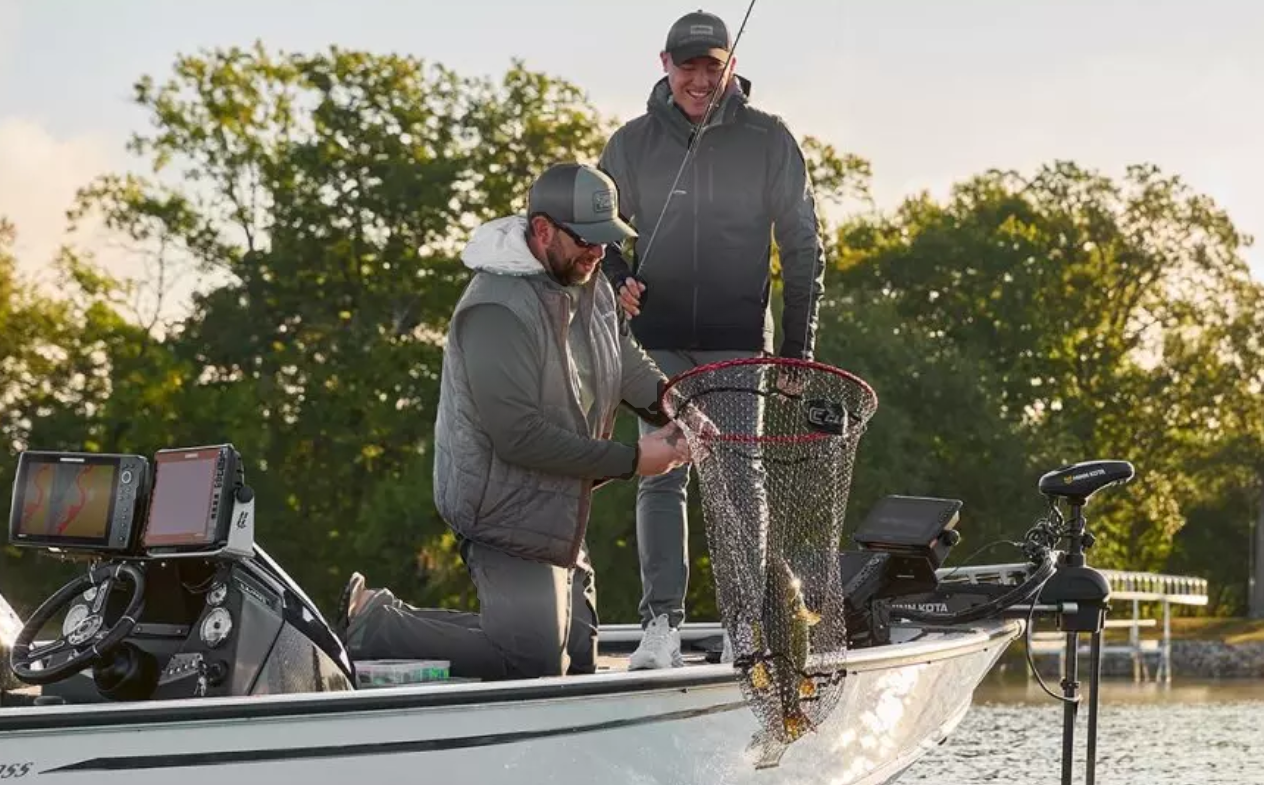
Colorways: White and light grey maximize UPF and heat reflection. Blue shades sell strongest in saltwater markets; green and seafoam dominate freshwater and inshore. Extended sizes lose color options first, so keep your fashion colors (coral, hi-vis yellow) concentrated in M–XL where the turn justifies the SKU count.
Anchor Category #3: Rainwear & Outerwear for Multi-Season Retail Coverage
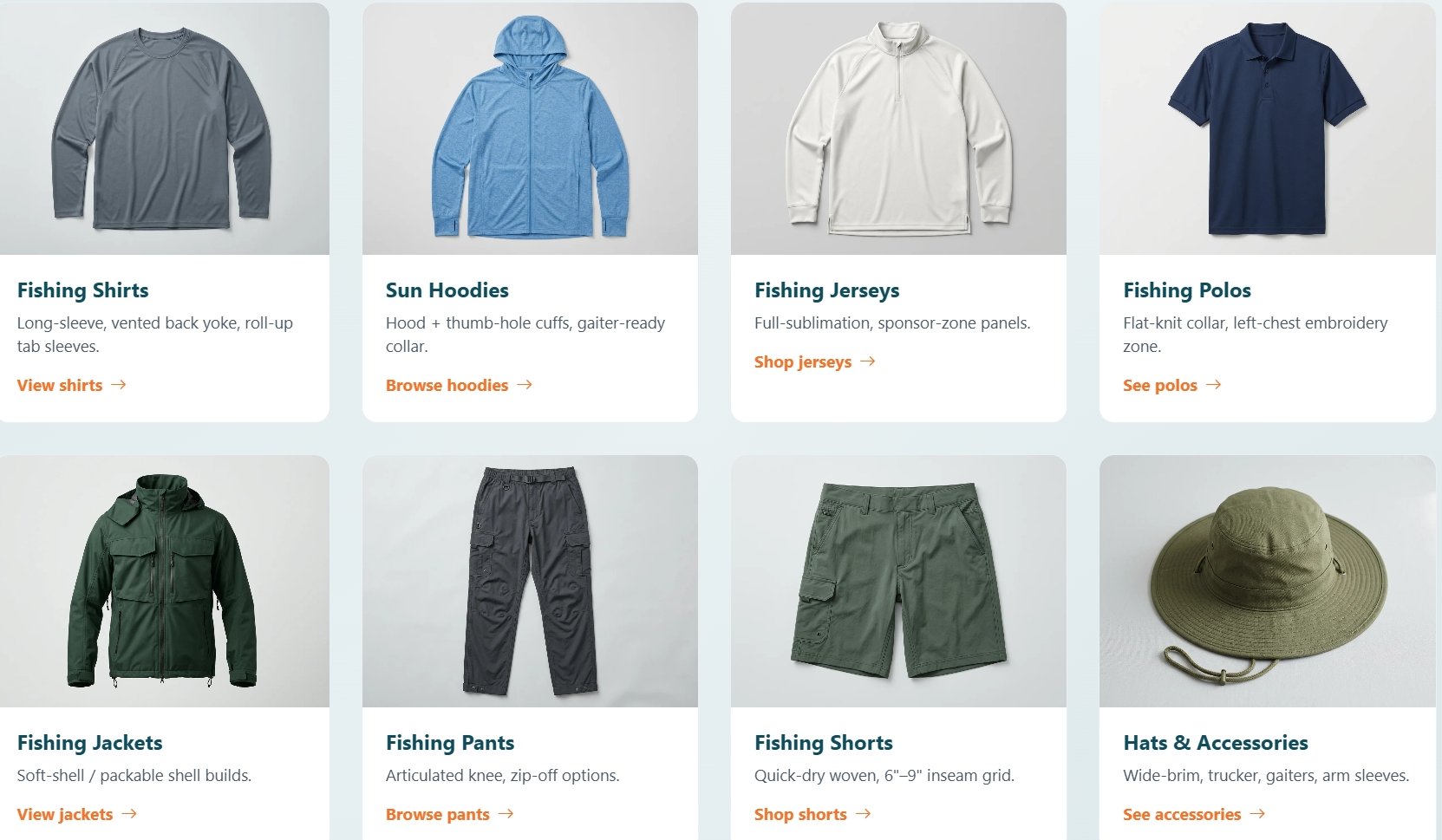
Rainwear is a year-round shelf anchor. The global rainwear market is growing at a 5–6% CAGR through 2030, with jackets alone pulling 40–45% of category revenue. For a tackle shop, one rain jacket SKU, stocked right, can outsell three impulse-buy accessories combined.
Seam Construction Determines Reorder Rate
Skip anything with glued seams. They leak within a season. Taped seams are the baseline for mid-tier jackets ($60–150 retail range), while welded seams paired with 3-layer laminate fabric define the premium tier ($200–500+). Ask your outdoor apparel wholesale distributor for hydrostatic head ratings before ordering; anything under 5,000mm won't hold up to a full day on open water.
Build for Shoulder Seasons
Entry-tier PVC/PU shells ($25–60) move volume in spring and fall. But 3-in-1 systems, shell plus zip-in liner, sell across three seasons and smooth your inventory management year-round. That SKU protects cash flow when foot traffic dips.
Lead-Time Planning: From Inquiry to Shelf-Worthy Stock
Lead time has four components, and most shop owners only track the biggest one. The four components are order processing (PO approval, artwork sign-off) at 3–7 days, supplier production for custom or private-label runs at 30–90 days, ocean freight from overseas manufacturers at 25–40 days, and receiving and QA once it lands at 1–5 days. Add those up, and a 90-day quote from your outdoor apparel wholesale distributor often hides 100+ real days once artwork approval and dock delays factor in.
Track each PO individually by logging the PO date, ship date, and actual receipt date for every order. After 5–6 cycles with the same custom Fishing apparel manufacturer , you'll have a real average lead time and a deviation range based on actual data.
Calculate your reorder point as (Daily demand × actual lead time) + safety stock.
If a supplier's lead time swings more than 20% order-to-order, renegotiate MOQ fishing clothing wholesale terms or diversify vendors before a stockout hits your best-selling rack.
The 5 Questions Every Retail Buyer Must Ask Each Supplier Before Writing the PO
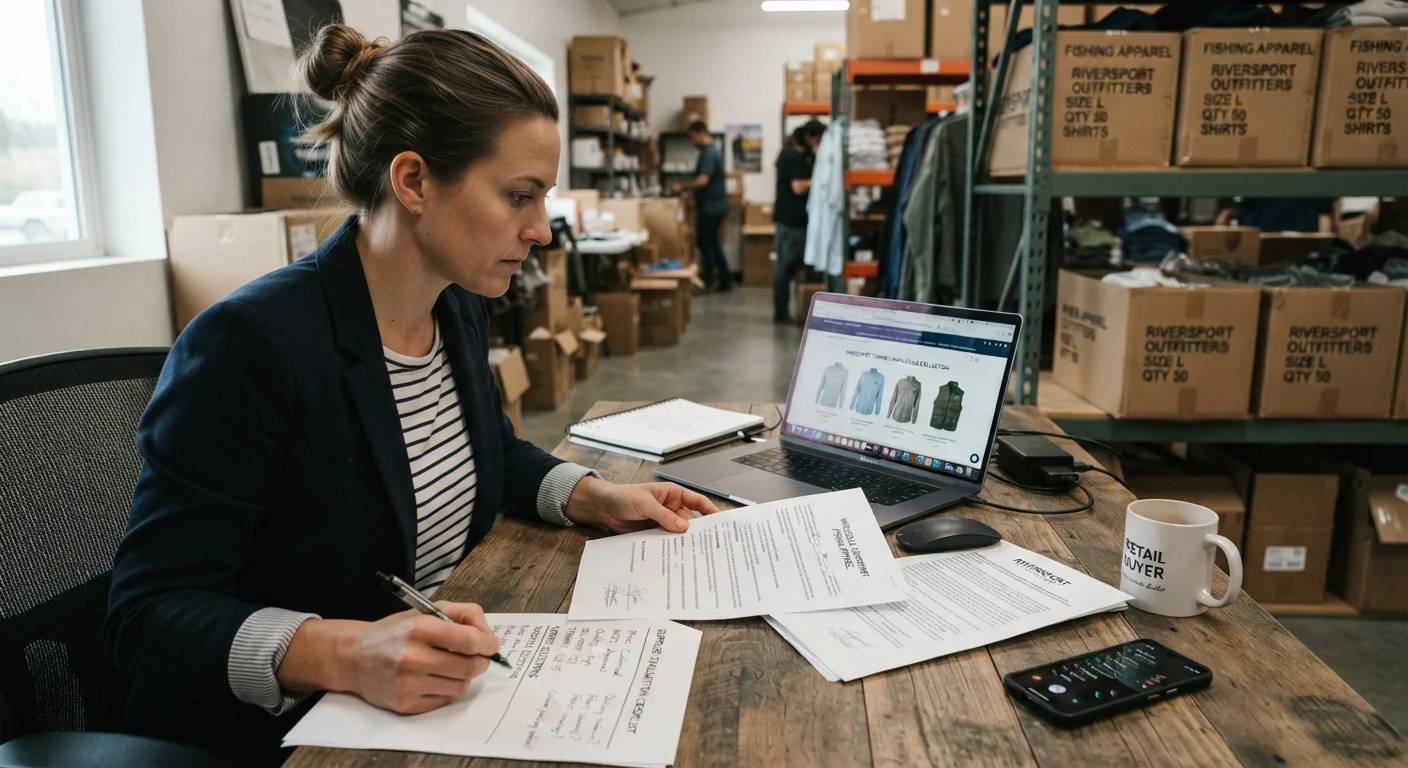
A supplier who can't answer these five questions in a single email isn't ready for your PO — full stop. Print this list. Bring it to every call before you commit to A Performance Fishing Wear supplier .
1. Where exactly is your factory, and how far is it from the nearest port or airport?
If they dodge the city name, walk away. Distance to port affects freight cost and delay risk on every future reorder.
2. Is this quote EXW or FOB, and what's my true landed cost?
EXW pricing looks cheaper on paper. Add domestic transport and export clearance, and it often costs more than FOB once you're ordering 300+ units.
3. What's your MOQ, and is it per style, size, or color?
Some outdoor apparel wholesale distributors quote 500-unit MOQs per style, others split it across colorways. That difference changes your first order quantity math.
4. What are your sample, bulk, and repeat lead times?
Repeat orders should run faster since the pattern's already cut. If they quote the same 90 days every time, that's a red flag.
5. What QC documentation and payment terms do you offer?
Ask for AATCC test reports, business licenses, and deposit percentage (10–50%). Get their claims process for defects in writing before wiring a deposit.
Full Cycle Costing: A Walk-Through for a Midwest Lake-Effect Tackle Store (Hypothetical Case)
Lakeshore Bait & Tackle, a 1,200-sq-ft shop on a Midwest lake, opened with $248,090 in startup capital and $39,000 in beginning inventory. Allocate 15% of that inventory — $5,850 — to apparel, and the full-cycle math gets real fast.
That $5,850 covers about 300 units of private-label UPF shirts at $16.80 landed cost, plus $500 freight and $150 packaging. Divide the $6,500 total by 300 units, and your true cost-to-serve per shirt is $21.67, not $16.80. Retail at $28, and margin drops from a theoretical 40% to about 22.6% once freight and handling hit the ledger.
Working capital tells the rest of the story. First-quarter cash reserves of $10,000 (about $3,333/month) carry the shop through the 90-day production lead time plus a 60-day sell-through window. That's a 150-day full cycle from PO to profit, the number every buyer should track before reordering.
Three Dead-Stock Traps That Wipe Out Inventory Cash
Every $1 of dead stock costs you 20–30 cents a year just to hold. That's capital cost, storage, and write-down risk stacking up while a UPF shirt collects dust. Three traps drain that cash fastest.
Trap 1: Dead-Stock Blindness. If a SKU hasn't sold in 90+ days, it's dead stock. Each month, pull your top 20 SKUs by value, log days since last sale, and flag anything over 180 days. If 15% of your rack is dead, your real margin is running 6–12 points lower than your books show.
Trap 2: Over-Ordering Without Par Levels. Big buys without velocity data can leave you with $3,000 in unsold hoodies. Base reorders on trailing 90-day sales. Turnover of 1 means a full year of stock sitting on shelves.
Trap 3: Slow Response. Once a SKU hits stale status, act within 30 days. Run 20–30% off for two weeks, escalate to 40–50% if it doesn't clear, then move to bundles or liquidation by day 90.
Conclusion
You have the formula now: size your first order against real foot traffic, the fabric specs that separate a UPF shirt worth reordering from one that hits clearance, and five pointed questions that expose which suppliers deserve your PO.
The retailers who win this season treated their first private label fishing clothing order like a financial decision, not a hunch. Pull out that MOQ fishing clothing wholesale worksheet, run your lake-effect case study numbers against your own store, and place an order small enough to sell through twice before you scale it. That's how dead stock turns into repeat customers who trust your shelf more than the big-box chain down the road.