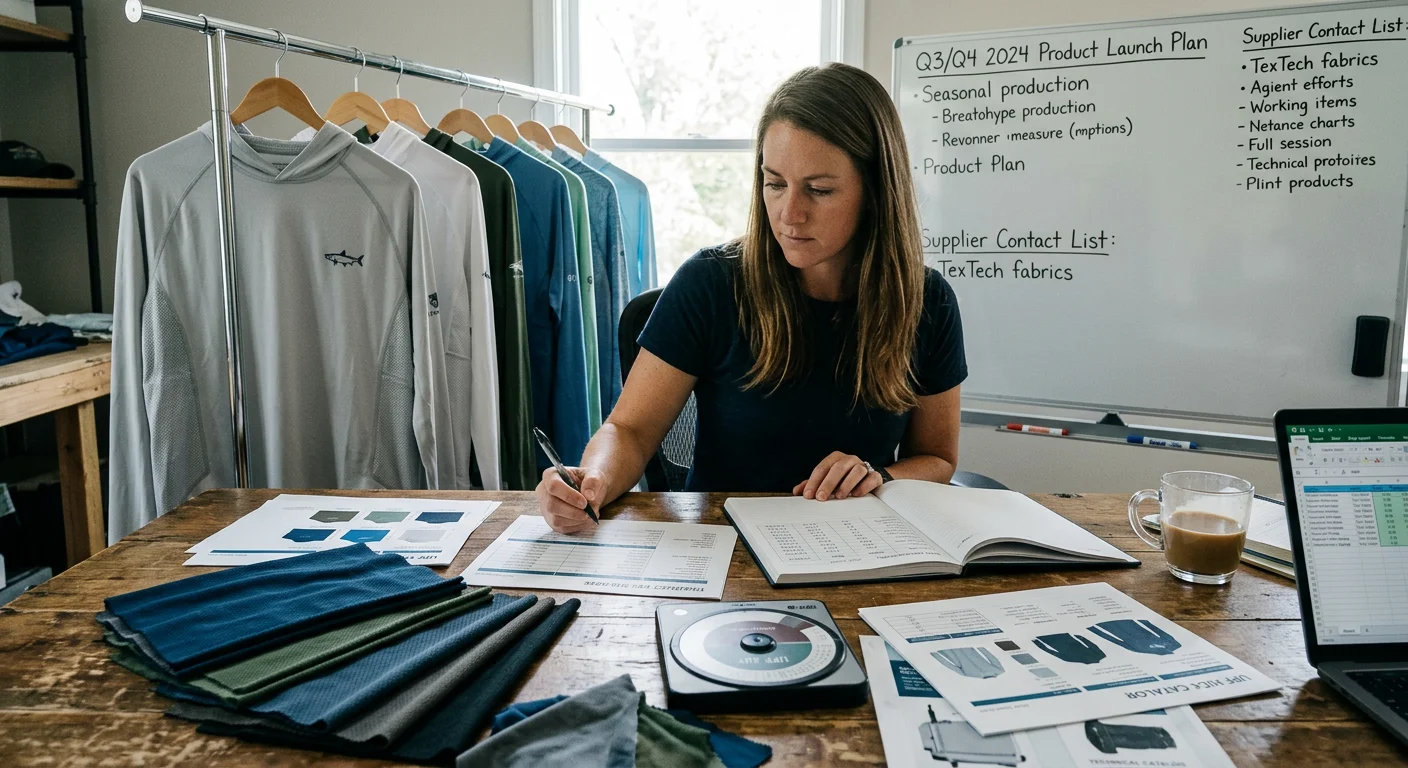
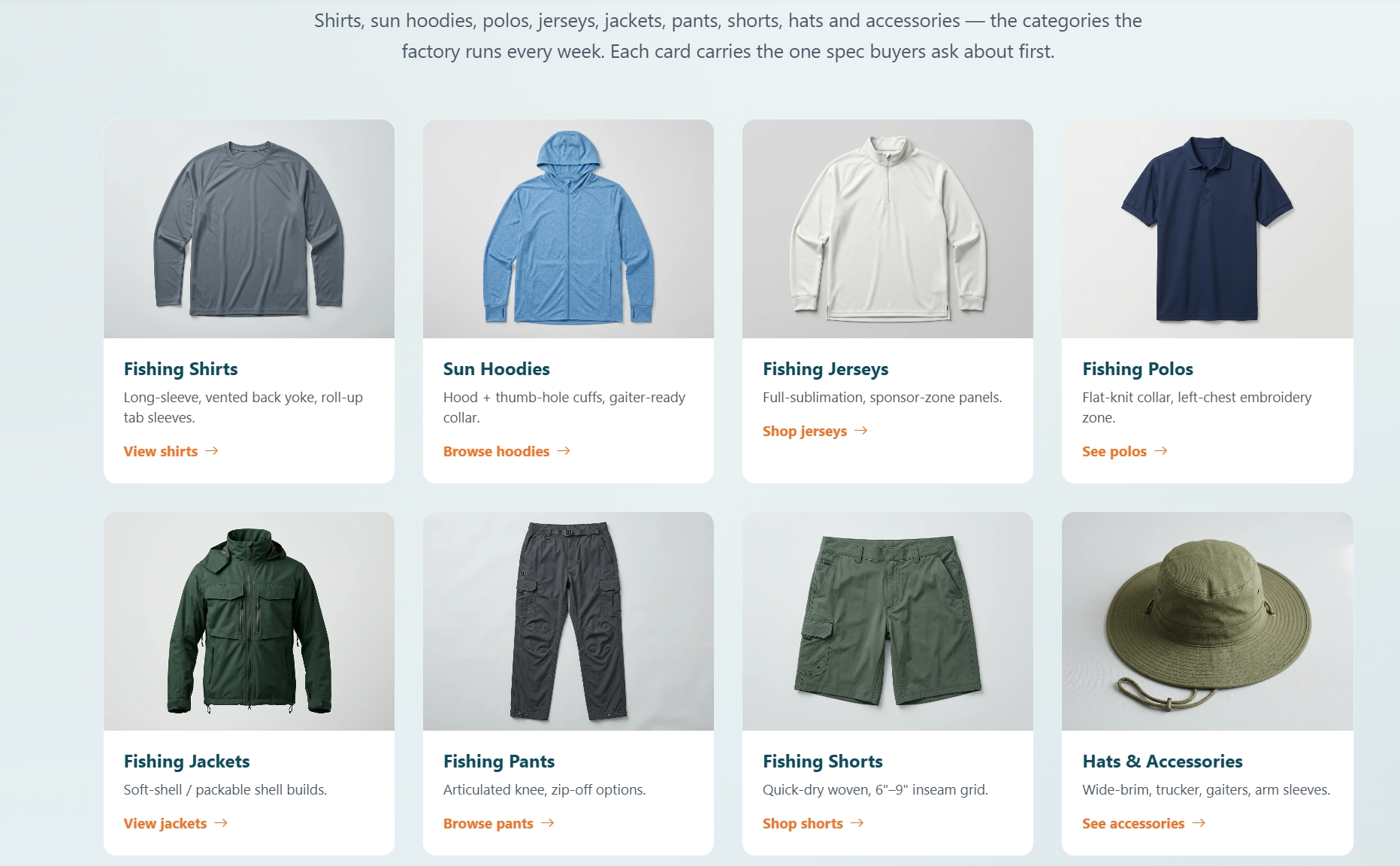
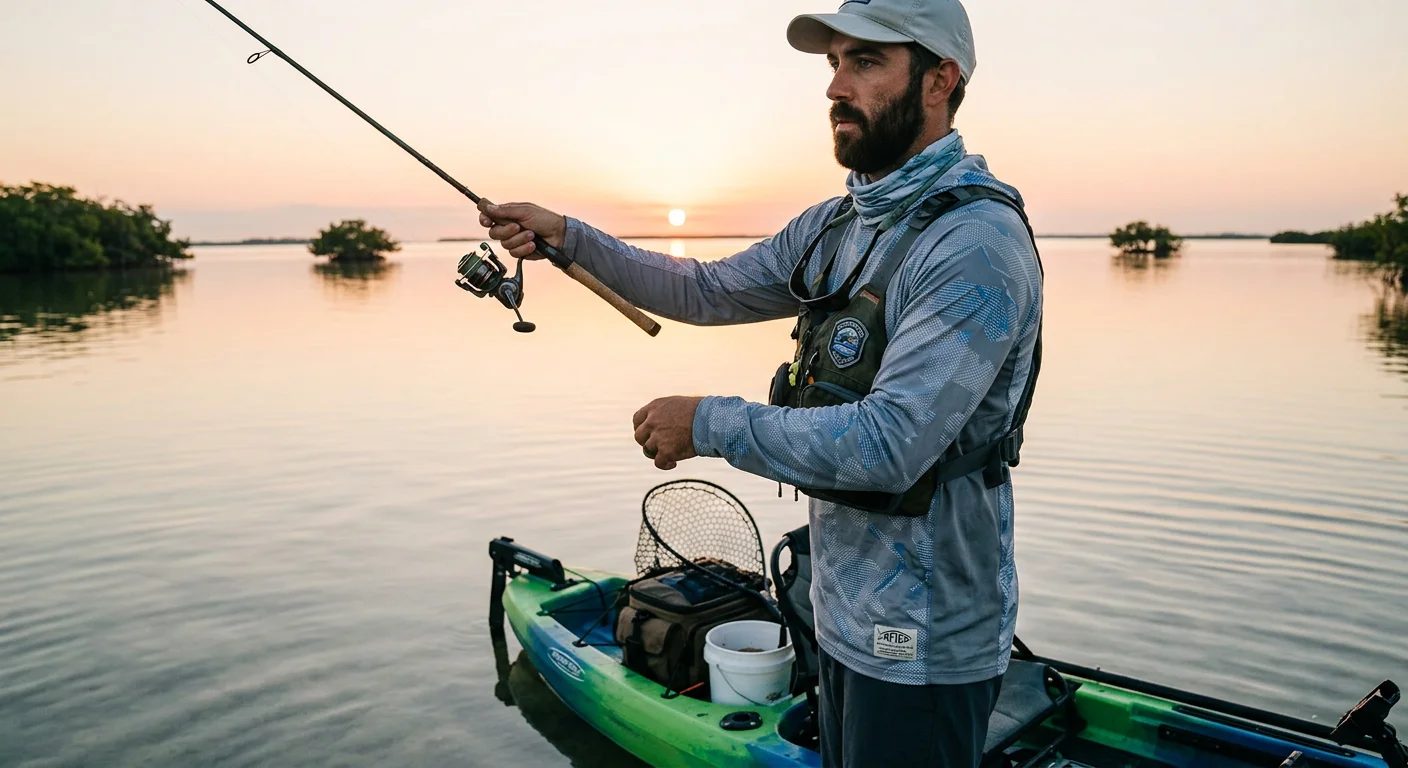
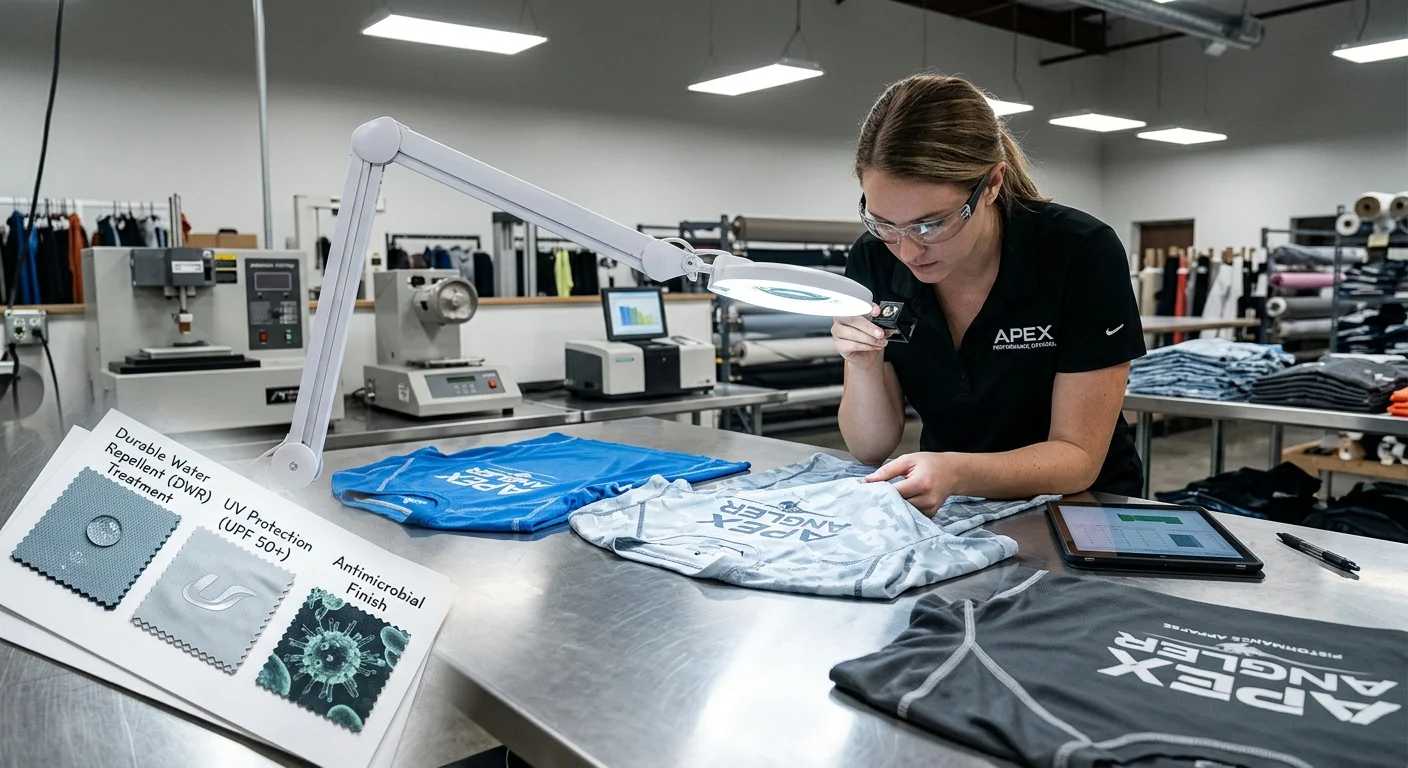
Most fishing apparel startups fail before they sell a single shirt. The product isn't the problem. The real killer is a 500-piece minimum order they can't afford to test.
Here's what nobody tells you upfront: custom performance fishing shirts and sublimation fishing jerseys with low minimum runs do exist . The suppliers offering them aren't sketchy back-alley operations. These are legitimate Fishing Apparel manufacturers who've built their entire business model around small-batch founders like you.
More research won't solve this. What you need is a clear decision framework:
Which production path fits your budget right now
What the real per-unit cost looks like at 24, 50, or 100 pieces
How to negotiate MOQs down 30–60% when a supplier's opening number feels out of reach
That's what this guide delivers — specific suppliers, real numbers, and a checklist you can execute this week.
Real MOQ Thresholds & Trade-Off Matrix for Fishing Apparel Production
The fishing apparel industry runs on a dirty little secret. The same custom fishing apparel factory that quotes you 500 pieces minimum will often accept 50 — you just need to know what to ask for and why.
Before we get to negotiation tactics, understand the actual production tiers. Not the marketing fluff. The real numbers, broken down by cost per shirt, lead time, and what you're getting for your money.
The 5 Production Paths — Real Numbers, No Fluff
Production Path | MOQ | Cost/Shirt | Lead Time | Quality Level |
|---|---|---|---|---|
POD / On-Demand | 1 pc | $28–$45 | 3–5 days | Commercial grade, logo only |
Stock Fabric + Custom Print | 30–50 pcs | $14–$19 | 7–10 days | Mid-tier performance |
Custom Sublimation (ODM) | 50–100 pcs | $11–$15 | 10–14 days | Tournament grade |
Domestic Small-Batch OEM | 200–300 pcs | $10–$18 | 18–25 days | Factory-direct consistency |
500–5,000+ pcs | $6–$9 | 30–45 days | Enterprise compliance |
Where the Real Cost Premiums Hide
Running fewer than 300 pieces doesn't just cost more per shirt — it costs 20–50% more per shirt. That premium isn't a supplier being greedy. It's math:
Fabric mills won't cut below 3,000 meters per custom specification of fishing apparel. Drop below that threshold and surcharges hit your unit cost hard.
Sublimation and screen-print setup fees spread across your total order quantity. At 500 pieces, that setup cost is noise. At 50 pieces, it's a line item you feel.
The practical breakpoints look like this:
- Small-batch runs of 50–300 pcs land between $10–$18/shirt
- Scale factory runs of 1,000+ pcs drop to $5–$9/shirt
That $5–$9 gap per shirt feels significant. Multiply it across 50 test units, though, and you're looking at $250–$450 in total exposure. That's far less than sitting on 500 unsold pieces of a design your market doesn't want.
The Fishing-Specific Variable Nobody Mentions
Custom UPF fabrics of fishing apparel change everything. Standard polyester mesh templates — the pre-approved pattern blocks most ODM factories already stock — let you run sublimation orders as low as 50–300 pieces. You won't trigger fabric mill minimums. The patterns exist. The fabric rolls sit ready in the supply chain. Setup costs drop close to zero.
Request custom UV-treated fabric or multi-panel technical construction, and the math shifts fast. Fabric mills need 3,000+ meters per spec . That pushes your minimum to 800–2,000+ pieces per colorway for fishing tops. Lead times also stretch by 5–10 extra days for UV testing and certification.
The decision rule is simple: start with ODM stock fabric and standard pattern blocks. Save the custom UPF technical build for version two, after you've proven demand exists.
Matching Production Path to Confidence Level
Confidence below 70% — Go with POD or stock fabric programs. Spend $14–$35/shirt on 1–150 pieces. Find out what the market wants before you commit to cut-and-sew production.
Confidence around 80% — ODM sublimation or domestic OEM at 50–300 pieces, $11–$19/shirt. Use a real production run to fine-tune fit, colorways, and artwork.
Confidence above 90% — Overseas OEM at 300–800 pieces across 2–3 colors. That's where the $6–$9/shirt economics start making sense.
fishingapparelfactory.com — Runfish Apparel (Guangzhou, China)
Runfish Apparel is the factory behind the domain. It was built for this exact problem.
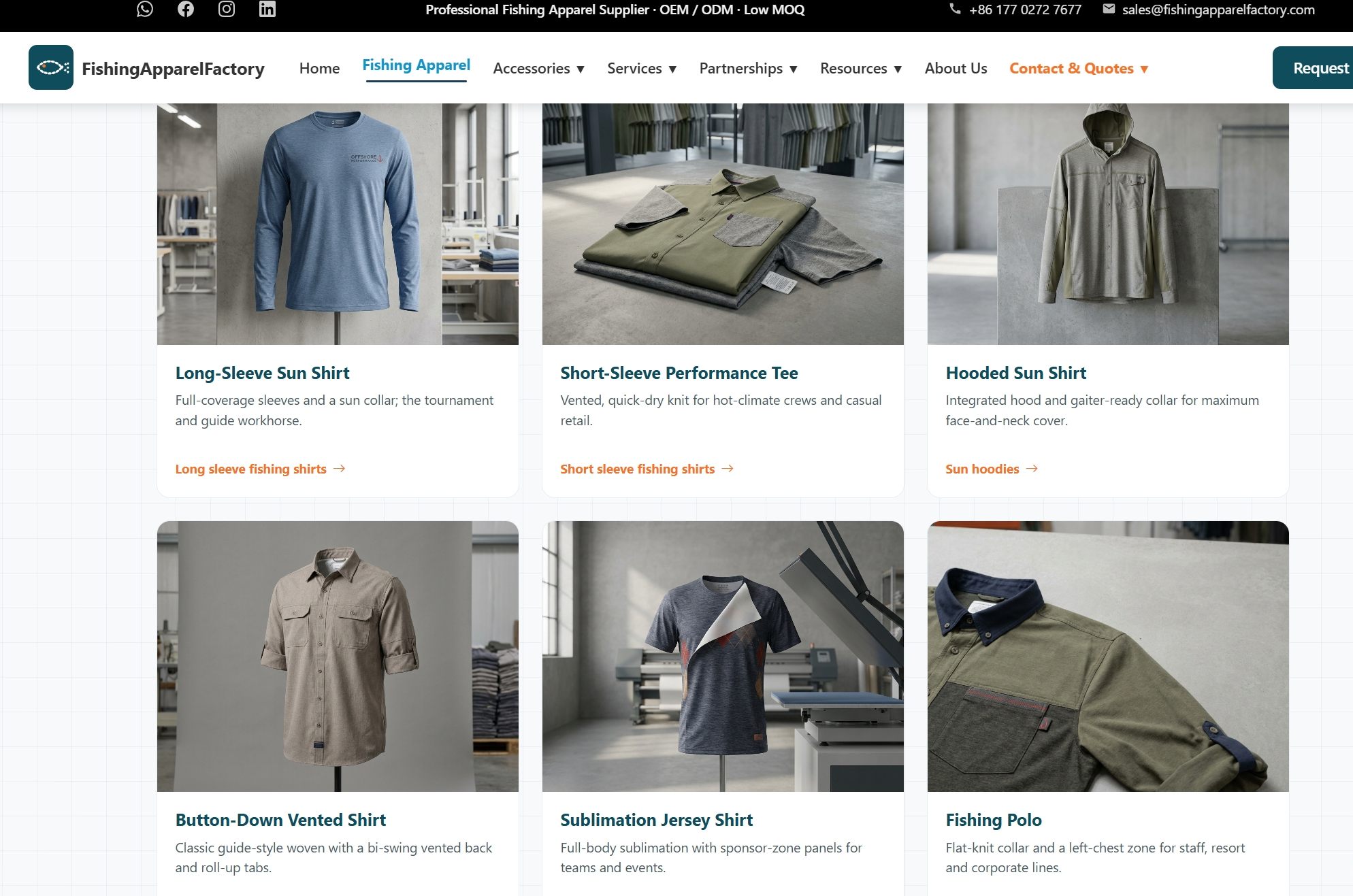
Based in Guangzhou, Runfish is a full-service fishing apparel OEM/ODM manufacturer . They cover everything — tech-pack development, bulk production, and global shipping. Their target customer isn't a major retail chain. It's you: a small fishing brand or tournament team that needs private label fishing clothing without staking the whole business on a 500-piece order.
MOQ structure, broken down:
- Simple sublimated fishing shirts and sun hoodies: 50 pcs/style
- Tournament jerseys and multi-panel designs: 100–300 pcs/style
- Repeat orders using existing templates: negotiable down to 30–40 pcs
Per-shirt cost at 50 pieces:
Cost Component | Per Shirt |
|---|---|
Fabric & trims (UPF 50+ polyester) | $4.80 |
Sublimation print (full coverage) | $2.90 |
Cut & sew labor | $1.60 |
Packaging & QC | $0.50 |
Factory overhead & margin | $1.70 |
Total (50-pc run) | ~$11.50 |
Scale to 100–300 pieces and that number drops another 5–15% .
Lead times are 5–7 days for samples on standard fishing shirts. First bulk production runs 20–25 days . Repeat orders with established patterns cut that down to 10–14 days .
Real trade-offs to know:
- Sample fees are due upfront — though they come off your bulk order total
- You need vector artwork files: AI, EPS, or PDF format
- That 10–14 day turnaround? It applies to repeat orders only, not your first production run
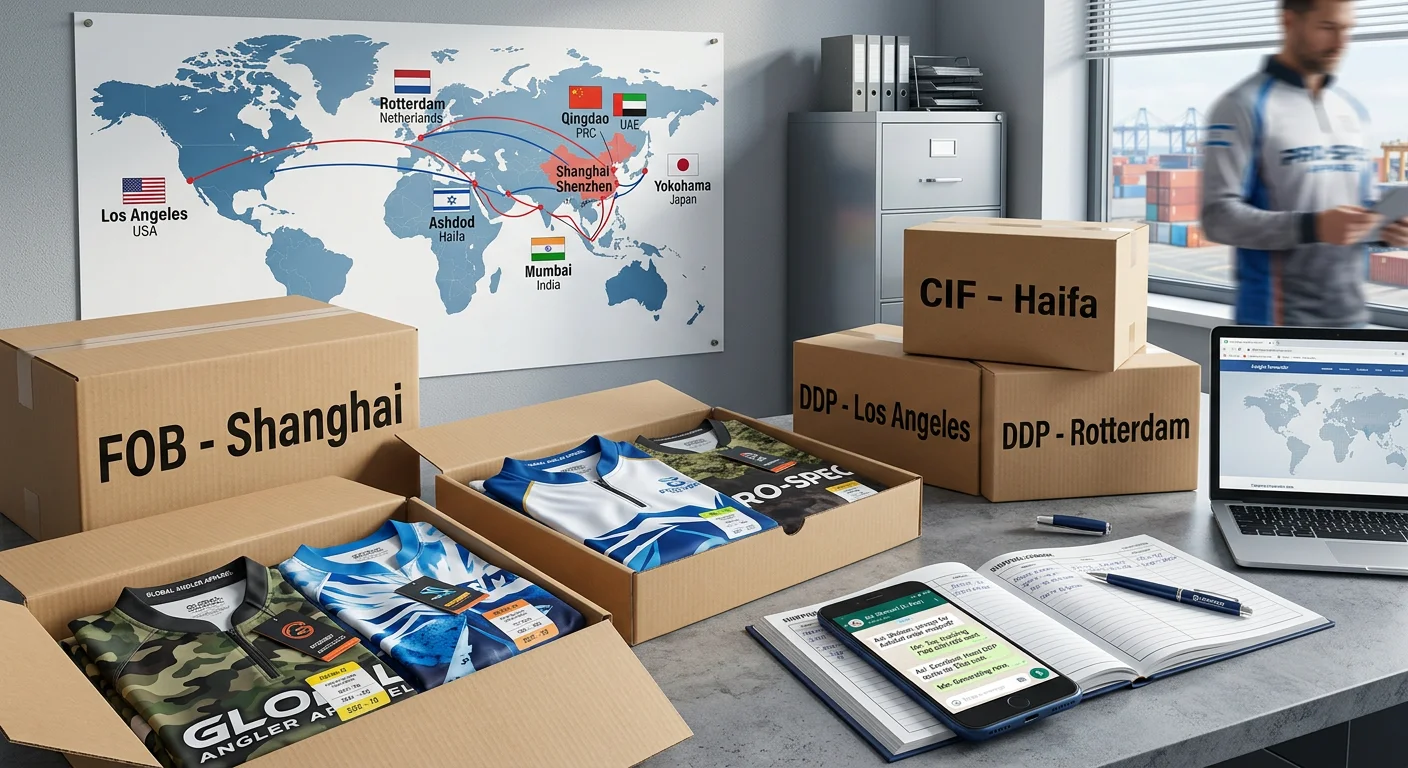
They ship FOB, CIF, or DDP to 30+ countries . Contact them at +86 177 0272 7677 via WhatsApp — 24-hour response time.
Redwood Sport
Redwood International Sports is based in Petah Tikva, Israel. That's an unexpected location for a fishing jersey supplier — and that's exactly what makes their multi-region contact structure stand out for international founders.
They list contact numbers across six territories:
USA & Canada: 919-447-7729
UK & Ireland: +44 1628 60 1515
Netherlands / Belgium / France / Nordics: +31 306 354 567
Germany / Switzerland / Luxembourg: +49 211 530 635 49
Rest of world: +31 30 6354567
General inquiries: [email protected]
What the public record doesn't confirm: sublimation fishing jersey capabilities, low-MOQ tiers, unit pricing, or production lead times. None of that information appears in their documented records.
The bottom line: Sourcing private label fishing clothing outside North America? Redwood's regional contact setup makes them worth a direct call. Verify their custom fishing apparel capabilities first. Don't build them into your supply chain until you do.
Pamoo Industries
Sialkot, Pakistan has been outfitting the world's sports teams for decades — and Pamoo Industries is one of the factories driving that tradition.
Their MOQ is 20 pieces per style per color . That's not a negotiated concession. That's their published starting point. Most Pakistan-based OEMs require 100–300 pieces as their floor. Pamoo starts well below that.
Realistic cost range at 20–30 pieces:
Component | Per Shirt |
|---|---|
Fabric & blank garment | $7–$10 |
Print / sublimation | $2–$4 |
Embroidery (logos) | $1.50–$3 |
Cut, sew, finishing, packaging | $1.50–$3 |
Total | ~$12–$18 |
What stands out: You get free in-house digitizing and a full digital mockup before a single stitch runs. For a startup still refining its logo, that's real money saved.
Production on sports jerseys takes 10–15 business days . International shipping adds 4–7 days on top.
One thing to know: Pamoo's catalog focuses on uniforms and general sportswear. Technical fishing fabrics are not a core part of their lineup. Check their UPF and moisture-wicking fabric options with them before you place an order.
Contact: +92 346 7428081 (WhatsApp) · [email protected]
Runfish Apparel
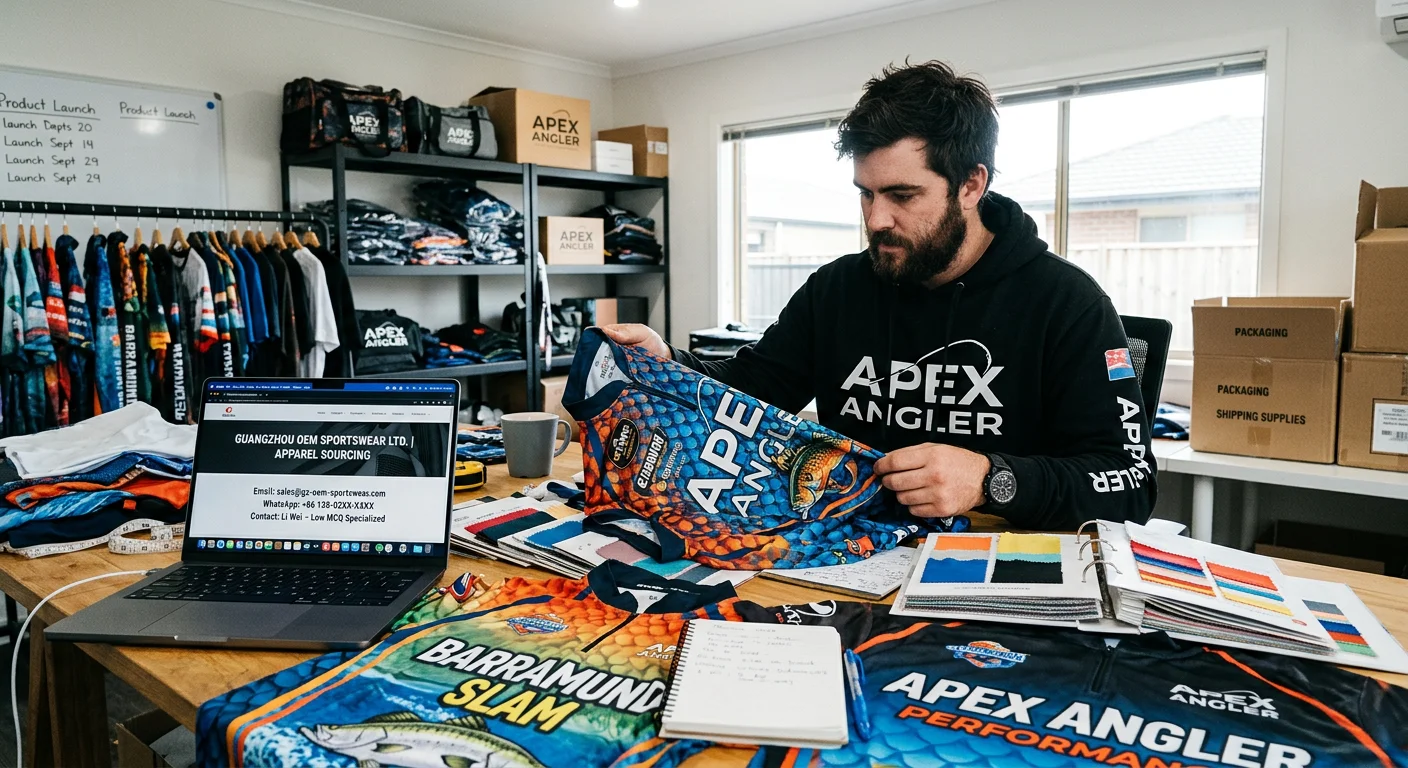
Runfish Apparel is based in Guangzhou. They built their whole business around one customer type: the small fishing brand that wants real OEM quality but doesn't need a warehouse full of unsold inventory.
The minimum order is 50 pieces per style per color . That's not a special deal — it's just their standard starting point for custom sublimation fishing shirts and custom performance fishing hoodies. Hats start at 100 pieces, dropping to 50 on repeat orders.
Estimated cost at 50 pieces (FOB, long-sleeve sublimation shirt):
Component | Per Shirt |
|---|---|
Performance fabric (100–150 gsm polyester) | $3.90 |
Full sublimation printing | $2.60 |
Cut & sew labor | $1.80 |
Packaging + freight to forwarder | $1.20 |
Total estimated FOB | ~$9.50 |
Production runs 12–20 days for a first bulk order at 50–300 pieces. Add international shipping and customs clearance on top of that. Plan for a 5–7 week window from artwork approval to product in hand.
What works in your favor:
- 24/7 WhatsApp support
- English-language communication
- OEM/ODM focus on fishing-specific products — shirts, hoodies, hats, neck gaiters, gloves
What to plan for:
- FOB terms mean you handle the freight side yourself
- They're on GMT+8, so back-and-forth with American and European founders runs on an asynchronous schedule
Contact: [email protected] · WhatsApp +86 177 0272 7677
Weft Apparel
New York has a solid answer for founders who want domestic accountability. No offshore guessing involved.
Weft Apparel is based in Amherst, NY. They run cut-and-sew OEM custom fishing apparel production with a 50-piece MOQ per design — a hard floor, not a negotiated favor. Their focus is sports and performance apparel. Fishing jerseys, performance polos, and team kits are all in their wheelhouse.
Estimated cost breakdown at 50 pieces:
Component | Per Shirt |
|---|---|
Performance fabric (moisture-wicking poly) | $4.20 |
Print / sublimation embellishment | $3.10 |
Cut, sew & assembly | $2.00 |
Packaging, QC & logistics buffer | $1.00 |
Total estimated | ~$10.30 |
That puts them in mid-tier pricing — higher than Guangzhou, lower than boutique domestic shops.
The timeline breaks down like this: 48 hours for a digital proof , 7–9 days for a physical sample , and 14–18 days for bulk production after sample sign-off. Full cycle: plan for five weeks from first inquiry to product in hand.
What works for fishing brand startups:
- End-to-end support covers pattern making, prototyping, and samples — no tech-pack experience needed
- English-speaking project management means zero time-zone friction
- Domestic ethical production is a real marketing angle you can put in front of buyers
What to account for:
- Sub-50 unit runs don't work here — consolidate styles or wait until you hit the minimum
- Complex custom patterns push sampling costs higher at this volume
- Per-unit cost will always run above offshore alternatives
Your buyer cares about Made in USA ? Weft is a legitimate option. Sourcing for a tournament team that needs a domestic paper trail? Same answer. Price-per-shirt is your primary constraint? Run the numbers against Runfish first.
Contact: (862) 298-5469 · weftapparel.com · Submit your inquiry with techpacks, fabric preferences, and quantity via their web form.
DERY Sport
Foshan, Guangdong. One of China's largest sportswear OEM/ODM operations. Fishing shirts are their stated specialty — not an afterthought buried deep in a general sportswear catalog.
DERY Sport (Foshan Chancheng Dery Clothing Factory) handles full OEM and ODM production. Their lineup covers fishing shirts, sun protection tops, rash guards, and performance hoodies. Their eco angle stands out too: they've already launched a long-sleeve fishing shirt made from 100% recycled plastic yarn . That's a real differentiator if your brand needs a sustainability story.
Realistic MOQ tiers:
- ODM stock patterns (logo/print customization): 50–100 pcs/style
- Full custom OEM fishing apparel builds: 100–200 pcs/style
Estimated cost at 200 pieces:
Component | Per Shirt |
|---|---|
Fabric & trims | $2.80 |
Full sublimation print | $1.90 |
Cut, sew & QC labor | $1.30 |
Packing & internal freight | $0.80 |
Total ex-factory | ~$6.80 |
Samples ship in 5–7 days . Bulk production runs 15–22 days after approval.
The honest trade-off: DERY is built for volume. Sub-50-piece test runs are possible, but you'll pay a higher per-unit cost and get less room to customize. Come in with clean artwork files and a clear tech pack. This factory focuses on production — not brand development hand-holding.
Contact: Junkay Lee · [email protected] · WhatsApp +86 13902424682
BOWINS / BW Fishing Clothing
Seventeen years of cutting technical fishing apparel leaves marks on a factory. Taian BOWINS Garment Co., Ltd. has those marks in the right places.
BOWINS has operated out of Shandong, China since 2007. They run dual manufacturing bases across China and Cambodia. Their fishing-specific catalog covers a lot of ground: UPF 50+ sublimation jerseys, tournament team kits, waterproof jackets rated at 10,000–20,000mm hydrostatic head, bibs, waders, softshells. This isn't a general sportswear factory that tacked fishing shirts onto a dropdown menu.
Where they sit in the MOQ landscape:
- Standard OEM programs start at 300–500 pieces per style
- Custom builds with multi-layer membranes or heated elements push toward the higher end
That 300-piece floor sits above Runfish or Pamoo. It's honest about what it is: a mid-scale factory built for brands ready to move past pure market testing.
Estimated cost at 300 pieces:
Component | Per Shirt |
|---|---|
Fabric & trims (UV/quick-dry poly) | $2.40–$3.00 |
Sublimation / sponsor logo print | $1.20–$1.80 |
Cut, sew & overhead | $1.00–$1.30 |
Packing, inland freight, compliance | $0.70–$1.00 |
Total ex-factory | ~$5.30–$7.10 |
That's a 20–50% cost advantage over finished branded equivalents. You get real margin room for private label fishing clothing programs.
Sampling runs 15 days . Bulk production kicks off in 30–45 days after approval. Budget US$50–80 per sample for technical garments.
The honest constraint: 300 units per style ties up capital for months before a single shirt reaches a customer. Still in pure validation mode? Start with Runfish or Weft. Come back to BOWINS once the design is locked and the demand signal is real.
Contact: [email protected] · +86 155 5381 1269
On-Demand POD Platforms (Printful / Printify Alternatives)
Zero inventory. Zero minimum. Zero commitment to a design your market might hate.
That's the POD promise. For a fishing apparel startup with $500 in the bank and no clue whether customers want a largemouth bass graphic or a minimalist rod-and-reel logo, it's the right place to start.
The catch: most mainstream POD platforms (Printful, Printify) weren't built for technical fishing apparel. They're built for cotton tees and graphic hoodies. You won't find UPF 50+ sublimation jerseys in their catalogs. What you will find is a zero-risk way to test artwork, colorways, and market response before you spend a dollar on real production.
Here's how the real alternatives stack up — with actual numbers.
The POD Comparison You Need
Platform | MOQ | Est. Cost/Shirt (US) | Production Time | Best For |
|---|---|---|---|---|
Gelato | 1 | $26–$32 | 2–5 days | Global orders, EU/UK/AU buyers |
SPOD (Spreadconnect) | 1 | $23–$28 | 1–2 days | EU speed, budget testing |
CustomCat | 1 | $18–$22 | 1–3 days | US-first brands, lowest POD cost |
Gooten | 1 | $26–$31 | 3–5 days | Multi-SKU automation, US/EU |
Tpop | 1 | $20–$24 | 3–4 days | Fast fulfillment, competitive pricing |
What You're Paying Per Shirt — Broken Down
The $18–$32 range isn't random. Every POD shirt carries four cost layers:
Base garment: $9–$13 depending on platform and blank
Print fee: $3–$4 for front/back DTG; add $8–$10 for all-over-print where available
Platform/packaging fee: ~$2 across the board
Shipping (US domestic): $4–$7 standard
CustomCat has the lowest landed cost at ~$18–$22/shirt — a clear $4–$11 drop below Printful's $26–$33. Your fishing brand launches US-first and cost per unit is the main constraint? Start with CustomCat.
Gelato wins on geography. Their print network covers 32 countries. Each order routes to a local facility. That gives EU, UK, and Australian buyers 3–7 day domestic delivery — plus far fewer customs issues than US-origin POD platforms.
SPOD is built for speed. Their 48-hour production SLA in Europe is the fastest in this group. Running a tournament weekend promotion or testing a new fishing design? SPOD's turnaround is hard to beat.
Gooten is built for scale. Their backend uses rules-based routing to pick the fastest or cheapest provider for each order. That keeps managing 20+ fishing SKUs — across bass, offshore, fly, and tournament niches — straightforward and clean.
The Hard Limit of POD for Fishing Apparel
Every platform above shares the same ceiling: none of them stock real performance fishing fabrics.
You're printing on cotton/poly blends and standard moisture-wicking tees. That works fine for graphic fishing hoodies and casual tees. It falls apart the moment a customer expects UPF 50+ sun protection, 4-way stretch, or tournament-grade sublimation coverage.
Your market starts asking for technical performance shirts? POD has done its job. That's the point to move to ODM sublimation at 50 pieces — Runfish at $11.50/shirt instead of CustomCat at $20.
One more option worth knowing: FFOrder pulls 40,000+ factories into a direct-factory POD/OEM model. It cuts costs 30–50% below SaaS POD platforms . It sits between pure POD and full OEM — a solid choice once you've confirmed a design and want real performance fabric without locking into 300 pieces.
The POD Decision Rule
Use POD to answer one question and one question only: does anyone want this design?
Spend $200–$400 testing three to five colorways across CustomCat or SPOD. Ship samples to tournament anglers in your network. Watch what gets reordered. The design that sells twice on a $22 POD shirt — that's the one worth committing to at 50-piece sublimation production.
MOQ Negotiation Scripts & 30-60% Reduction Tactics
Suppliers don't lower MOQs out of generosity. They lower them because you make it worth their while financially.
That's the whole game. Not charm. Not persistence. Economics.
Every MOQ has a concrete reason behind it — fabric mill run sizes, machine setup costs, idle capacity commitments. Understand why a factory needs 200 pieces. Then you can build a deal that solves their actual problem, instead of just arguing against their number.
Here's the framework that delivers 30–60% reductions.
Ask About Their Cost Structure First
Before you propose anything, map the supplier's real constraints. Use these questions:
"What's your standard fabric mill run size and cutting batch for this style?"
"What MOQ do you need per color and per size run if we keep to stock fabric and a standard pattern?"
"Can you share your tiered price breaks at 100, 200, and 500 pieces so we can model a premium for a smaller first run?"
"Do you have scheduled production runs using the same base fabric where our order could be grouped with other clients?"
That last question matters. Many factories run multiple small orders at the same time under one material pull. Say your fishing shirt uses the same 150gsm polyester as three other ODM clients that week. Your 50-piece run stops being a problem. It becomes a batching opportunity.
The Exchange Formula: What You Give Up Gets You In
Factories accept lower MOQs when the trade makes sense. Here's what works:
Trade complexity for quantity. Stick to a single colorway, stock collar, 2-color maximum print, and polybag packaging. This cuts almost all the friction that pushes MOQ floors up. Ask straight: "If we limit to one colorway and standard trims, what's the lowest workable trial quantity?"
Trade price for quantity. Offer 10–20% above standard unit price on the trial run. This isn't a concession — it's a math trade. At 50 pieces with a $1.50 per-shirt premium, you pay $75 extra. That can cut your capital commitment by thousands of dollars.
Trade timeline for quantity. Add 2–3 weeks of flexible lead time. Ask: "Would a longer window plus simplified packaging let you run 50 pieces instead of your 120-piece floor?" Off-peak capacity costs a factory nothing. Give them scheduling room and they'll often give you the units.
The Repeat Order Commitment Script
This is the highest-leverage move in the playbook. Done right, it shifts the conversation away from a one-time favor. It becomes a business relationship worth protecting:
"If we commit to three repeat orders within six months, can you approve an initial run of 35–40 pieces at your 200-piece unit pricing as a market test?"
Then back it with paper. Attach a draft purchase order showing 50% deposit readiness, your sizing breakdown, and a stated reorder timeline. Suppliers who see a PO respond to that very differently than suppliers who only hear a pitch.
The full ask, structured:
Product: Long-sleeve UPF fishing shirt, single colorway, 2-color print max
Trial quantity: 35–60 pcs
Your stated MOQ: 100–200 pcs
What you offer: Standard lead time, stock materials, 10–15% unit price premium, setup fees covered upfront
What triggers scale: 60%+ sell-through within 30 days triggers an immediate follow-on order of 150–200 pcs
The Quantified Reduction Targets
Stop negotiating in vague terms. Name the specific outcome you're working toward:
Starting MOQ | Target Trial Quantity | Lever Used |
|---|---|---|
100–120 pcs | 40–60 pcs | Stock materials + 1 colorway + 15% price premium |
200–300 pcs | 80–120 pcs | SKU bundling + off-peak capacity + written repeat commitment |
500+ pcs | 150–200 pcs | Separate setup fee payment + simplified spec + deposit upfront |
Put everything in your PO: quantity, unit price, materials, payment terms, lead time, QC checkpoints, and late-delivery provisions. A verbal agreement to run 50 pieces disappears. A signed PO with a 50% deposit does not.
<$1,000 Market Validation & Risk Minimization Checklist
A thousand dollars is not a production budget. It's a truth-finding budget.
The goal here isn't to build a fishing apparel brand. The goal is to find out — with the least money on the table — whether anyone wants to buy what you're making. Everything below serves that single objective.
There are three paths. Each one matches a different risk tolerance and capital level.
Path A — $500 POD Smoke Test
Spend $270–$375 on 15 POD performance shirts. Spread sizes S through XXL across a 3–4 size run. Per-shirt cost lands at $18–$25 all-in at CustomCat or SPOD.
Take the remaining $300 and run a Meta Lead Ads campaign: $50/day for six days . Target tournament anglers, fishing guides, and interest-based audiences. Aim for 20–60 email leads at $5–$15 per lead. Set aside $200 for domestic shipping to beta testers. That covers about $8–$12 per parcel — your 15 sample units plus return labels on 3–5 pieces.
What you're measuring: design preference and fit feedback — nothing else. Get 15–25% of your leads wanting to buy at $45–$55 retail, and the design has legs.
Path B — $1,000 Domestic Stock Fabric Run
Step up to 30–50 pieces through a domestic cut-and-sew shop like Weft Apparel. Stock performance fabric with sublimation included runs $14–$16/shirt . Thirty pieces costs $420. Fifty pieces costs $800.
Allocate $150 for a basic Shopify setup — first month, a domain, and an email pop-up app. Gift shirts to 10–15 micro-influencers — fishing guides, charter captains, and tournament regulars. Budget $100–$200 for that.
What you're measuring: conversion rate, sizing accuracy, and repeat intent. Target >10% of your email list buying on the first drop. Track returns by size. Anything above a 10% return rate signals a fit problem, not a demand problem. Collect at least 20 structured reviews. Each one should note fit, sleeve length, and print quality.
The 4-Step Execution Sequence
No matter which path you pick, the execution order stays the same:
Build three digital mockups — distinct colorways, different logo placements, hood versus no-hood variation. Cost: $0–$100 with factory templates or Illustrator.
Run $50/day Facebook Lead Ads for 5–7 days. Offer beta testers a 20–30% discount on the first drop. Target 50–150 email sign-ups. A cost per lead below $5 is strong. Up to $15 is still workable in fishing niches.
Convert the top 15% of engaged leads at break-even pricing. Say COGS plus shipping hits $30 — price the beta at $35–$40. You're not here to profit. You're here to build structured data.
Track three product metrics with specific targets:
Fit score: Average ≥4.0/5. Flag any size with >25% complaints.
Print opacity: Ask after 3 washes. Target ≥4.0/5, with under 10% reporting fading.
Moisture-wicking performance: Gather feedback after 2–4 hour fishing sessions. Target ≥4.0/5.
Decision Branches After Your First Run
Scale when: retention exceeds 60%, fit scores hit 4/5 or above, and size-related returns stay under 10%. Place a 100–300 piece reorder. Use your reorder commitment as leverage — push for 5–10% off unit pricing.
Pivot when: retention falls below 40%, or print complaints average below 3.5/5. Simplify the panel design. Switch to a heavier GSM fabric. Retest with another $500 POD batch to pinpoint whether the problem was the design or the factory.
Move to wholesale when: five or more charter captains or tackle shop buyers ask for pricing. Build a simple volume tier sheet — 25–49 pcs at $24–$26, 50–99 pcs at $22–$24, 100–249 pcs at $20–$22. Send it as a PDF with lead times and minimums attached.
Risk Controls That Matter
First overseas order: Pay a 30–50% deposit through Alibaba Trade Assurance or an equivalent escrow service. Hold the balance until you get pre-shipment QC photos. Those photos need to cover prints, seams, and labels on 5–10 random units per size. Third-party inspection in Asia runs $100–$300 for small batches. That cost is worth it on your first custom sublimation fishing apparel order.
Price stability: Lock in a 90-day reorder clause at the same unit price for the same fabric spec. Fabric and FX variance can push your unit cost up 5–15% with no warning. A written clause stops that from wiping out your second run's margin.
Timeline alignment: Bulk production runs 15–30 days. Sea freight adds 25–35 days. Start your lead-gen ads and waitlist campaign 2–3 weeks before the bulk shipment leaves the factory — not after it arrives. Launching to a cold list the week your inventory lands is how you burn through ad spend with nothing to show for it.
Conclusion
You don't need a $10,000 purchase order to build a real fishing apparel brand. You never did.
What you need is a clear sense of where you stand on the budget scale — and the right suppliers to match. Here's what that looks like at each stage:
$500 POD test run through Printful — validate a design before you commit to anything
50-piece sublimation fishing jerseys through Runfish or DERY Sport — nail your fit and fabric before scaling
200-piece private label fishing clothing run through fishingapparelfactory.com — once you have proof of demand
Every stage has a clear path forward. You just need to know which one fits where you are right now.
The entrepreneurs who fail don't run out of money. They run out of information at the wrong moment.
You now have the supplier list. You have the cost breakdowns, the negotiation scripts, and the $1,000 validation roadmap. That's more than most people start with.
The one thing left is the part nobody can hand you: sending the first email.
Do that today. Everything else follows.