You're already getting burned before you wet your first line.
Water doesn't just reflect sunlight — it amplifies it. UV radiation bouncing off the surface can spike exposure by 40 to 60 percent above standing on dry pavement. That means a full day on the water isn't the same as a day at the beach. It's closer to two days of sun exposure. That little tag sewn into your fishing shirt that reads UPF 50+ ? It's doing serious work — or it should be. But most anglers can't tell you what that number means. They don't know how it's measured. They don't know if the protection holds up after a season of hard use, salt spray, and 52 washes. This guide breaks down the real science behind ultraviolet protection factor ratings and UV blocking fabric technology . No lab-coat talk — just what you need to fish smarter, buy better, and stop guessing at the rack.Brands developing custom UPF fishing apparel should start with the same testing standards.
Water Surface UV Reflection Data and the <2% Transmission Baseline
The numbers are worse than most anglers realize — and they compound fast.
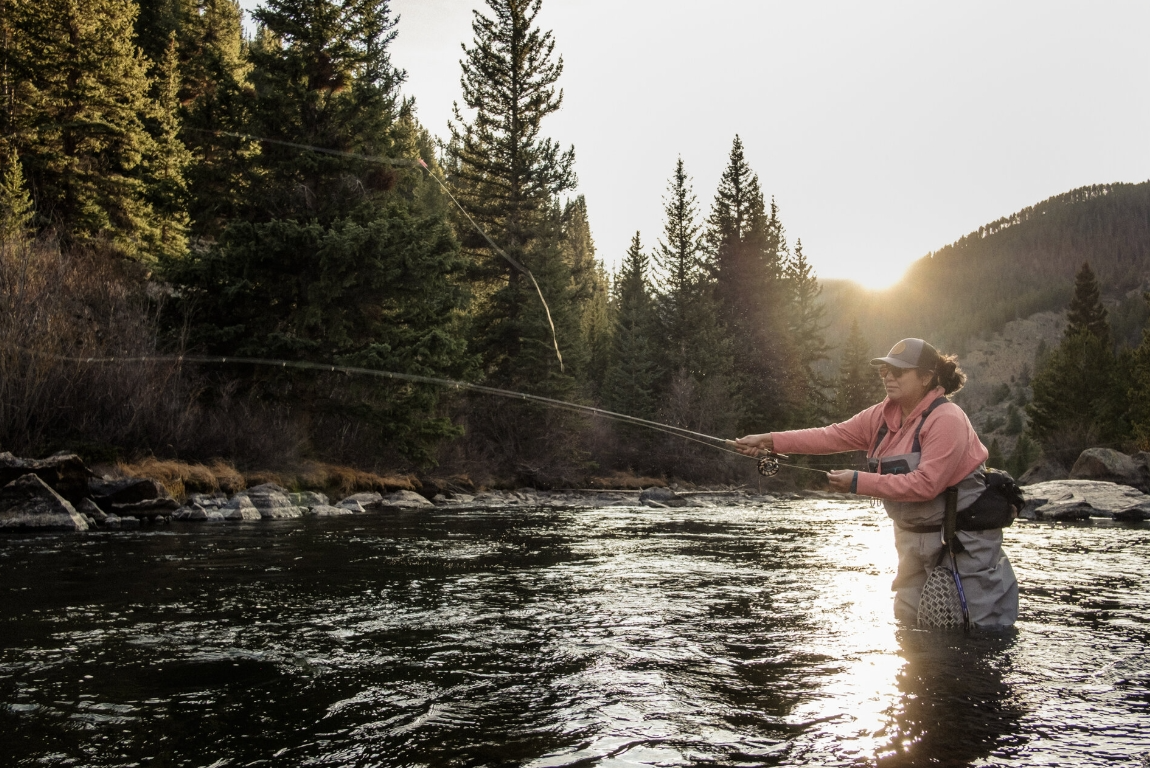
Calm water reflects 5–10% of UV radiation straight back up at you. Add some chop, a shallow flat, or a low sun angle and that figure climbs to 15–25% . Here's what that means on the water: inshore anglers fishing reflective coastal shallows absorb 25–40% more total UV than someone standing on dry ground under the same sky. You're not just getting hit from above. The water throws it back from below — targeting the underside of your chin, your neck, the exposed skin around your face, and the inside of your forearms. These are the spots that get cooked first and complained about last.
The peak window runs 10:00 AM to 4:00 PM , with UV intensity hitting hardest between 10 and 2. That's prime fishing time. It's also your highest-risk hours — no accident there.
Now consider what your average white cotton T-shirt is doing in that environment. Its UPF sits around 5–10 . That means it lets 10–20% of UV pass straight through to your skin .
UPF 50+ flips that equation.
The UPF 50+ threshold is the ceiling rating under AS/NZS 4399 standards. At that level, fabric transmission drops to ≤2% of incident UV . That's the <2% transmission baseline : 98 out of every 100 UV photons stopped at the weave. Sunscreen washes off, sweats off, and rubs off the moment a wave breaks across your forearm. UPF 50+ fabric doesn't. It gives you consistent protection at every angle — from above, and from the reflected glare coming off the water below.
That last detail matters more on the water than anywhere else.Any reliable UPF fishing apparel wholesaler should be able to verify these protection ratings.
UPF 50 Vs SPF: Rating Scale Explained and Passive Shielding Mechanics
Here's something that surprises most anglers: UPF and SPF don't measure the same thing. They're not even close cousins. One measures what a fabric blocks . The other measures how long your skin takes to burn . Treat them as the same thing, and you end up fried at noon wondering why the number on the bottle failed you.
UPF is a transmission rating. UPF 50 means 1/50th — 2% — of UV light passes through the fabric. Both UVA and UVB. That's it. No behavior required. No timer. The rating is built into the material itself.
SPF is a time-delay rating. SPF 50 means your skin takes 50 times longer to redden than bare skin. But that math runs on UVB alone, and it assumes you applied 2 mg per square centimeter in a lab setting. That's 1 to 1.5 ounces of sunscreen for full-body coverage. Most people put on less than half that amount. Drop the dosage, and your effective SPF can fall to one-third of the label — SPF 50 behaving more like SPF 17 on the water.
The UPF Scale Doesn't Leave Much Room for Debate
UPF Rating | Protection Category | UV Transmitted | UV Blocked |
|---|---|---|---|
15–24 | Good | 4–6.7% | ~93–95% |
25–39 | Very Good | 2.6–4% | ~96–97% |
40–50+ | Excellent | ≤2% | ≥98% |
A standard white cotton T-shirt rates around UPF 5. That means 20% of UV punches straight through to your shoulders. On the water, reflected UV already hits your skin 40 to 60 percent harder than dry ground. That cotton shirt isn't a shield out there. It's a suggestion.
UPF 50+ flips the ratio — 98% of UV gets blocked. Plus, it covers both UVA and UVB by design . SPF sunscreen, unless the label says broad-spectrum, targets mostly UVB. Your UVA exposure stays wide open.
Passive vs. Active: Why It Matters on the Water
This is where the real-world gap opens up wide.
UPF clothing is passive protection . You put the shirt on. The shirt works. No reapplication window to track. No thickness to measure. No patch of skin you forgot at 11:47 AM when the redfish started schooling. The protection sits at the fiber level — physical structure, not a surface coating. Saltwater, sweat, and rogue waves don't change how it performs.
SPF sunscreen is behavior-dependent . You need the right dose, reapplication every two hours, and another round after every swim, sweat session, or towel dry. Dermatology data is clear on what happens without that discipline: effective SPF drops 50 to 70 percent below the label value . That SPF 50 you applied at launch? By mid-morning with no reapplication, it's likely running closer to SPF 15 to 25 — just above the minimum for basic outdoor use.
On a boat in July, with reflected UV already stacking up on your skin, that gap doesn't just matter. It's the entire ballgame.
The practical rule: UPF 50+ clothing covers your skin steadily and without any effort on your part. Sunscreen fills the gaps — face, hands, neck — but treat the SPF number as conditional, not guaranteed. Use both. Don't swap one for the other.
For long fishing days, high-UV conditions, or open-water trips where reapplication isn't realistic, UPF 40–50+ is the starting point , not a bonus feature. Premium UPF 50+ garments use fiber-embedded protection — not a surface coating — and hold ≥98% UV block through about 40 wash cycles. That translates to one to two years of solid performance under hard, high-exposure use.
Sun Protective Textile Construction and Fabric Weave Density UV Protection
Fabric construction is engineering, not marketing. The difference between a shirt that blocks 98% of UV and one that blocks 80% comes down to decisions made at the yarn level — long before the garment hits a rack.
The central variable is cover factor : the ratio of yarn surface area to total fabric area. Think of it as how much of the fabric is solid fiber versus open air. UV photons don't care about brand names. They travel in straight lines. A gap in the weave means they go straight through it. Cover factor and UPF don't have a linear relationship — it's exponential. Small increases in weave density produce big jumps in UV blocking. Push cover factor past 95% and the fabric stops acting like a mesh. It starts acting like a physical wall.
Why Weave Structure and Denier Matter More Than Weight
Not all dense fabrics perform the same. A satin weave with a high thread count beats a loose plain weave at identical GSM. The structure forces photons to change direction multiple times before clearing the fabric. Research on woven cotton confirms that only high-density satin constructions hit a "good" UV protection rating. Looser weaves at the same weight fell short.
Synthetic fibers change the math here. Microdenier polyester and nylon allow thread counts above 100–150 ends per inch without adding mass. The result: a fabric that hits UPF 50+ in the 110–150 GSM band — light enough for July heat, dense enough to block reflected UV off the water. Cotton can't match that. To reach equal UV protection in cotton, you need more mass, more weight, and more heat trapped against your skin.
Here are the practical benchmarks:
Fabric Type | Typical GSM | Approximate UPF |
|---|---|---|
White cotton T-shirt | 120–150 | ~5 |
Standard summer fabric | ~150 | ~20 |
Purpose-built UPF synthetic | 110–150 | 30–50+ |
Double-Knit Architecture and the Multi-Layer Advantage
Some high-performance fishing shirts go further with interlock or double-knit structures . The logic is simple. Two offset layers of yarn create two separate barriers a UV photon must get through before reaching your skin. The front and back beds sit slightly out of alignment. So the pores don't line up. There's no straight path through the fabric. This is called aperture staggering, and it's why double-knit fabrics test at the top of the UPF scale.
Anglers working open water or tropical flats face UV from two directions — above and reflected off the water. For them, this construction detail isn't optional. It's doing real protective work.
The Breathability Equation
Dense construction creates a real trade-off: more fiber means less airflow. Purpose-built fishing apparel solves this by working at the fiber level rather than adding mass. Microdenier synthetics deliver high cover factor at lower GSM than cotton. You get structural density that drives UPF up — without killing air permeability. UV-absorbing dyes and finishes push the rating even higher without adding a single gram of weight.
The practical target for hot-weather, high-humidity fishing: UPF 50+ at under 150 GSM , built through tight synthetic construction rather than heavy fabric. That's the gap between a shirt that delivers real sun protection and a heavier garment that just carries a label.
Polyester Nylon UV Resistance Versus Natural Fiber Baseline Limits
The fiber itself is the first line of defense — and not all fibers start from the same baseline.
Polyester and nylon hold a structural advantage that cotton and linen don't. At the molecular level, synthetic fibers absorb and scatter UV radiation better than untreated natural fibers. You don't need a chemistry degree to use that fact. Just understand what it means the next time you're in a fly shop, comparing two shirts with identical UPF labels but different fiber contents.
Untreated white cotton rates around UPF 5–7 . Bleached summer cotton and linen land in the UPF 5–10 range without major construction upgrades. That's not a coincidence. Those fibers have weak natural UV absorption. To reach UPF 30+ territory, Sun-Protective Fishing manufacturers have to compensate — tighter weave, heavier weight, darker dye, or an applied UV treatment. That compensation comes at a cost: breathability, weight, or both.
Polyester and nylon skip that compensating work. They reach high-UPF territory with lower GSM and no chemical help. That's the real edge synthetics hold in fishing apparel.
What Happens When the Fabric Gets Wet
Here's the detail that gets skipped on hang tags: wetness cuts UV protection hard . Research shows getting a fabric wet can cut its protection by as much as half. Cotton and rayon blends take the worst hit. A garment rated UPF 20 dry can drop toward UPF 10 or lower after a wave hits your forearms or sweat soaks the shoulders.
Quick-drying polyester works differently. Many polyester constructions maintain or even improve their UPF rating when damp . For anglers on open water in July heat — dealing with constant sweat, spray, and the occasional drenching — that gap isn't small. It decides whether your shirt is doing its job at hour six of the trip.
The Stretch Problem Nobody Talks About
Movement opens gaps. An overhead cast, a reach across the gunwale to land a fish, a bend to work a bank — the fabric stretches. Stretched fabric loses UPF.
The numbers are stark. Dark cycling shorts tested at UPF 85 at rest dropped to UPF 8 at full stretch . That's not minor degradation. That's near-total protection loss from one motion.
Fishing puts constant demand on fabric — reaching, shoulder rotation, crouching. This matters at the design level. Consider these key points:
Relaxed cuts keep the weave geometry intact under movement
Engineered stretch-UPF fabrics use higher-denier yarns and tighter interlock construction — they hold their cover factor under load
Standard knits don't do this. You get rated UPF on the hanger and something much lower on the water
The practical frame: Polyester and nylon are your highest-baseline options for UV resistance. No added weight. No chemical treatments needed. Buying cotton or linen? Look for explicit UPF certification, tight weave construction, and darker colorways. Accept that the rating applies to a dry, unstretched garment. For high-motion fishing, the cut of the shirt matters nearly as much as the fiber itself.
UV Blocking Fabric Technology: Titanium Dioxide Treatment and Dye Integration
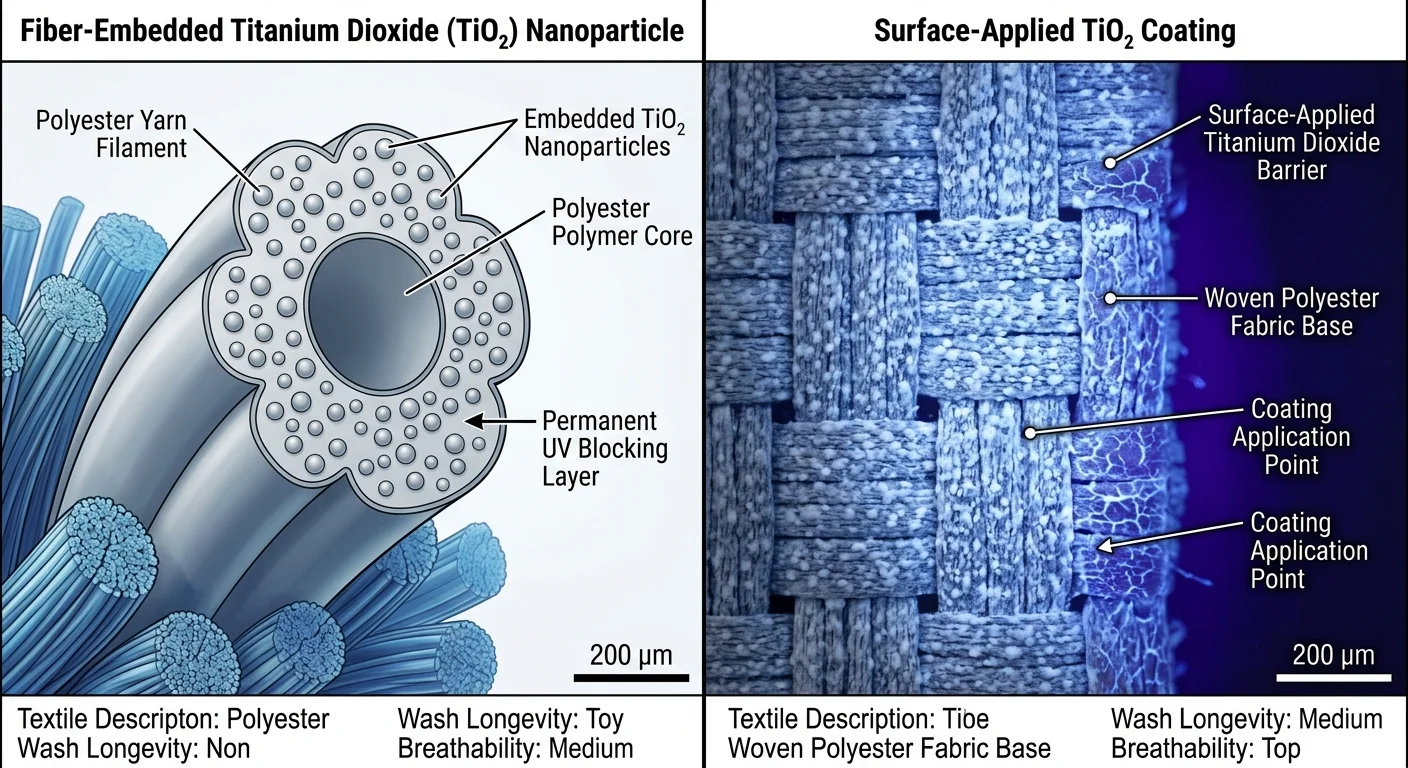
Two shirts. Same UPF 50+ label. Same fiber content. Same UPF fishing clothing price point. One has titanium dioxide locked inside the yarn at the spinning stage. The other has a surface coating applied after the fabric was woven. They will not perform the same after a season of hard use — and the hang tag won't tell you which is which.
This is where the chemistry separates the serious gear from the shelf filler.
How Titanium Dioxide Stops UV
Titanium dioxide — TiO₂ — works on a principle familiar to anyone who's heard of reef-safe sunscreen. UV photons strike TiO₂ nanoparticles. Electrons jump from the valence band to the conduction band. The photon energy gets absorbed and converted. UV radiation that would otherwise reach your skin gets captured and released as minor heat and chemical energy instead. Nothing gets through.
Particle size matters here. Nano-scale TiO₂ — in the 5–20 nm range — stays clear to visible light while blocking the full 280–400 nm UV window. That covers both UVA and UVB. The fabric doesn't look white or chalky. Colors stay clean. The finish doesn't add stiffness. From the outside, nothing looks different. From a UV physics standpoint, the fabric has become a near-total UV barrier.
The data backs that up clearly. Untreated workwear cotton rates UPF 3.67 . The same fabric after TiO₂ deposition rates UPF 55.82 — clearing the UPF 50+ threshold with room to spare. It also keeps the fabric's moisture management and wicking behavior intact. Treated polyester with 1–5% TiO₂ nanoparticle add-on has tested at UPF 255–284 , with UVA transmission at 0.6–0.8% . At high TiO₂ levels in lab conditions, some cotton fabrics have posted UPF values exceeding 3,500 .
Those aren't rounding errors. That's what inorganic oxide chemistry does when it intercepts UV at the fiber level.
Three Points of Entry: Where Manufacturers Apply the Treatment
TiO₂ protection doesn't go into a fishing shirt at one fixed stage. Three distinct engineering pathways exist, and each one produces a different durability outcome.
Yarn-stage integration is the most durable method. UPF fishing apparel Manufacturers blend nano TiO₂ masterbatch into polyester or nylon polymer melt before spinning the fiber. The particles sit locked inside the yarn — not on the surface, not bonded to the exterior with a binder that can break down. Patagonia has documented this approach in its custom UPF fishing apparel manufacturing process. The protection doesn't wash off because there's nothing on the surface to wash away. It's built into the fiber's structure. This method holds UPF ratings through 40+ wash cycles with little degradation.
Solution dyeing with UV-absorbing colorants puts dye molecules into the fiber at the same pre-spinning stage — color and UV chemistry go in together. Darker and high-saturation shades add a secondary layer of UV blocking on top of the structural protection. Colorant molecules absorb photon energy across the near-UV range. The practical effect is a modest but real boost to the base UPF rating. One key point: dye depth alone does not replace dedicated UV treatment. TiO₂ nanoparticles block UV better than dyes in every tested comparison. Color is a secondary boost, not the main protection.
Post-cure surface finishing applies TiO₂ or ZnO nanosol to finished fabric through a padding process — at 1–5% add-on — followed by heat curing at 150–180°C. This bonds the nanoparticles to fiber surfaces using binder and emulsifier chemistry. Post-cure finishes with citric acid cross-linkers have shown UV blockage of 92–97% and held functional UPF ratings through 15–36 wash cycles . The durability ceiling is lower than yarn-stage integration. Still, the performance window covers the typical lifecycle of a fishing shirt under normal care.
What This Means When You're Buying
The wash durability question — the one most anglers care about — ties directly to these three methods. Premium yarn-stage TiO₂ integration targets 40+ wash cycles at UPF 50+. Post-cure finishes, well-bonded, hold through 30–36 cycles. Lower-grade surface treatments without cross-linking chemistry fade faster.
One more data point worth knowing: TiO₂ finishing on cotton showed a ~9% increase in tensile strength alongside the UV protection gain. The treatment also showed 93% antibacterial activity in testing. On saltwater trips where gear stays wet for hours, that secondary benefit is real and useful.
Dark colors help. Tight weave structure helps. But the gap between a shirt that tests at UPF 55 and one that holds that rating after two seasons of washing, sweat, and salt exposure comes down to where and how the TiO₂ was added. Yarn-stage integration is the stronger engineering choice. Post-cure finishing is the budget trade-off. Knowing which one you're buying puts you ahead.
ASTM Certification Protocols and Real-World UPF Degradation Factors
The UPF number on your fishing shirt isn't a permanent promise. It's a snapshot — taken under controlled lab conditions, after a standardized aging process, on fabric that has never touched saltwater or handled a single overhead cast. Knowing how that number gets assigned — and what tears it down — tells you how much to trust it after a full season on the water.
How the Lab Arrives at That Number
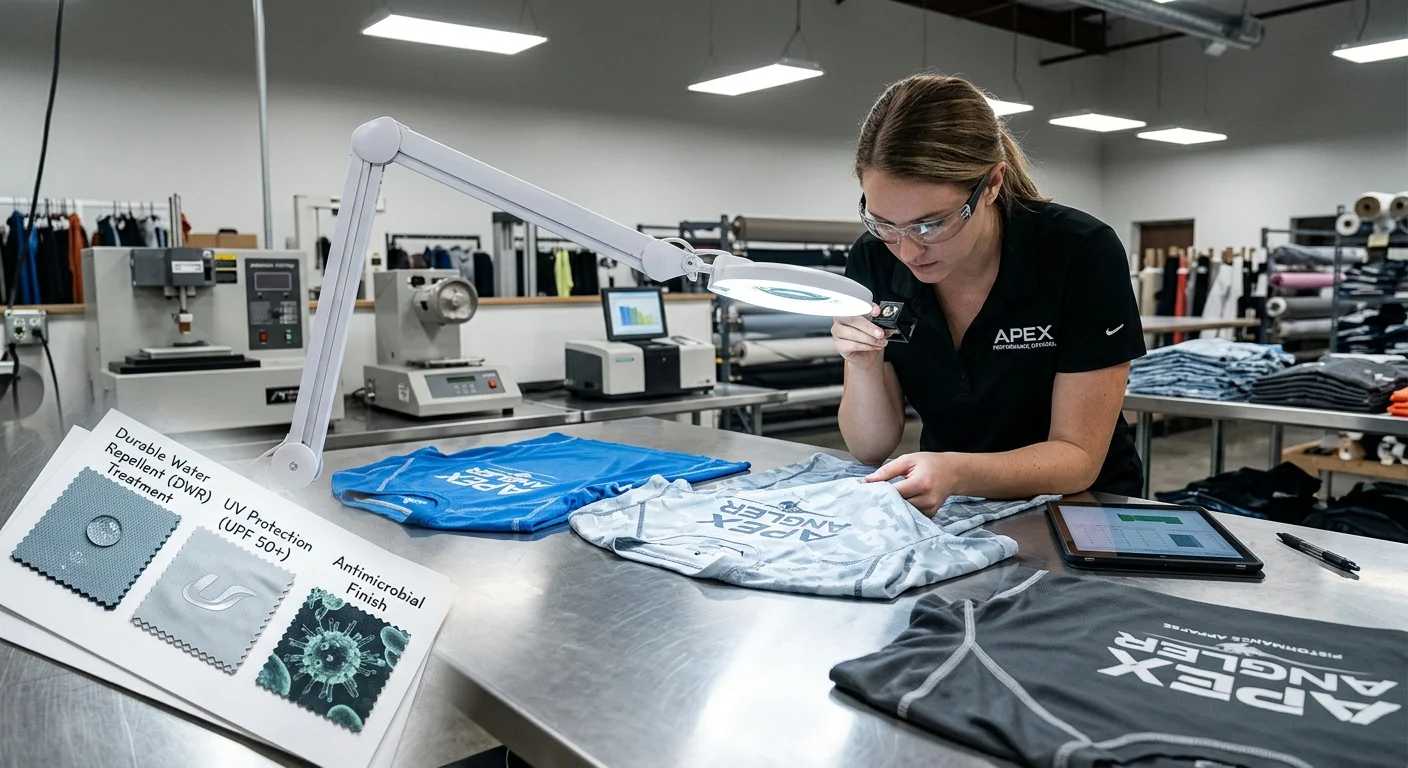
Three standards run the process: ASTM D6544 (pre-aging protocol), AATCC 183 (UV transmittance measurement), and ASTM D6603 (labeling rules). They don't work on their own. They run in sequence.
The fabric goes through a simulated aging gauntlet before any UV measurement starts. Standard garments must complete 40 full laundering cycles — washed and dried per care label — followed by 100 AATCC Fading Units of simulated sunlight exposure . Swimwear adds a third stage: chlorinated pool water immersion under AATCC 162 before testing begins. That three-step sequence is built to approximate two seasons of real-world use before the fabric ever reaches a spectrophotometer.
After conditioning, labs measure UV transmission across 280–400 nm . The measurement is erythemally weighted. That means it accounts for the specific wavelengths that damage human skin — not just how much light the fabric blocks overall. Labs test both dry and wet states . They also stretch specimens under mechanical load before re-testing, to simulate high-motion use. Multiple specimens get averaged. The final labeled value rounds down to the nearest multiple of 5 , and labs sometimes subtract standard error first. UPF 57 becomes UPF 50+. The system is built to be conservative on purpose.
Where Protection Goes After You Buy the Shirt
Forty wash cycles in a lab is one thing. Forty washes in the real world — with sweat, sunscreen residue, salt deposits, and line-handler abrasion — is a different story.
Laundering is the main driver of degradation. UV absorbers and dyestuffs leach out a little more with each wash cycle. Fiber porosity grows as the structure loosens. A shirt that tested at UPF 55 at certification may hold near UPF 50 through 30–36 washes with proper care. Lower-grade post-cure finishes without cross-linking chemistry drop faster. Yarn-stage TiO₂ integration — locked inside the fiber before spinning — holds the longest. Surface treatments have a hard ceiling.
Wetness cuts protection in real time. Generic cotton and lightweight fabrics can show 20–40% UPF reduction when saturated — not based on the certification test, but based on the actual conditions you fish in. Water fills the fabric pores, shifts internal light scattering, and lets more UV through. Quick-dry synthetics with hydrophobic yarns and tight construction shed water before it penetrates the weave. That limits UPF drop to under 20% in comparative lab testing.
Stretch and abrasion hit hardest in predictable spots:
- Elbows
- Collar creases
- The band where a backpack sits across your shoulders
High-motion areas under constant strain show localized UPF reductions as the weave geometry opens under load. Pilling makes this worse. Raised surface pills do scatter UV slightly better in some cases — but yarn breakage and thinning underneath win out. Local UV transmittance rises at your highest-wear contact points.
The Coverage Gap the Label Doesn't Mention
Lab certification rates the fabric. It says nothing about your neck.
V-neck openings, short sleeves that ride up mid-cast, gaps at the wrist between cuff and glove — these are zero-UPF zones no matter what the hangtag says. High collars, thumb-hole cuffs, and integrated gaiters made from certified UPF fabric close those gaps by design. Sunscreen handles what fabric can't reach: face, ears, and the tops of your hands.
The shirt does its job on the skin it covers. What it doesn't cover is on you.
Scenario-Optimized Selection: Matching Fabric Weight to Boat, Shore, and Fly Angling
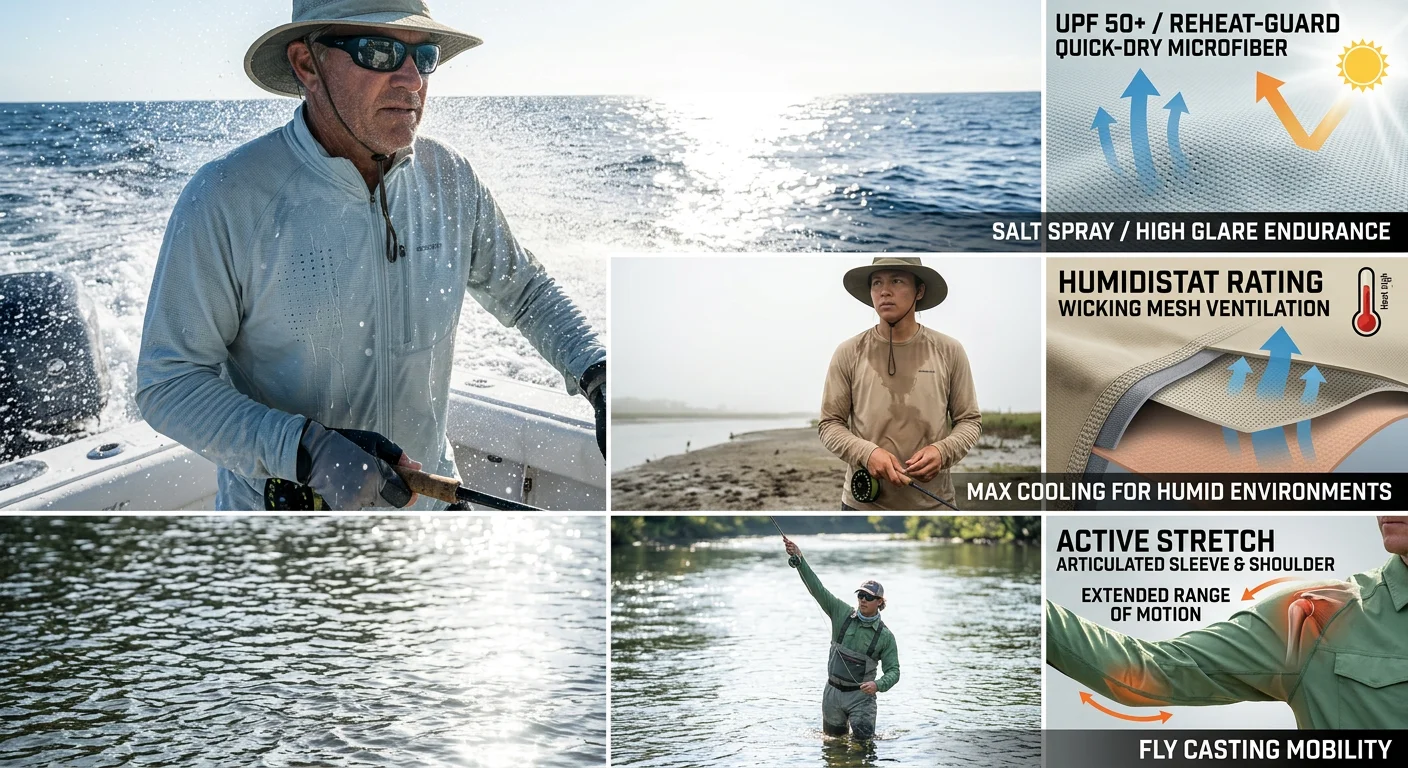
Three anglers. Three different UV problems. The offshore guy takes sun from above and reflected glare off open water at the same time. Salt spray soaks his sleeves every time a wave breaks across the bow. The shore angler stands still in dead-humid air, sweating through his shirt by 9 AM. The fly fisherman throws forty overhead casts an hour. His shirt needs to move with him — not fight him.
Same UPF 50+ label. Different fabric requirements entirely.
Offshore and charter boat fishing needs a polyester-spandex blend with saltwater-resistant, hydrophobic treatment. The fabric has to shed brine before it soaks through. Look for extended hems, an integrated hood or neck gaiter, and mesh ventilation panels. You're managing heat, spray, and direct exposure all at once. Four-way stretch and permanent UPF construction are non-negotiable. A surface-treated shirt loses its rating after repeated salt exposure. By day three of a charter week, it's no longer protecting you.
Shore and freshwater fishing works on a different equation. You're stationary or slow-moving. Humidity builds up fast. The biggest enemy is your own sweat breaking down your protection. Target fabric weight under 5 oz/sq yd — the 4.0–5.0 oz/sq yd range gives you the best balance between coverage and airflow. Thumb loops and a high-coverage cut keep sleeves down and your neck protected through long hours of static exposure. No adjusting needed.
Fly fishing is a mobility problem first. An overhead cast puts the shoulder seam under load forty times an hour. Standard knits fail that test. They open at the weave under stretch and drop UPF right in the spot taking the most sun. A dense polyester or polyester-spandex four-way stretch knit holds its cover factor through a full range of motion. Fishing-specific cuts give you 15–20% better range of motion than standard athletic shirts. That's not just a comfort upgrade. It's a protection upgrade.
Scenario | Fabric Weight | Key Features | UPF Priority |
|---|---|---|---|
Offshore / charter | 4.0–5.0 oz/sq yd | Hydrophobic, hood, mesh vents | Inherent fiber construction |
Shore / freshwater | <5 oz/sq yd | Thumb loops, high neck, quick-dry | UPF 50+ certified |
Fly fishing | 3.5–5.0 oz/sq yd | 4-way stretch, casting cut | Stable UPF under stretch |
Hot/humid peak summer | <5 oz/sq yd | Mesh panels, wicking finish | Breathability first |
Shoulder season / cool water | Layered system | Wicking base + light shell | Base layer UPF 50+ |
One principle runs across all three scenarios: inherent fiber UV protection outlasts surface treatment, every time. Yarn-stage construction holds through 100-plus wash cycles. A treated finish breaks down after repeated laundering and salt exposure. Buying for a full season — not just a single trip — means the durability of the protection matters just as much as the rating itself.
Conclusion
You've spent years reading water — currents, structure, light. Now you can read fabric the same way.
UPF 50+ isn't a marketing number stamped on a hang tag. It's a real, measurable fact. Tight-woven polyester or nylon blocks 98% of UV that bounces off the water surface. That UV never reaches your skin. Add titanium dioxide treatment and solution-dyed pigment, and you've got three separate shields working at once — not one hoping for the best.
Here's what to check at checkout: weave density, fiber type, color depth, and chemical treatment. Those four things tell you more than any brand story ever will.
Pick the shirt that checks all four. Fish longer. Protect the skin you'll still need in twenty years.
The sun doesn't take a day off. Your protection shouldn't either.Building your own line? Choose private label UPF fishing apparel backed by certified UV testing.