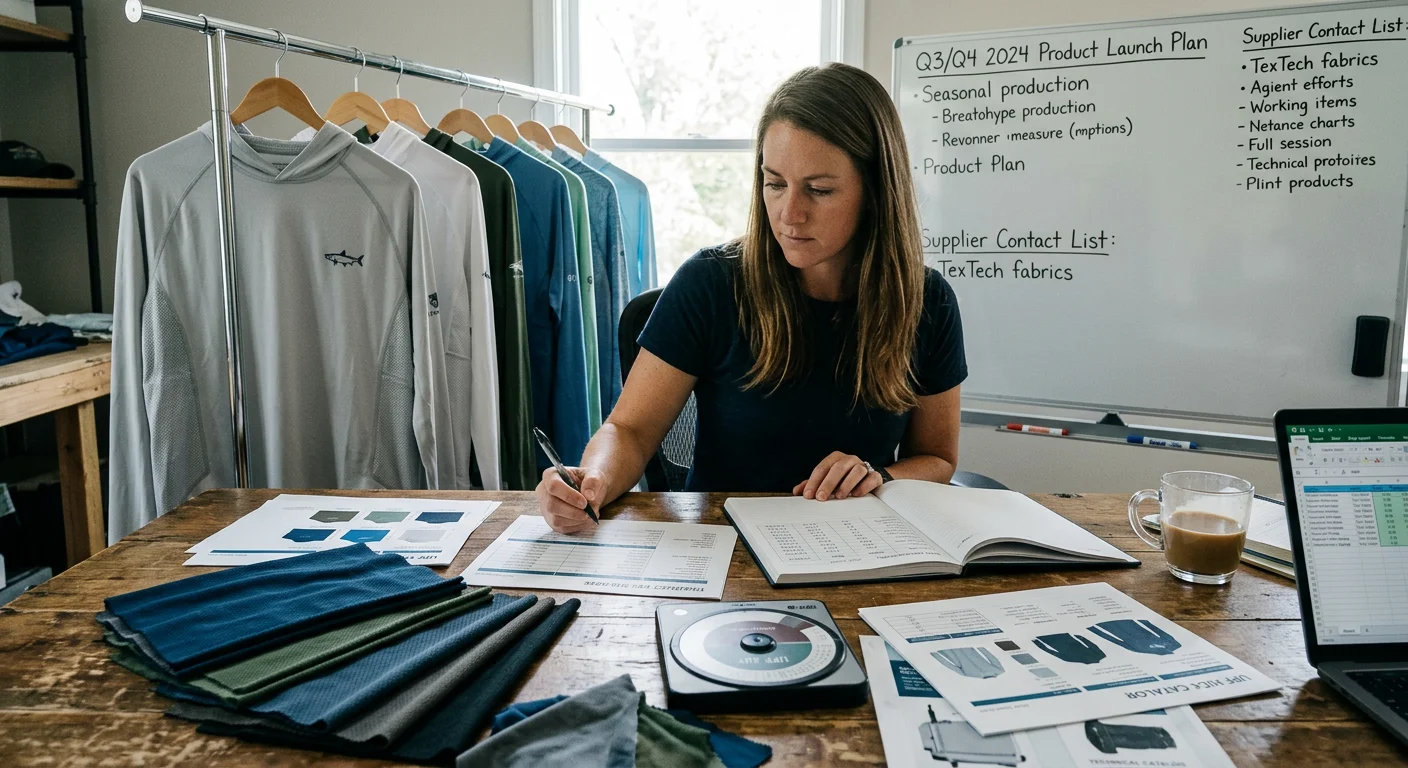
You've settled on fishing apparel as your niche. Good move—the category's growing, margins are decent, and you're not fighting a thousand competitors for a "cool graphic tee" concept. But now you're staring at a spreadsheet with a Fishing Apparel factory MOQ deadline in three days, and nobody's telling you whether to lead with sun-protection shirts or quick-dry long sleeves, how many colors to test, or whether UPF 50+ fabric is worth the upcharge over standard polyester.
That's the gap this guide closes. You'll get an actual SKU matrix priced out across $3,000, $5,000, and $10,000 stocking tiers, showing exactly what a lean but credible fishing apparel manufacturing partner order looks like at each budget. This is the list you hand your custom fishing apparel factory contact today.
Sun-protection shirt (UPF)
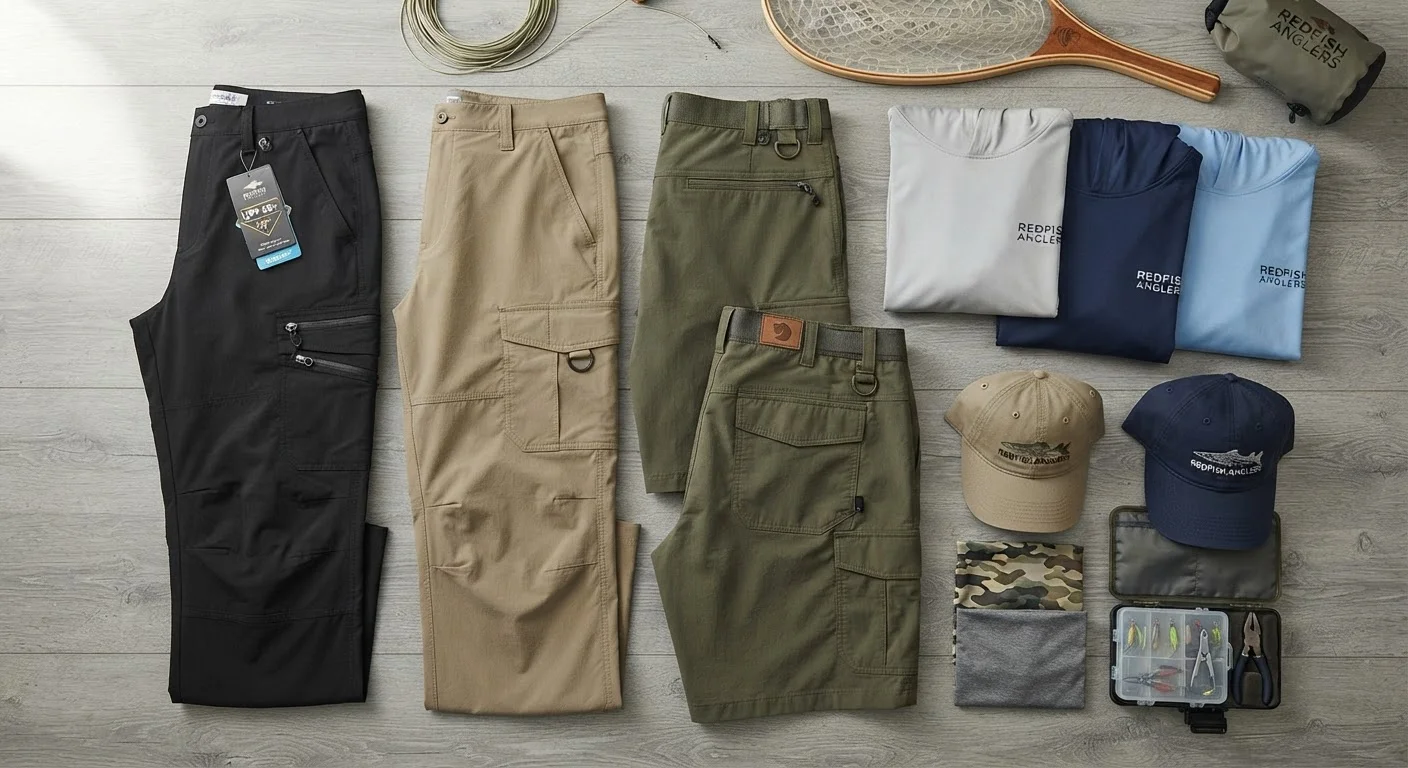
Every credible fishing apparel line starts with the UPF sun shirt—not the hoodie, not the hat. If you only had budget for one SKU, this would be it.
The fabric spec that matters
Target UPF 50+ , which blocks 98% of UV rays. That's the top tier on the classification scale. Anything from UPF 40 to 50+ is rated "excellent," blocking 97.5% or more. Don't just print "UPF 50+" on a hang tag and hope nobody checks. Get it tested to AATCC TM 183 or AS/NZS 4399 , the two standards buyers and reviewers actually recognize.
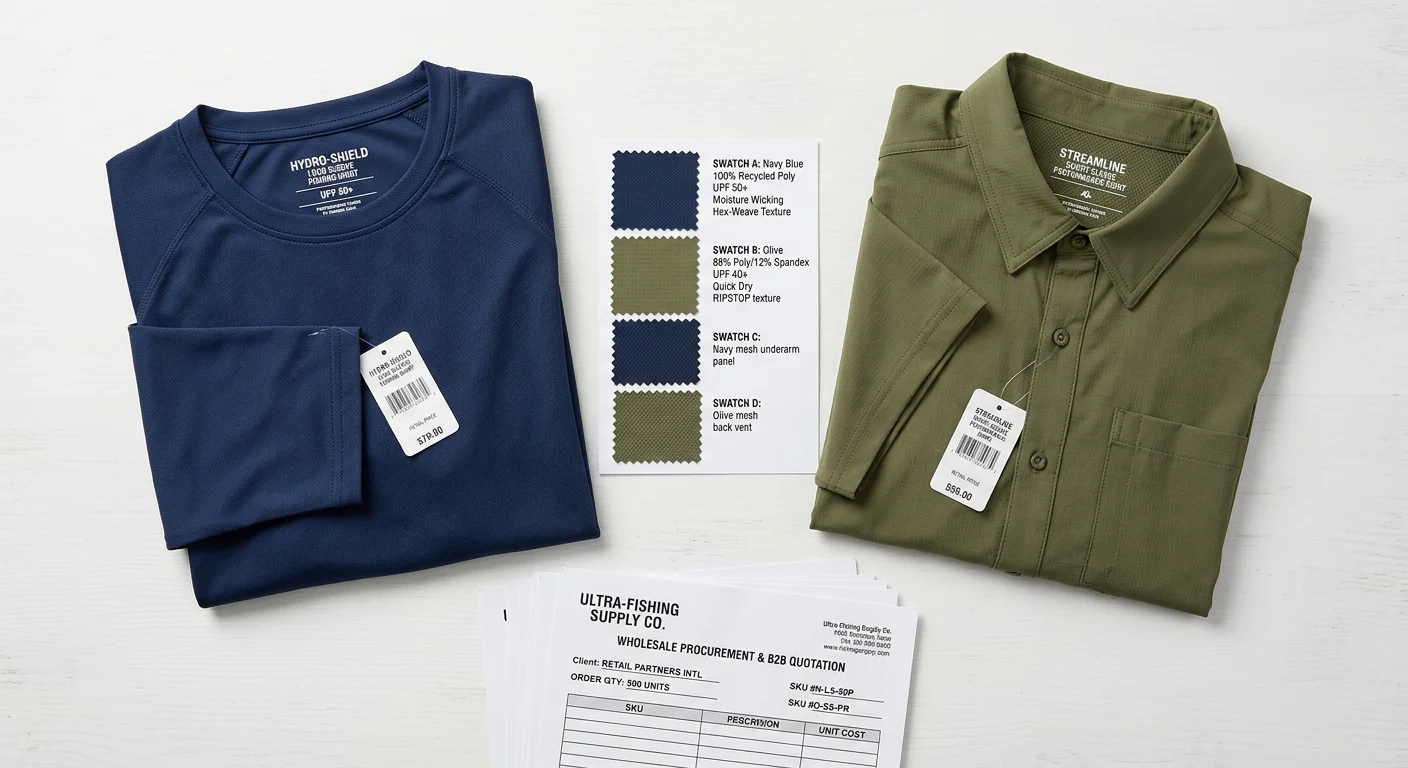
For fabric composition, look for a polyester/spandex knit, 88–92% poly, 8–12% spandex , weighing 140–160 gsm . That's light enough for boat and surf fishing but dense enough to hold its UPF rating under 4-way stretch. One catch most new brands miss: stretching thins the fabric, which can tank UPF. Test after stretch, not before.
Build it as a long-sleeve, crew or mock-neck shirt with flatlock seams (no chafing on a 10-hour offshore trip), a tagless heat-transfer neck label, and a hidden zipper pocket at the side seam. You need a moisture-wicking finish that dries in under 30 minutes.
Color and size math for your first order
Run 4–6 colors : three or four core neutrals (white, navy, charcoal, light grey) plus one or two seasonal brights like aqua or coral for visibility on the water. Size range should cover S–3XL unisex .
MOQ reality check
Most mid-tier factories want around 100 pieces per color per size . Five colors × 8 sizes × 100 pieces lands you at roughly 4,000 pieces —that's your full opening order for one style. Tight on cash? Cut to three colors and you're at 2,400 pieces , still enough to look like a real fishing brand product assortment instead of a one-off drop.
fishingapparelfactory.com
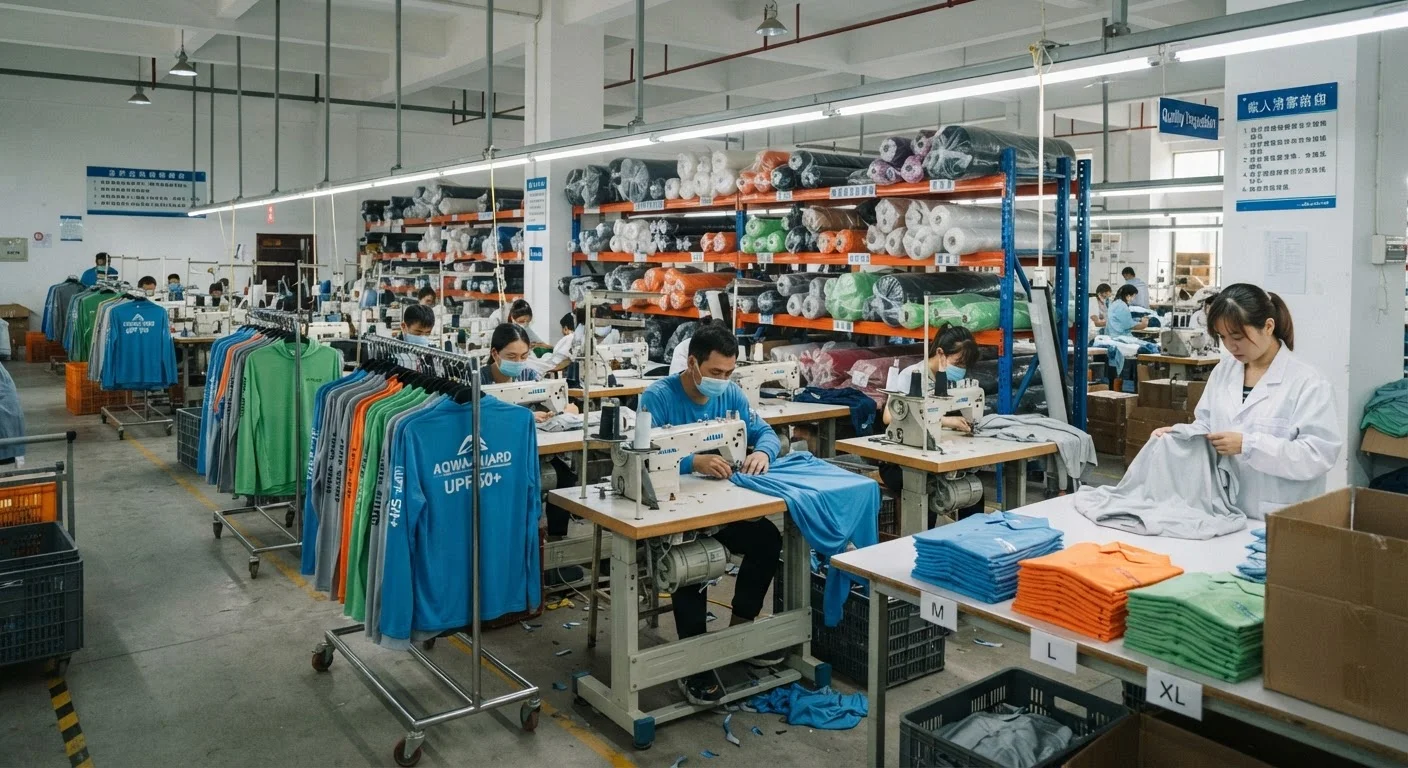
Numbers on a spreadsheet only matter if a factory will produce them. That's where Runfish Apparel comes in—the custom fishing apparel manufacturer behind fishingapparelfactory.com, and one of the few source factories in Guangzhou that builds fishing apparel exclusively. No graphic tees, no general activewear line they're squeezing you into. Patterns, fabric weights, and sublimation setups are all tuned for water-facing garments, which matters when you're trying to hit UPF 50+ specs on your first run.
Why the MOQ matters for your budget tiers
Runfish's standard floor is 50 pieces per style per color. That's roughly a quarter of what most mid-tier factories require, and it's the number that makes the $3,000 tier in this guide possible without gutting your color or size range. They didn't back into this MOQ by accident. It's built for startup-friendly fishing apparel production, where cash flow is tight and you'd rather test five colors at 50 units than commit to 200 units of one color you're not sure will sell.
The suggested pathway for new brands
Runfish lays out a three-step ladder that mirrors the budget-tier thinking you need:
A ~$500 print-on-demand test run (done elsewhere) to validate a design before committing fishing apparel factory minimums
A 50-piece sublimated fishing jersey run through Runfish once you've got a design worth producing at scale
A 200-piece private label run once demand is proven
That's a legitimate way to de-risk your first order instead of guessing.
What's behind the MOQ
The low minimums aren't a corner-cutting move. Runfish runs ISO 9001, OEKO-TEX Standard 100, and BSCI certifications, plus in-house colorfastness testing and pre-shipment inspection. They've been manufacturing fishing apparel since 2009 and ship to 30+ countries under FOB, CIF, or DDP terms. DDP is standardized to spare first-time overseas buyers the broker headache. Quotes come back within 24 hours of a brief; samples in about a week.
Quick-dry LONG-SLEEVE shirt
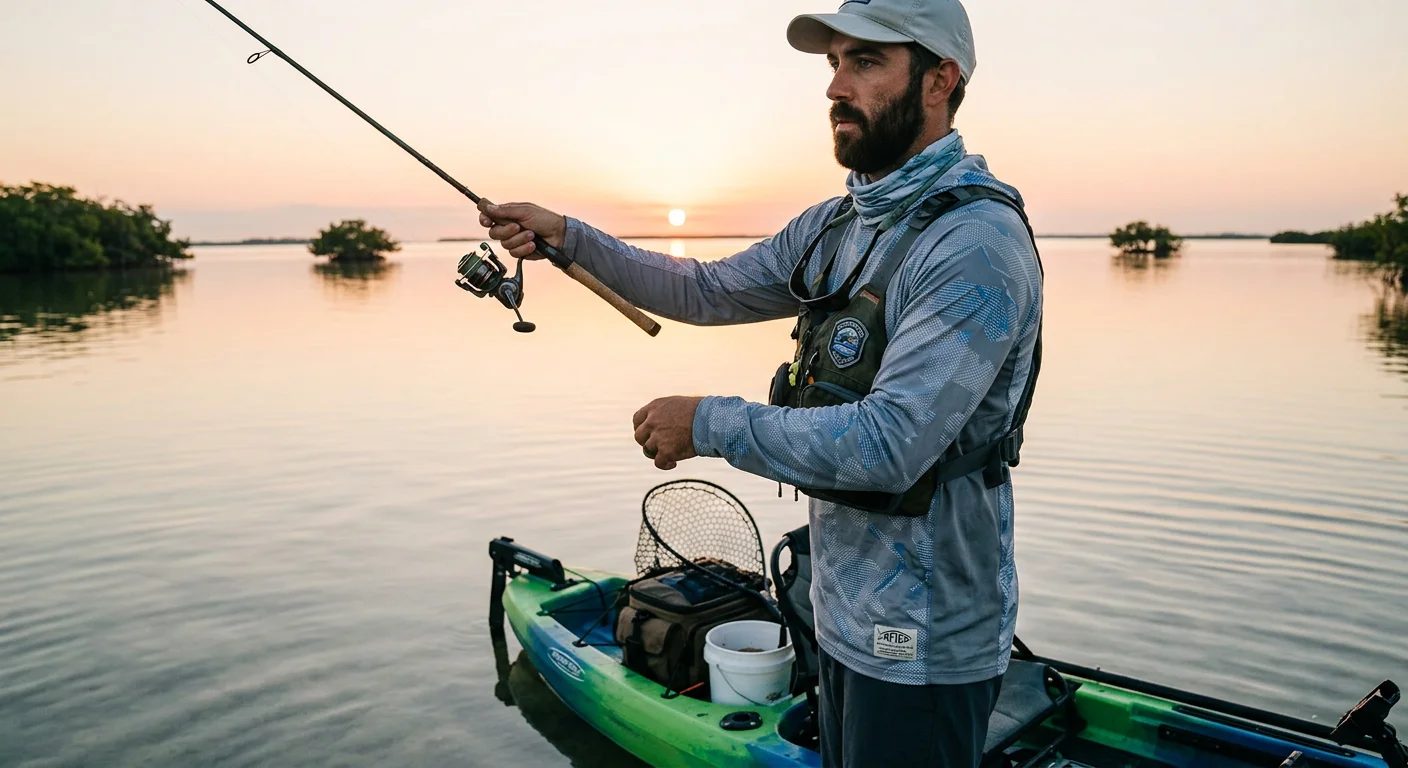
Lure anglers don't sit still. They cast, retrieve, cast again—hundreds of times a session—and that repetitive motion is exactly why your second core SKU needs to move differently than the UPF sun shirt. This is the piece built for 路亚 (lure fishing) and boat fishing, where mobility matters as much as sun coverage.
Fabric that moves with the cast
Skip the heavier poly/spandex blend from your sun shirt here. A 93% nylon / 7% spandex blend at 120–130 gsm is the sweet spot. Light enough to disappear on the arm, stretchy enough to keep up with an overhead cast repeated all afternoon. Nylon-based quick-dry fabrics evaporate faster than straight polyester, which matters when you're getting splashed on a boat deck or sweating through a summer session.
Construction details that separate this from a basic tee
Three features do the heavy lifting:
Raglan sleeves — the diagonal seam frees up shoulder rotation, which a set-in sleeve restricts
Mesh underarm or back panels — dumps heat where anglers actually generate it
Anti-odor treatment — HeiQ® Mint or silver ion finishes both work; either lets a shirt survive a multi-day fishing trip without a wash
Keep UPF in the 40+ to 50+ range . It's not the headline feature like it is on the sun shirt, but skipping it entirely undercuts your fishing brand's credibility.
Sizing, color, and order math
Run S–3XL . If you want cleaner inventory, split XXL–3XL into a separate plus-size run. For color, 3–5 options is the efficient range: black, white, gray, navy as your core, plus one accent color for shelf variety.
MOQ benchmark
Factories typically want 80 pieces per color per size on this style. That's lower than the UPF shirt's typical floor, which makes the long-sleeve quick-dry shirt a smart second SKU when you're stretching a tight budget across a fuller assortment.
Short-sleeve shirt
Beach and surf anglers don't need the full-coverage armor of a long-sleeve piece. They need something that breathes, dries fast, and doesn't feel like a wetsuit under a midday sun. That's the gap the short-sleeve shirt fills in your assortment, and it's often the SKU that moves fastest in warm-climate markets.
Fabric and build
Go with a 150–170 gsm poly/cotton twill or ripstop, roughly 55–65% polyester to 35–45% cotton, with a moisture-wicking, quick-dry finish baked in. Want a pure performance option? Switch to 100% polyester for max quick-dry, though it runs slightly less breathable than the blend. Either way, build in UPF 30+ as your baseline—cheaper to spec now than to retrofit later.
Two details separate this from a generic tee: a chest pocket with a drain hole (so it empties fast after a wave splash) and a vented mesh back yoke for airflow.
Colors, sizing, MOQ
Run 4–5 colors—white, light gray, navy, orange, camouflage—across S–3XL. Most factories land around 120 pieces per color per size, so five colors at six sizes puts you near 3,600 units for this style alone.
Hats & accessories (caps/buffs)
Caps and buffs bring zero sizing complexity and maximum visual merchandising payoff to your fishing hats and buffs lineup. Every unit is one-size-fits-most, so you skip the size-curve math and put your budget toward color variety instead.
Caps
Run 3 colors: black (hides stains, pairs with everything), navy (the marine standard for boat anglers), and khaki (reflects heat for beach/surf positioning). Build them as 6-panel, pre-curved brim caps in 100% cotton twill, 180 gsm, with a moisture-wicking sweatband and a dark under-brim to cut water-surface glare. Adjustable Velcro or buckle closure covers 55–61 cm heads. MOQ is 50 pieces per color, so 150 units total gets you a full cap assortment.
Buffs
Two designs cover the range: a solid neutral (light grey or sand) for broad appeal, and a camo sublimation print for anglers who want gear that looks the part. Spec 100% polyester microfibre, 90 gsm, tested toward UPF 50+, seamless tubular construction, 48–53 cm length. Buff MOQ sits at 100 pieces per design, so 200 units for both.
Combined: 5 SKUs, 350 units, rounding out boat, lure, and beach/surf scenarios without touching your size inventory.
Pants/shorts
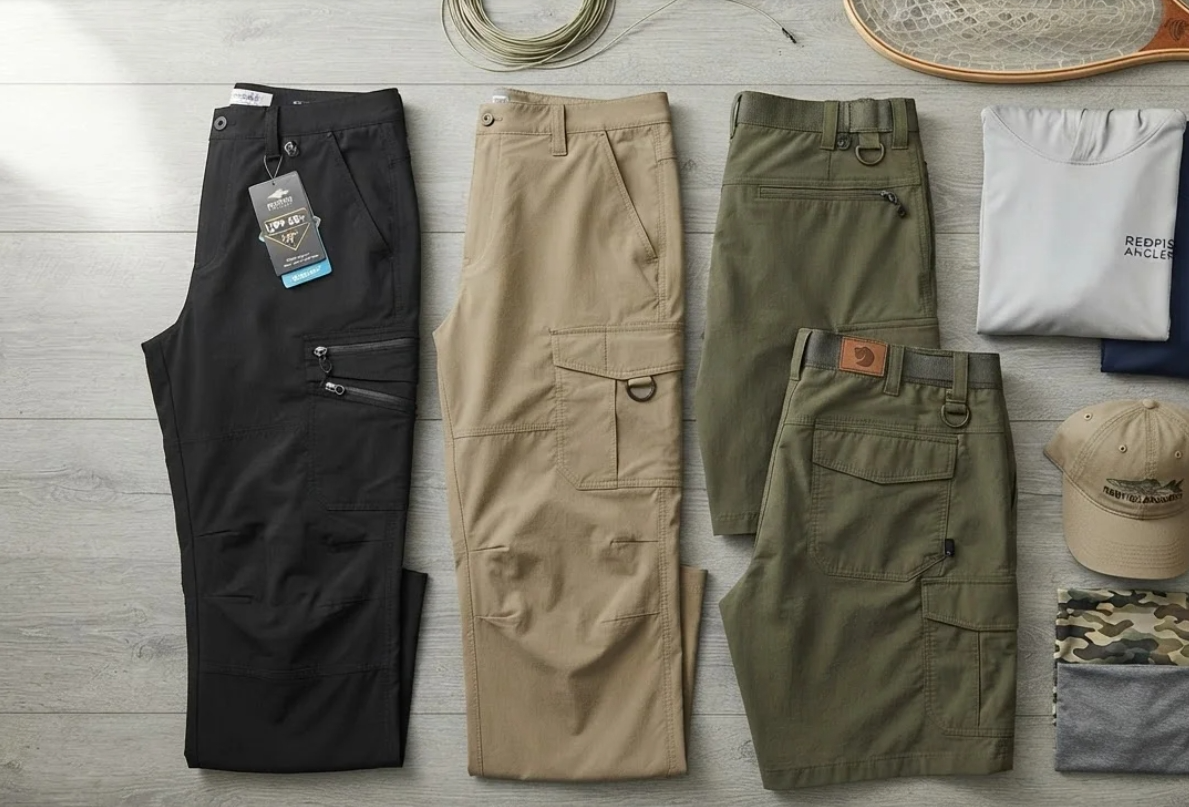
Bottoms get overlooked in a lot of first-run fishing apparel lines, and that's a mistake. Pants and shorts are what separate a real outdoor apparel brand from a t-shirt company that stumbled into fishing.
Pants: 3 colors, stretch nylon build
Run black, khaki/sand, and gray. Black hides stains and matches everything. Khaki reads as outdoor gear and performs well under direct sun on beach and surf trips. Gray pairs with technical tops. Spec the fabric at 170–190 gsm stretch nylon with 8–12% elastane, plus a DWR (durable water-repellent) finish for boat splash and light wading. Set inseam at 31" regular for launch, then add short (29") and long (33") once sales data tells you it's worth the extra SKUs.
Shorts: 2 colors, dual inseam
Stick to black and olive/dark green. Fabric runs 140–160 gsm quick-dry polyester, light enough for beach heat but sturdy enough to hold pockets and hardware. Offer 7" and 9" inseam options. The 7" works for wading and mobility, the 9" gives boat anglers more coverage from sun and spray.
Sizing and pocket function
Cover S–3XL, mapping to a 29–52" waist range using standard outdoor benchmarks. Build in 4–6 pockets minimum: front slash pockets, cargo pockets for tackle, a rear zip pocket for phone and keys. Add a D-ring or gear loop for pliers and line cutters.
MOQ math
At 100 pieces per color/size, pants total 1,800 pieces (3 colors × 6 sizes). Shorts, with two inseam options, hit 2,400 pieces (2 colors × 6 sizes × 2 inseams). That brings the combined bottoms inventory to 4,200 pieces.
Budget-tier stocking plans ($3,000 / $5,000 / $10,000)
Money dictates assortment. Here's how each budget tier breaks down into units, colors, and sizing.
$3,000 tier: two SKUs, tight and defensible
Target 120 units at an average landed cost of $22–$25 per piece . That buys you the UPF sun shirt and quick-dry long-sleeve only— 2 colors each , sizes S–2XL . Skip bottoms and accessories at this tier.
Split it 60/60. The UPF shirt fabric runs 100–120 gsm , ex-factory around $10–$13 . The quick-dry runs 120–140 gsm polyester microfibre , priced $9–$12 . Size curve per color leans heavy in M–L (8–10 units), lighter at S and 2XL (3–4 units)—standard outdoor-apparel distribution.
$5,000 tier: four SKUs plus accessories
Roughly 250 units at $18–$20 landed . Add the short-sleeve shirt and hats/buffs to your first two SKUs. Tops get 2–3 colors and extend to 3XL . Caps run 2 colors at $4–$6 ex-factory; buffs add 1 color at $2–$3.50 .
Breakdown: UPF shirt (3 colors, 90 units), quick-dry (3 colors, 75 units), short-sleeve (2 colors, 50 units), accessories (~35 units). That's enough spread to run one full season across boat, lure, and beach scenarios.
$10,000 tier: full five-category assortment
~550 units at $17–$19 landed . This is where pants and shorts enter the lineup. Tops jump to 3–4 colors , accessories to 3 cap colors + 2 buff colors , bottoms to 2 colors each in pants and shorts.
Pants run 140–170 gsm nylon/poly stretch , fishing apparel priced $14–$18 . Shorts land at $11–$15 . Upgrades worth considering: UPF 50+ across the line, anti-odor finishes, laser-cut vents. This tier is where a fishing brand product assortment starts looking like it came from an established label, not a first-run test.
Conclusion
The brands that win a custom fishing apparel line aren't the ones with the biggest catalog. They nailed the core five before chasing anything else: sun-protection shirts, quick-dry long sleeves, short sleeves, hats, and pants. That's the entire foundation your customer expects when they land on your site looking for real gear, not novelty prints.
Whether you're working with a $3K budget testing the waters or $10K going in with confidence, the framework stays the same. Lock in your fabric weights, size runs, and color counts before you touch a minimum order quantity apparel brand agreement. That's where money gets wasted.
Go build your spec sheet. Pull the SKU matrix, match it to your budget tier, and send it to your manufacturing partner this week. Momentum beats perfection. Your first order doesn't need to be flawless, it just needs to be shipped.