Order 500 custom fishing hats with the wrong closure, and you'll find out the hard way when your charter crew is fighting salt spray on a windy morning, watching half their snapback inventory blow into the water. That mistake costs real money, not just embarrassment.
The closure you pick (velcro closure hat, adjustable strap, or fitted) determines whether your hats survive actual fishing conditions or end up as expensive giveaways nobody wears twice. The same goes for embroidery versus printed logos: one fades in a season, one doesn't.
Once you know which styles and closures hold up in real fishing scenarios, you can walk into your supplier conversation asking the right questions instead of guessing, and skip the reorder nobody budgeted for.
Trucker Cap (Mesh Back) Fishing Hats — Why They Dominate Tournament & Charter Crews
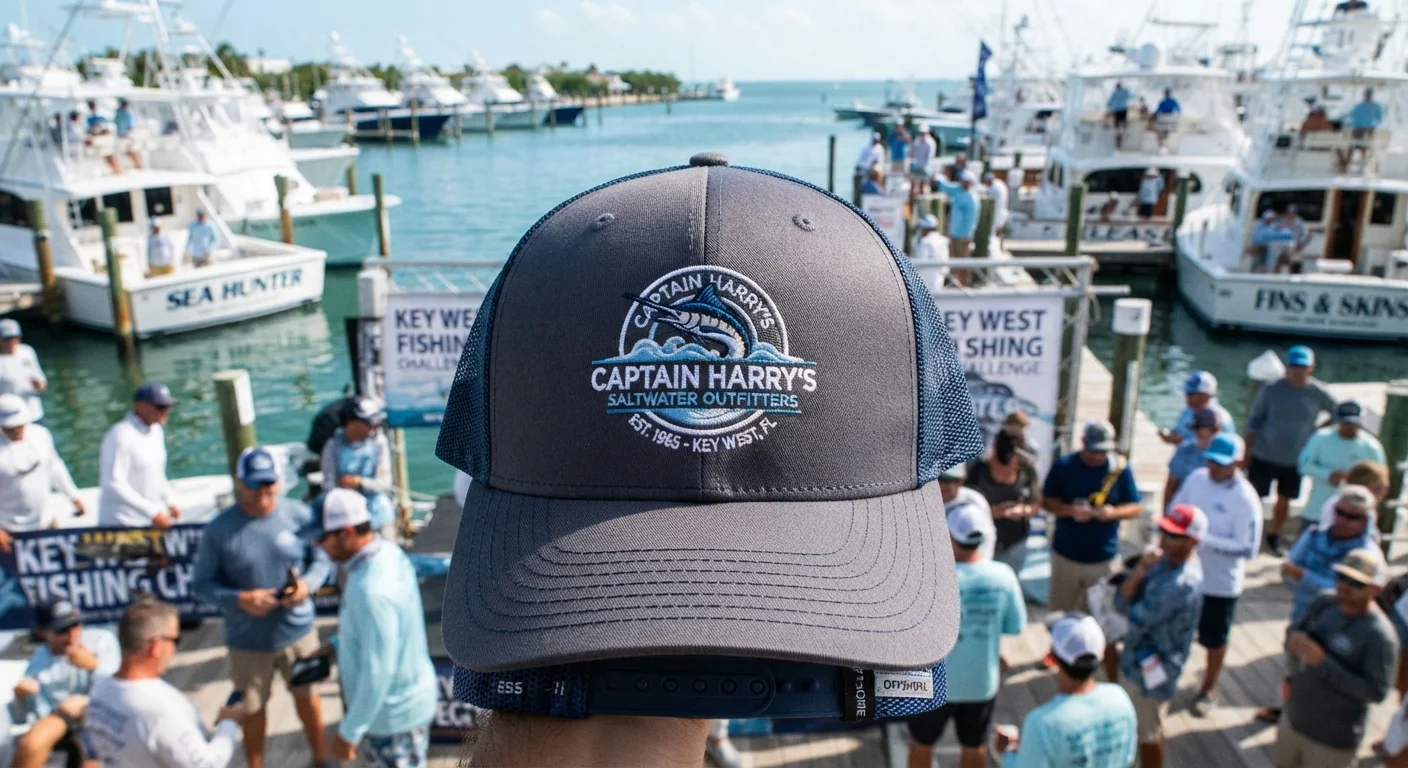
Walk into any fishing tournament weigh-in and count the mesh back hats. You’ll lose track fast. There’s a reason this style has become the default for charter crews and sponsored anglers.
The standard build is a structured 6-panel construction with a mid-profile crown, reinforced front panels, and a snapback closure. That structured front isn’t decorative. It holds shape for embroidery and printed logos without warping or sagging after months of saltwater exposure.
The polyester or nylon mesh back is what separates a functional fishing cap from a cotton dad hat. It pulls heat off the scalp and keeps airflow moving during 8-hour boat days, bass tournaments, or fly-fishing trips where sun exposure doesn’t let up. Pair that with a UV protection rating and quick-dry front panel material, and you’ve got a cap built for actual water time, not just merchandise tables.
Trucker caps almost always use a plastic snapback closure — adjustable, one-size-fits-most, covering roughly 54–61 cm head circumference. No velcro to gunk up with salt residue, no elastic to stretch out after a season of hard wear.
For brands, the flat front panel is prime real estate for full-color embroidery, patches, or screen-printed sponsor logos. That’s why guide services, tackle retailers, and tournament organizers default to this style for team gear and giveaways. It’s the one cap that balances cooling, adjustable fit, and branding surface without asking wearers to sacrifice comfort for logo visibility.
Bucket Hat (Fisherman Bucket Hat) — Full Coverage for All-Day Sun Exposure
Ears and necks don't get a second chance against sunburn. That's the entire case for the bucket hat.
A 3.9–4" brim is the benchmark you want here, not the 2–2.5" brim you see on casual bucket hats at the mall. That extra inch and a half translates to real coverage. Standard brims give you maybe 20–35% more shade than bare skin at midday, ears still exposed, neck still cooking. A proper fishing bucket hat with a wide brim plus a neck flap markets itself as "360° full sun coverage" for a reason — face, ears, and neck all shielded.
Material matters just as much as brim width. Look for waterproof or water-repellent polyester , UPF 50 rated, quick-dry. UPF 50+ blocks roughly 98% of UV rays, and the good performance lines keep that rating even when soaked. That matters if you're wading, kayak fishing, or working the flats for 6–10 hours straight.
For brands, front-center patches (roughly 2–3" wide, 1–1.5" high ) work best for embroidery. Side panels handle smaller woven labels when the crown's already busy with mesh venting.
This is the hat you spec for shore guides and flats trips, not boat cockpits where a wide brim just gets in the way.
Boonie Hat (Military-Style Wide Brim)
Over open water, a snapback won't stay on your head once the wind picks up. The boonie hat is built for that. It belongs in every offshore and surfcasting kit.
The 360° wide brim is 2.5–3 inches. You want at least 3 inches for sun protection. Unlike a floppy bucket hat, the boonie brim is stiff. That rigidity holds shade across your face and neck even when you're leaning into a cast or fighting a fish boatside.
An adjustable chin strap paired with a rear drawcord or cinch lock keeps the hat anchored through boat wake, gusty banks, and sharp head turns during a hookset. No trucker cap or bucket hat in this lineup has that retention. A few military-style variants swap in rust-proof side snaps instead of drawcords, trading a bit of security for faster on/off convenience.
Ventilation eyelets at the crown let heat escape, often backed by a moisture-wicking sweatband for humid, tropical conditions. Stick with lightweight polyester or nylon builds, quick-dry, ideally UPF-rated.
For branding, front-center embroidery is standard. Side labels work as a secondary placement when the crown eyelets take up visual space.
Snapback Closure Fishing Hat
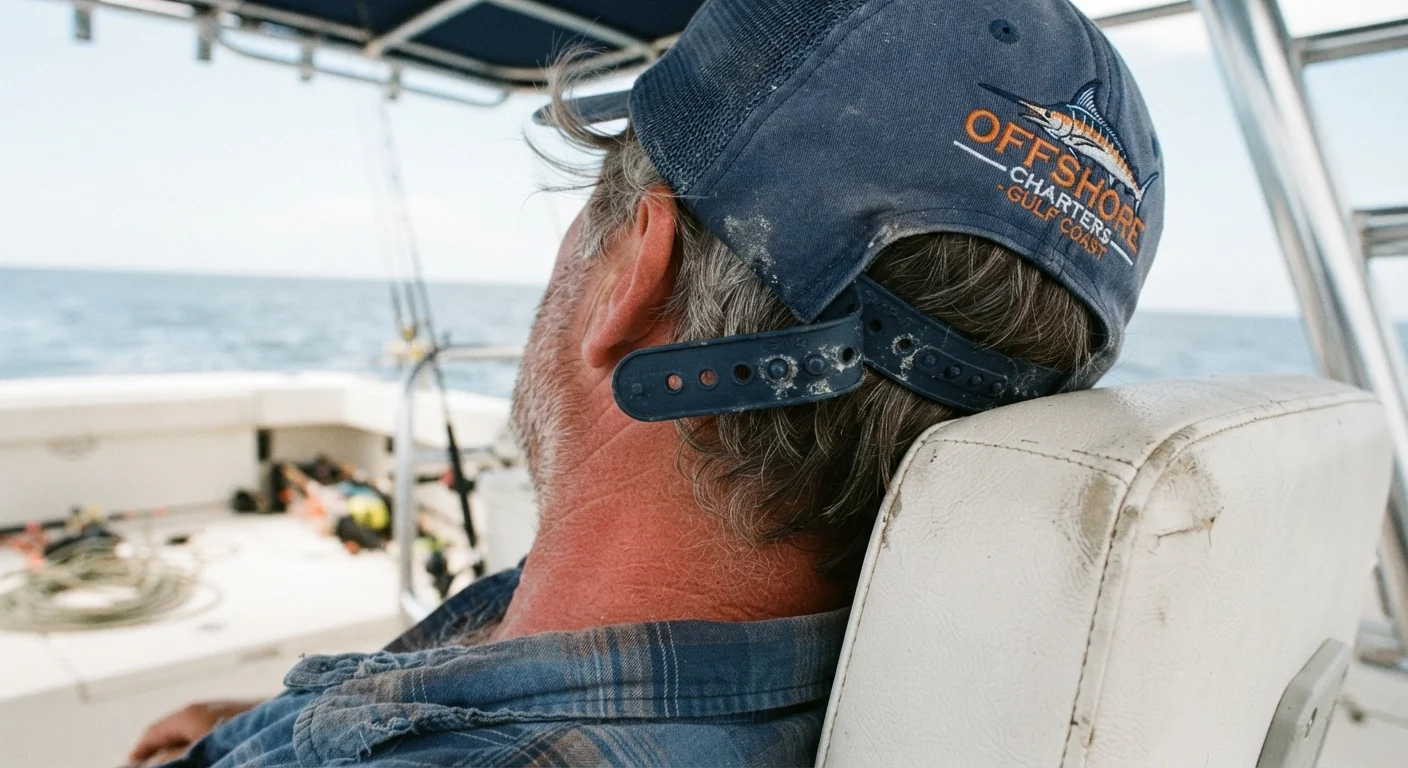
Six to eight snap positions is the industry standard for fishing snapbacks. That range—54 to 61 cm—covers most head sizes without stitching a size chart. But when a captain leans back against a boat seat or truck headrest, that hard plastic strip presses into the occipital area. Charter captains wearing hats 12+ hours a day feel it by hour three.
The fix is straightforward. Specify COMFORT SNAP™-style construction, where elastic is woven into the snap closure. It cuts the pressure points without losing the one-size-fits-most convenience. For coastal or high-sun orders, ask your custom fishing gear supplier for UV-stabilized plastic. Standard closure plastic goes brittle under sustained UV; stabilized versions don't.
Care is simple. Hand-wash only. Rinse salt off the closure after every trip. Skip the bleach. No hook-and-loop means no lint or hair jamming the mechanism—already a win over velcro closure hats.
Velcro Closure Fishing Hat
Velcro is the cheapest closure to manufacture and offers the widest fit range, but it's also the fastest way to blow through a promo budget on hats that won't survive a season of real use.
Most velcro fishing caps top out around a 7.5" head size, covering roughly 85–90% of heads in the 6¾–7½ range (about 54–60 cm circumference). The Smallmouth Bass Performance cap and Tirrinia's hunting/fishing model both hit that ceiling. Add an elastic loop to the strap, like Fishouflage's Freedom Mesh Cap does, and you gain another 1–2 cm of stretch. That's enough to fit mixed adult and teen groups at a youth derby without stocking multiple sizes.
The catch is durability. Hook-and-loop grabs everything, including monofilament, stray hook points, lint, and bait fibers. Orvis builds a front velcro patch into their trucker hat specifically to hold flies. That's proof of how aggressively the surface catches anything with a barb. That same grip works against you at the back of the hat. Industry rule of thumb puts velcro's noticeable adhesion loss around 500–1,000 open/close cycles, and salt, sand, and sunscreen push that number down fast in fishing conditions.
For branding, the strap itself is usable real estate. AFTCO embroiders its AFLAG logo directly onto the velcro tab. Pelagic prints its label the same way. You're working with a small zone, about 10–15 mm high and 30–50 mm long, but it's a free secondary placement most buyers overlook.
Velcro makes sense for short-season tournaments, corporate fishing events, youth derbies, and bulk giveaways where per-unit cost matters more than year-two performance. It doesn't work for daily guide uniforms or charter gear expected to survive multiple seasons without the strap losing grip or the back mesh catching every stray hook that swings past it.
Adjustable Strap (Nylon Strap + Tri-Glide Buckle) Fishing Cap
The cap uses a woven nylon strap sliding through a tri-glide buckle, with no snap teeth or hook-and-loop. That's the entire mechanism, and it's why guide services keep specifying it for uniform caps.
The strap threads through two parallel slots around a center bar. Pull it, and friction locks it in place. It provides continuous micro-adjustment across roughly 54–62 cm , without preset holes or gaps. Strap width runs 15–20 mm , sized to sit flat against the skull so it doesn't press a hard tab into your head when you lean back against a boat seat.
Buckle material depends on where you fish. POM plastic handles inshore and freshwater fine. Saltwater charter work needs stainless steel or corrosion-coated alloy, otherwise you get pitting and staining after a season of spray. Either way, nylon webbing itself resists corrosion and dries fast, with tensile strength up to 150 lb, far beyond what a fishing cap ever needs.
For branding, this closure reads cleaner than a snapback fishing hat. Buckles take a debossed or molded logo, and the strap itself can be color-matched to your crown fabric. It gives the cap a clean, intentional look on a charter crew.
Flexfit / Fitted Fishing Hat (No External Closure)
No snaps, no buckle, no strap. Flexfit's fitted caps use a polyurethane spandex sweatband woven straight into the crown. It creates even elastic tension around the whole head instead of pressure at one closure point. That's the actual Flexfit® Technology trademark, and it's why lifeguard teams and watersports staff use this closure style for anything involving running, turning, or boat movement.
Sizing runs S/M (7"–7¼") and L/XL (7⅜"–7⅝"), with no one-size-fits-most option. Bucket-style Flexfit fishing hats cover roughly 55–60 cm using the same internal band logic.
Skip this one for open-audience promo runs. It belongs on pro-staff and guide crews where you're capturing size data upfront. Structured buckram front panels hold embroidery registration cleaner than any soft unstructured fishing cap.
Embroidered Logos on Custom Fishing Hats vs. Printed Logos — Durability & Cost Comparison
One comparison test found embroidered polos surviving 100+ wash cycles while printed shirts started failing after roughly 10. That gap is the entire argument for embroidery on fishing hats, and it gets more pronounced once you factor in sun, sweat, and saltwater.
Embroidery works because the thread becomes structurally part of the fabric. It doesn't peel, crack, or rub off the way surface-level ink does. Screen printing sits on top of the fabric and starts showing cracks or fading after about 30–50 wash cycles — call it 6–12 months of heavy outdoor use before it looks tired. Embroidery holds its appearance past 100 washes, often outlasting the hat itself.
The cost-lifespan math:
Method | Initial Cost | Lifespan | Monthly Cost |
|---|---|---|---|
Cheap print | $12 | 4 months | $3.00 |
Premium print | $18 | 12 months | $1.50 |
Embroidery | $25 | 24 months | $1.04 |
Embroidery costs more upfront — digitizing runs $20–$80 depending on complexity — but wins on total cost of ownership for anything worn multiple seasons.
Thread matters too. Polyester embroidery thread rates "excellent" for UV and bleach resistance. Rayon looks premium but is built for indoor wear, not saltwater exposure. Stick with polyester for any embroidered fishing hat logo.
Stitch counts for cap logos typically run a few thousand up to 10–15k stitches. Fine detail and small text under 5–6mm height don't translate well to thread — enlarge text to around 1.5cm for clean legibility, or switch to print for photo-realistic or gradient designs.
Choose embroidery for guide crews, charter uniforms, and retail caps expected to survive multiple seasons. Pick printing for short-run tournament giveaways or complex full-color artwork where a 6–12 month lifespan is acceptable and volume pricing matters more than year-two appearance.
UV Protection Fishing Hat Materials — How to Evaluate UPF Ratings
A UPF 50+ label means less than 2% of UV rays get through the fabric. That's the number fishing hats suppliers should be quoting.
The rating scale:
UPF 15–24 : "good" — blocks ~93–96%
UPF 25–39 : "very good" — blocks ~96–97.4%
UPF 40–50 : "excellent" — blocks ~97.5–98%
UPF 50+ : "excellent/maximum" — blocks 98%+
Dermatology guidance sets UPF 30 as the floor. For all-day boat time, spec 50+.
Fabric choice drives the rating more than anything else. Nylon/poly blends hit UPF 50+ consistently, dry in 15–20 minutes, and hold up in saltwater. Waxed or untreated cotton caps out around UPF 15–25. Untreated cotton shirts can drop as low as UPF 5–10. Straw and bamboo land UPF 25–40 unless specifically lab-rated. Performance mesh tops out at UPF 30–45, and ordinary open mesh on trucker caps provides close to zero meaningful UPF — those large pores leave the back of the neck exposed regardless of what the crown claims.
Overall hat UPF is determined by the lowest-performing component. If your mesh back panel is unrated, your "UPF 50+" hat isn't actually UPF 50+ where it matters. Either drop the UPF claim or spec high-density, lab-rated mesh with small apertures.
Don't take a supplier's word for it. Ask for a lab report against AATCC 183 or AS/NZS 4399 , covering UV transmission across UVA and UVB, tested on crown, brim, and any mesh inserts separately.
Minimum Order Quantities (MOQ) & Customization Workflow for Custom Fishing Hats
MOQ numbers vary wildly depending on what "custom" actually means to your custom fishing apparel supplier. Get this wrong and you're either sitting on 500 units of a hat nobody wanted, or paying premium pricing for a run too small to matter.
MOQ by Customization Level
Blank cap + logo embroidery only: 50–100 pcs per style/color. Some branded programs set the floor at 144 pcs.
Semi-custom (color changes, trim swaps on an existing base): 100–200 pcs per style/color; suppliers with stocked fabric often accept 100.
Full custom (custom-dyed fabric, branded sweatband, custom closure): 100–300 pcs per design, climbing to 500+ once you introduce custom dyeing. Most factories treat 500 pcs as their efficient "mid-tier" run.
Specific benchmarks worth knowing:
- Sublimation/all-over print polyester hats: 20 pcs MOQ (cotton bumps to 50).
- Bucket hat blanks: Singmin and Goldmyk both sit at 100 pcs per color if fabric's in stock, 200 for non-stock. Sample runs possible at 12 pcs, at a markup.
- CrownsForge: 100 pcs standard, sampling from 1 piece.
- Alibaba verified suppliers: sample tier 50–100, small bulk 200–300, mid-tier 500, large volume 1,000–5,000+.
Lead Times
Embroidery on stocked blanks: 10–20 days for sample runs, 15–30 days at 500 pcs.
Full custom cut-and-sew of fishing hats: 30–45 days production , plus 7–30 days shipping depending on transit mode.
Cost Structure (Per Piece)
Item | Cost Range |
|---|---|
Blank hat base | $10–$40 landed |
Embroidery decoration | $1–$2 (light stitch), $2–$5 (10k+ stitches, 3D puff) |
Digitizing/setup fee | $30–$80 one-time per logo |
Packaging (polybag/box/tag) | $0.10–$0.50 |
Supplier Negotiation Templates
Use these verbatim in your first fishing gear supplier email:
"Please quote your per-unit embroidery rate for a 6-panel structured trucker fishing cap, front logo approximately 10,000 stitches, using your standard UV-stabilized plastic snapback. Include digitizing setup fee, color-change surcharge, and MOQ per style and per colorway."
"We plan an initial order of 500 units as Phase 1, with a roadmap to 1,000+ units if quality and sell-through meet targets. Confirm standard MOQ per design and color, whether we can split across two colorways (e.g., 300/200) at the same price, and your landed cost at 100, 300, and 500 pieces."
Pitfalls That Trigger Costly Rework
Skipping the physical sample. A digital mockup isn't enough. Insist on a stitched sample using final fabric and thread before committing to bulk — this alone prevents the reorder that erases your 20% cost savings.
Assuming MOQ is per design, not per colorway. Ask directly: does splitting into two colors require 50/50, or a minimum of 30 pcs per color?
Ignoring hardware corrosion. Specify saltwater-resistant or stainless-steel snaps and UV-stabilized plastic upfront, not after the first field failure.
Jumping straight to 500+ units. That's Alibaba's own mid-tier threshold for inventory risk. Test at 50–100 pcs first, gather feedback on fit and breathability, then scale.
Missing embellishment-location minimums. Some decorators charge per location — 12 hats for one logo spot, 24 for two. Confirm this before adding a side patch to your front-embroidered design.
Conclusion
The wrong closure choice won't show up until hat number 47 slips off mid-cast on a windy charter trip. That's why getting custom fishing hats styles closures right upfront—snapback for quick-swap crews, velcro for solo anglers who need one-hand adjustment, elastic strap for all-day comfort—saves you from a costly reorder down the line.
The same logic applies to branding. Embroidery costs more per unit but survives five seasons of saltwater and sun; printed logos fade faster but work for short-run promotional runs. Match the technique to your hat's actual lifespan, not just your budget line.
Before you request a quote, lock in your closure type, UPF-rated fabric, and logo method. Then ask your supplier for sample swatches and MOQ tiers based on those specs—not their standard catalog.