You've got twenty anglers, one shared Venmo group, and a sponsor who just asked why their logo looks like an afterthought on last year's jerseys. Sound familiar?
Ordering custom a whole tournament fishing team jerseys isn't like buying a birthday gift online. It’s part logistics puzzle, part design negotiation, part fabric science experiment—especially when your "office" is a boat deck under six hours of direct sun.
This guide skips the marketing fluff and gets straight to the mechanics: how to collect sizes without twelve confusing text threads, where sponsor logos belong on a sublimated fishing jersey, and which fabrics survive bait, sweat, and saltwater without falling apart by week three.
Bring your team roster. By the end, you'll have a checklist ready for your supplier call—not just inspiration.
Understanding the Team Budget & MOQ Landscape
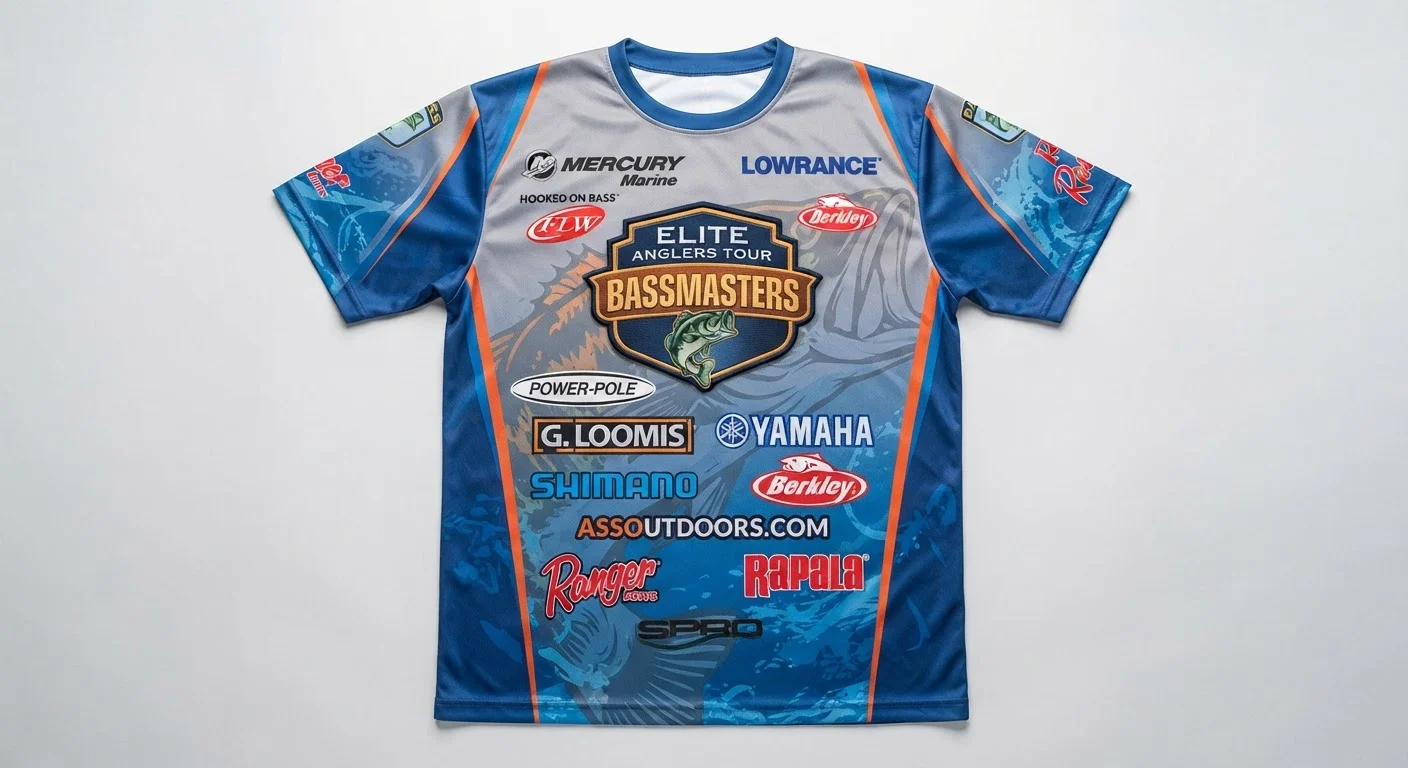
MOQ means the minimum units a Tournament Fishing Jersey supplier will produce in one run. Setup costs, screen prep, and sublimation runs aren't free just because your order is small. Suppliers aren't being difficult — they're covering their own margins.
The formula that matters: Min Order Spend = Unit Price × MOQ. That number makes or breaks your team's plan.
Real numbers, real stakes:
Supplier A quotes $5/jersey at a 1,000-unit MOQ → $5,000 minimum spend
Supplier B quotes $7/jersey at a 300-unit MOQ → $2,100 minimum spend
If your team budget caps at $3,000, Supplier A is dead on arrival, even though the per-unit price looks better on paper. Supplier B wins, despite costing 40% more per jersey, because it fits inside your budget. Lower price doesn't matter if the MOQ locks up cash you don't have.
The Hidden Cost: Excess Inventory
Say your club needs 220 jerseys this season, but your bulk order fishing jerseys supplier enforces a 500-unit MOQ. You're forced to round up — 500 units ordered, 280 sitting unused. That's 127% over demand, and at $10/unit, roughly $2,800 of your budget is tied up in jerseys nobody's wearing.
Your budget feasibility checklist, before you sign anything:
Does Min Order Spend fit inside your total event budget?
Is any single Tournament Fishing Jersey supplier eating more than 30-40% of your project budget?
Is leftover inventory under 15-20% of what you'll use?
Two or more "no" answers? Time to negotiate a lower MOQ, switch suppliers, or pool orders with another fishing club uniform program to split the minimum together. Team aggregation is the move most captains overlook, and it's often the fastest way to unlock better per-unit pricing without blowing the budget.
Team Size & Sizing Collection: A Repeatable SOP
Twelve text threads asking "wait, are you a Large or an XL?" is how sizing chaos starts. Fix it with one form, not twelve conversations.
Build a single shared spreadsheet. Google Sheets works fine. One row per angler. Each row needs: name, jersey size, cut preference (unisex vs. women's fit), sponsor acknowledgment (yes/no if they're wearing a logo variant), and a deadline column that actually gets enforced.
Attach a size chart before you collect a single response. Sublimated fishing jerseys run differently than cotton tees. A guy who wears a Large in cotton might need a Medium in moisture wicking fishing shirt fabric because it's cut athletic, not boxy. Skip the chart, and you'll reorder half your team's jerseys in three weeks.
Here's the size distribution most 20-person fishing clubs actually see:
Small : 2 people (10%)
Medium : 4 people (20%)
Large : 7 people (35%)
XL : 5 people (25%)
2XL+ : 2 people (10%)
Use that as a rough planning benchmark, not gospel. Every roster skews differently.
Add a confirmation question before the form locks: "Confirm your size selection, Y/N." This one line kills 90% of the "I meant to pick Large" emails that show up after production starts.
Test it before you trust it. Hand the form to one teammate who wasn't involved in building it. Watch where they get stuck. Fix that spot. Then send it to the full roster.
Store the finished sheet in one shared folder, team Drive or group chat pin, wherever everyone already looks. Set a deadline hard enough that late sizes don't reopen the whole order.
Designing the Tournament Layout: Logo Placement & Sponsor Management
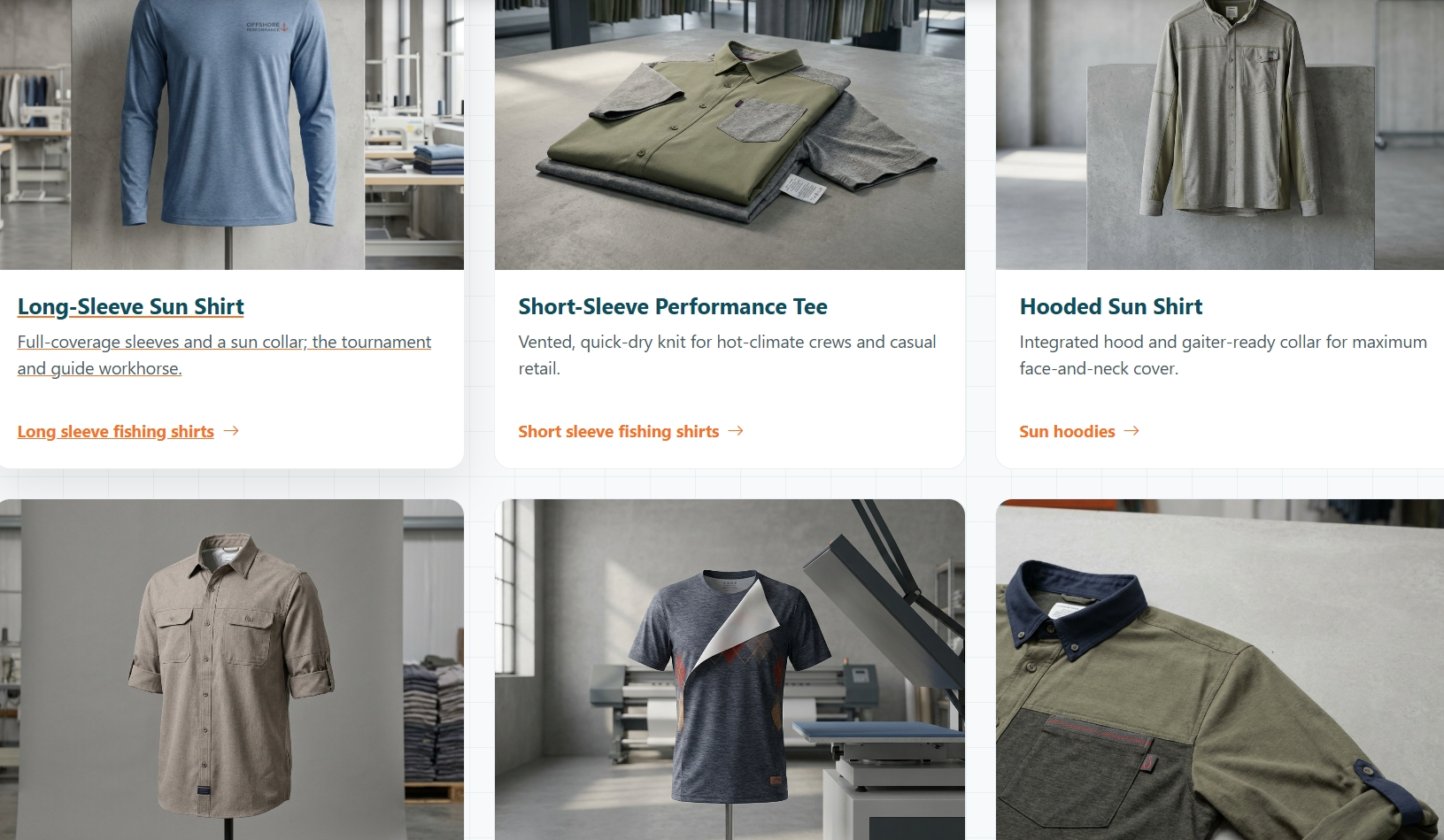
Your sponsor didn't write a check so their logo could hide near the hem. They paid for visibility. Give them real estate that earns it, and you'll have their check again next season.
Jersey space is a hierarchy, not a free-for-all. Get the layout wrong, and you'll spend more time smoothing sponsor egos than fishing.
Front Chest: Prime Real Estate
The front chest is your most valuable square inch of fabric. A main sponsor logo placed in the top third of a jersey captures up to 80% of viewer attention . That's why your title sponsor goes here, not your bait shop's cousin's logo.
Standard placement for a custom fishing shirt printing job:
Title sponsor (center chest) : 3–4" wide, positioned just below the team crest or collar
Custom Tournament Fishing Jersey Manufacturer logo (right chest) : max 2.33" wide, centered between collar and side seam
Team crest or secondary logo (left chest) : 3–4" wide, 7–9" down from collar
Shoulders & Sleeves: Where Co-Sponsors Live
Not every sponsor gets front-chest treatment. Communicate the tiers upfront and shoulder space works fine for co-sponsors: 2.5–3.5" wide logos on the upper shoulder seam.
Sleeves handle stacking. Cap it at three logos per sleeve , each 1.5–2.5" high. Beyond that, sleeves look cluttered, unreadable, and a little desperate.
Back Panel: The Second Stage
The upper back can hold a large team ID or main back sponsor, 3–4" wide and about 1" down from the collar. Lower back logos should stay smaller at 2.5–3.5" wide, with at least 0.5" of clearance from names or numbers so nothing overlaps when the sublimated fishing jersey is printed.
Spacing Rules That Prevent Visual Chaos
Leave 0.5–1" of clear space between every logo zone: chest, shoulders, sleeves, back. Skip this, and your $200 sponsor package looks like a ransom note. Group sponsors by tier (Title, Supporting, In-Kind) and keep each tier's sizing consistent. Mixing a 4" logo next to a 1" logo in the same row signals disorganization, and sponsors notice even if they don't say it.
Before final approval, ask your printer for a proof with all logos placed at true scale. Not a mockup and not a sketch, but the actual sizing. This is the moment you catch spacing problems, before 20 fishing team logo designs go into production and someone's name gets clipped by a sponsor block nobody measured properly.
Fabric Showdown: Best Materials for Long-Day Sun & Water Exposure
A wet white cotton tee blocks less than 60% of UV rays. Think about that when you're six hours into a tournament with zero shade on the water.
Dry, a lightweight 100% cotton tee sits around UPF 7. Get it wet — sweat, splashback, a fish flopping against your chest — and that rating drops to UPF 3. A tightly woven polyester shirt holds steady at UPF 40-50+ whether it's bone dry or soaked through. Same sun, wildly different protection.
Why Sublimated Polyester Wins on the Water
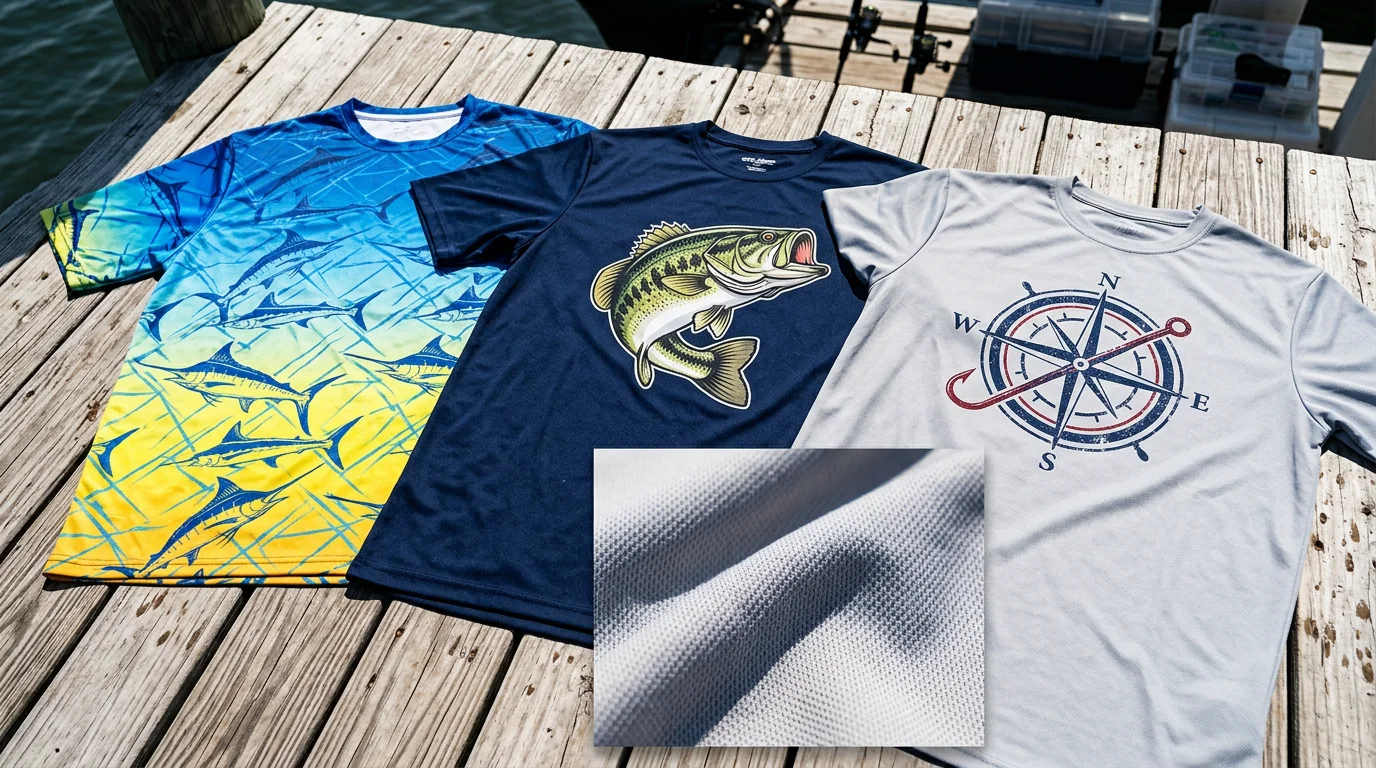
A sublimated fishing jersey uses tightly woven polyester, and that construction is exactly why it beats a screen-printed cotton alternative. Tight weave means fewer gaps for UV to sneak through. Polyester is hydrophobic — it doesn't absorb water the way cotton does, so it dries fast and keeps its UPF rating close to what's on the tag, even after hour four on the deck.
Nylon is the closer competitor here. It's abrasion-resistant and holds a similar UPF 30-50+ range in tight-knit builds, which matters if your team is hopping in and out of boats or dragging sleeves across gear. It absorbs slightly more water than polyester, but still dries faster than cotton by a wide margin.
What to Actually Order
For a moisture wicking fishing shirt built for full-day sun and water exposure, look for:
UPF 40 minimum, 50+ preferred for torso and shoulders
Polyester or nylon, tightly woven with no visible pinholes
Darker or saturated colors — they absorb more UV than pale pastels
Loose, non-stretched fit — stretching fabric over skin widens the weave gaps and drops the UPF
Skip thin white cotton entirely. Even doubled up, it rarely clears UPF 15-20, and water tanks that number further.
The Team Ordering "Ready-to-Execute" Checklist (Template)
Print this. Pin it. Skip the fancy project-management jargon. This is the one-page checklist your team captain actually needs before calling a supplier.
Copy this into a shared doc. Check boxes as you go. Don't skip to "order now" until every row is checked.
# | Task | Owner | Due | Status |
|---|---|---|---|---|
1 | Roster finalized, sizes collected via shared sheet | Captain | ☐ | |
2 | Budget confirmed, MOQ math checked against supplier quote | Treasurer | ☐ | |
3 | Sponsor logos received in vector format (AI/EPS, not JPEG) | Sponsor liaison | ☐ | |
4 | Logo placement approved: chest, shoulder, sleeve, back | Design lead | ☐ | |
5 | Fabric selected — polyester or nylon, UPF 40+ confirmed | Captain | ☐ | |
6 | Proof mockup reviewed at true scale, not thumbnail | Design lead | ☐ | |
7 | Sponsor sign-off on final proof | Sponsor liaison | ☐ | |
8 | Payment terms and deposit confirmed | Treasurer | ☐ | |
9 | Delivery deadline set, buffer week built in for tournament date | Captain | ☐ | |
10 | Backup contact at supplier saved for order issues | Captain | ☐ |
Before you hit "confirm order," ask three questions:
Does every size on the roster match a size on the sheet — no blanks, no guesses?
Are all sponsor logos placed where the contract promised, at the size the contract promised?
Is the fabric rated for six-plus hours of sun and water, not just "athletic wear" in general?
Two "no" answers mean you're not ready. Fix those before the supplier call, not after the invoice.
fishingapparelfactory.com — B2B Custom Tournament Jersey Manufacturer
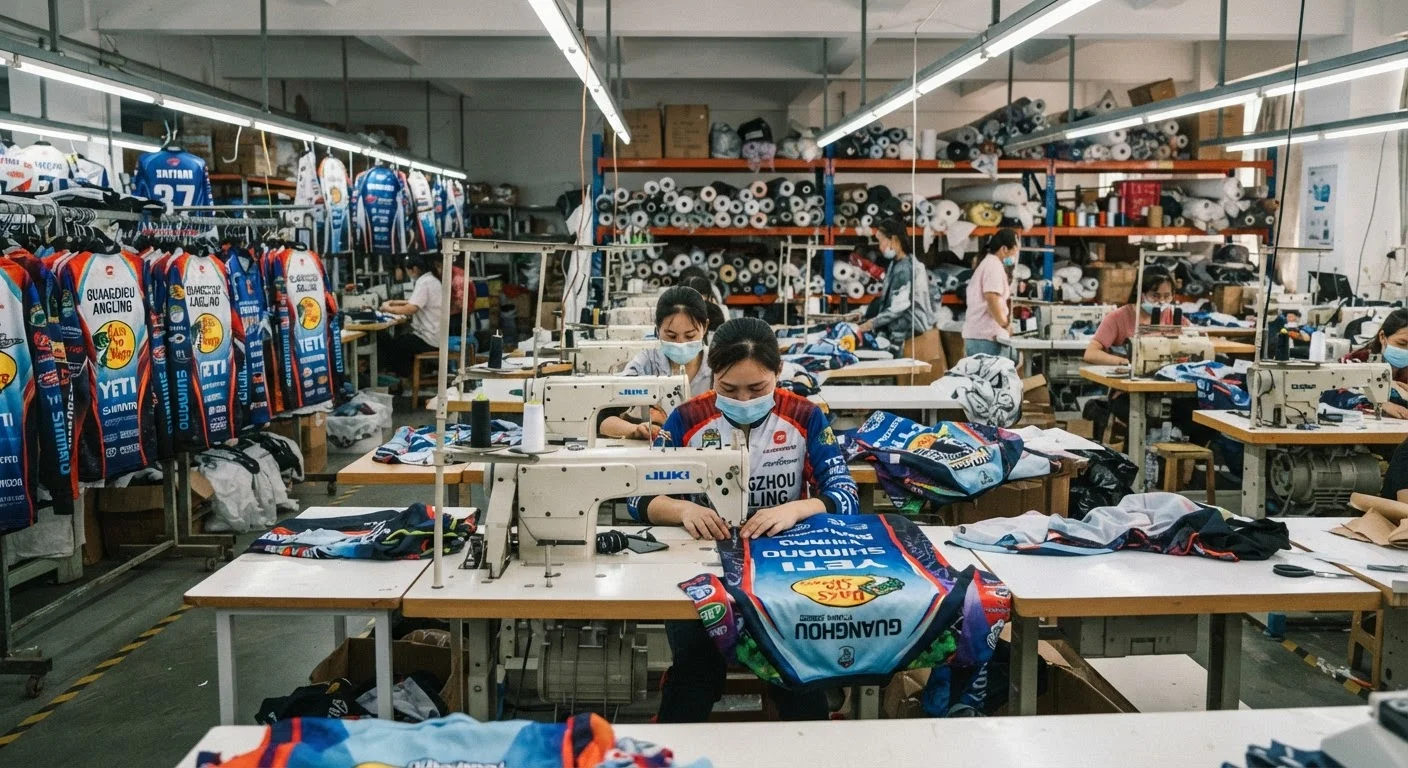
Somewhere in Guangzhou, a fishing apparel factory called Runfish Apparel spends its days doing one thing: building tournament jerseys for teams too small for the big factories to bother with, and too serious to settle for a screen-printed t-shirt.
That's the whole pitch behind fishingapparelfactory.com. No 1,000-unit MOQ wall. No six-week minimum before you even see a sample.
The numbers that matter:
MOQ starts at 50–100 pieces per design, a real number for a 20-person club
Tournament-grade sublimation jerseys run $11–$15 per piece
Fabric is 145–160 GSM polyester, UPF 50+ certified on saltwater lines
Samples land in 7–10 business days; bulk production takes 10–14 days after approval
Ships FOB, CIF, or DDP to 30+ countries
They answer inquiries within 24 hours. Reach them at [email protected] or WhatsApp +86 177 0272 7677. That's the shortcut for a captain trying to move from spreadsheet to supplier call.
Conclusion
Your team needs you showing up with a plan. That means no more spreadsheet headaches or jerseys that peel after one humid tournament weekend.
You now have one. You know how to collect sizes without twelve follow-up texts, how to give your sponsor's logo the real estate it deserves without crowding your team's identity, and why sublimated fishing jersey construction beats a cheap screen-print every single time water's involved.
The whole game with bulk order fishing jerseys is to nail the prep work, and then the ordering part practically handles itself.
So pull out that checklist. Fill in your numbers. Then send it to a Tournament Fishing Jersey manufacturer who builds fishing gear, not one that slaps a logo on a generic tee and calls it a day.