Your samples came back perfect. Then your supplier says bulk production will take "about 6 weeks"—and you're left wondering if that's a real number or a placeholder to keep you calm.
Most lead time quotes in custom fishing apparel are vague on purpose. Vague is easier to blow past when fabric sourcing gets delayed or sublimation printing queues back up during peak season.
This breakdown fixes that. You get the actual day-by-day range for every stage—sample development, fabric confirmation, bulk production schedule, quality control, shipping—mapped against a real 500-piece order. Then we cover the five variables that stretch your timeline, and three questions that tell you whether a supplier's promised delivery date is realistic or just optimistic guesswork.
Stage-by-Stage Lead Time Breakdown, from Sample Request to Bulk Shipment
Here's what the industry delivers, stage by stage, based on real production benchmarks.
Sample Development: 3–21 Days (First Sample), 3–6 Weeks Total
Your first proto or fit sample typically takes 3–21 business days. Custom tooling, exact color matching, and branding elements (embroidered logos, custom sublimation patterns) push you toward the upper end of that range.
If you're working with a custom fishing jersey manufacturer on a fully personalized design, expect 10–14 days for the first fit sample with development work. Revisions add another 7–10 days per round.
Most custom fishing apparel orders need 3–6 weeks total for the full sample stage (proto, fit, and pre-production sample rounds) before you've approved anything for bulk.
Fabric Confirmation and Pre-Production Sample: 14–35 Days
Once you approve your tech pack, getting to an approved pre-production sample (PPS) takes 14–35 calendar days. Fabric sourcing lead time becomes critical here: if your supplier needs to order specialty moisture-wicking or UV-protective fabric from a mill, this stage stretches. Stock fabric on hand shortens it significantly.
Sample Approval to Bulk Production Start: 1–7 Days
Once you approve your sample and pay deposit, production setup takes 1–7 days. Suppliers use this window to calculate fabric consumption and confirm material availability, typically 5–10 days for larger orders.
Bulk Production Run: 2–6 Weeks (Standard 30–60 Days)
This is where MOQ fishing apparel orders separate into tiers. For a 500-piece order, cutting takes 1–2 days, sewing 7–14 days, sublimation printing adds 3–7 days depending on design complexity and color count, finishing 2–3 days, quality control inspection 1–2 days, and packing 1–2 days.
Standard apparel bulk production runs 30–60 days post-approval. Some private label fishing wear factories quote up to 90 days during peak season (spring/early summer fishing gear demand) or for complex OEM ODM fishing clothing projects with multiple print zones.
Shipping and Logistics: 3–10 Days (Air) vs. 20–40 Days (Sea)
Air freight takes 3–10 days transit. Sea freight takes 20–40 days depending on lane and customs clearance. For a 500-piece order, sea freight wins on cost because air freight adds up fast per unit at that volume.
The Full Picture: Approved Sample to Shipped Bulk Order
From approved pre-production sample to shipped goods, expect 6–16 weeks for standard woven or knit fishing apparel. Fast-track scenarios (stock fabric, simple design, established factory relationship) can hit 8–10 weeks. Complex custom builds with printing revisions push into 18–24 weeks territory.
From Order to Delivery: The Real Timeline of a 500-Piece Custom Fishing Shirt Order
Let's put real numbers on paper. A 500-piece order sits comfortably above most MOQ thresholds — fishing shirt manufacturers usually set minimums at 20 pieces, sublimation-heavy programs at 50–100 pieces, and some OEM ODM fishing apparel factories at 100 pieces per design or color. At 500 units, you're running a standard bulk order, which means your factory should have a repeatable, quotable process, not a guess.
Here's what that process looks like day by day.
Day 1–2: Quote and artwork confirmation. Reputable custom fishing jersey manufacturers turn this around in 1–2 business days once you send final art files and specs.
Day 3–7: Tech pack and design review. Expect 2–5 business days here as the factory maps out fabric, seam construction, and print placement before cutting any sample fabric.
Day 8–17: Sample making. Budget 5–10 business days for a physical sample. If you need revisions, add another 5–15 days for the full approval cycle — this is where most projects either stay on schedule or start slipping.
Day 18–22: Sample shipping. If you're overseas, DHL or FedEx delivers your sample in 3–5 days.
Day 23–52: Bulk production. This is the biggest chunk of your timeline. First bulk runs for a 500-piece order usually land in the 20–30 day range, though some factories quote 25–35 days after sample approval, especially if sublimation printing or multi-panel construction is involved.
Day 53–57: Quality control and packing. Usually folded into the tail end of production, but plan for 2–5 days if your inspection happens as a separate step.
Day 58–60+: Shipping. Domestic transit adds 1–3 days. International transit depends on whether you're shipping FOB, CIF, or DDP, and whether you're flying or sailing the order.
Total realistic window: 35–60 days from sample approval to delivery. That's the most defensible core estimate for a 500-piece custom fishing shirt run, and it lines up with broader custom apparel benchmarks — 8–12 weeks domestic, 12–18 weeks international, from first prototype to shipped goods when you're dealing with fully custom cut-and-sew and non-stock materials.
If a supplier quotes you 2–3 weeks total for this exact scope, ask why. That number only makes sense for a fast-track program running on stock fabric and pre-approved blanks, not a from-scratch 500-piece custom build.
Five Variables That Stretch or Shrink Your Lead Time
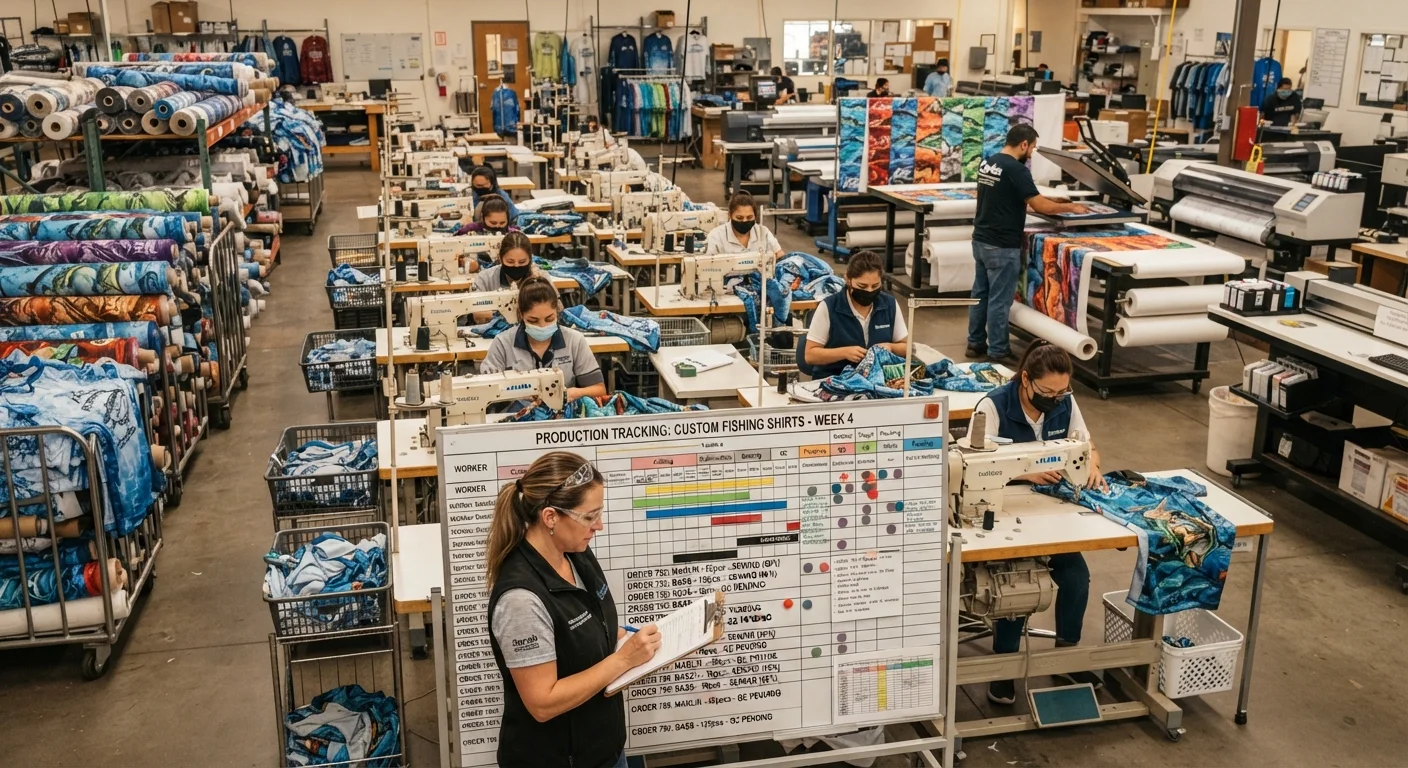
Every lead time quote is really just five variables stacked together. Get one wrong, and your delivery date doesn't slip by a few days — it slips by weeks. Here's what actually moves the number.
1. Order Volume Relative to MOQ
Lead time scales with lot size. A 200-piece order and a 2,000-piece order don't just take different total time — they take different time per unit. Most factories have a fixed setup cost (cutting tables, sublimation press calibration, sewing line changeover) plus a variable run rate per piece. Push past your custom fishing jersey manufacturer's comfortable capacity, and you're not just adding units. You're adding queue time behind other clients' orders.
2. Fabric Sourcing: Stocked vs. Ordered
This is the single biggest swing factor. If your fabric is sitting in the mill's warehouse, sourcing lead time is close to zero. If it needs custom dyeing, moisture-wicking treatment, or a minimum mill run, you're looking at 2–4 extra weeks before cutting even starts. Ask your supplier directly: is this fabric stocked, or ordered on your behalf?
3. Print and Design Complexity
Sublimation printing turnaround depends on color count and panel layout. A simple two-color chest logo prints fast. A full all-over sublimation design with multiple panels and precise color matching adds days to setup and can trigger rework if registration is off — and rework loops are where quoted timelines quietly blow past.
4. Factory Load and Peak Season Capacity
Capacity isn't static. Spring and early summer — peak fishing gear demand — mean your 500-piece order competes with everyone else's. The same factory that quotes 30 days in the off-season may quote 60–90 days in April. Ask what season your production slot falls in before you trust the number.
5. Quality Control and Inspection Process
A rushed QC process saves days upfront and costs weeks on the back end if defects surface after shipping. Factories that build in proper AQL inspection add 2–5 days — but they catch problems before your 500 units are already on a boat.
Stack these five variables against any quote you get, whether it's for private label fishing wear or a full OEM ODM fishing clothing program. If a supplier can't explain how each one applies to your order, the number they gave you isn't a real timeline. It's a placeholder.
Three Questions to Ask a Supplier Before You Trust Their Quoted Lead Time
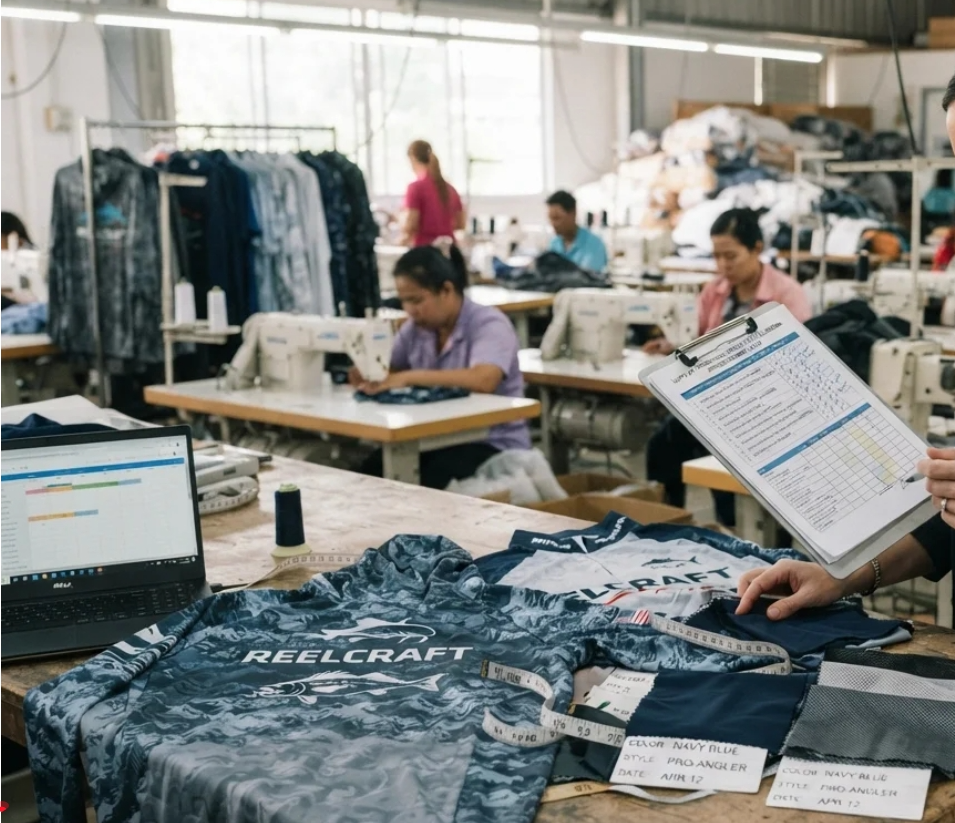
A quoted number means nothing without proof. Ask these three questions to get that proof.
Question 1: What is your current production queue, and where does my order sit in it?
If your supplier can't tell you their active queue position, their work-in-progress load, or their booked capacity, you're getting a rough estimate. Push for the queue status plus the exact trigger that releases your slot. No answer here means no real schedule exists yet.
Question 2: When is my production slot actually reserved, and what causes it to be released or delayed?
Ask for the reservation rule. Ask for the cutoff date on PO acceptance. Ask whether materials, deposit payment, or final artwork approval have to clear before the clock even starts ticking.
Question 3: What happened with your last three late orders, and what caused the delay?
This forces honesty. A supplier who can walk you through specific late orders — was it capacity, raw materials, a QC hold, freight, or internal planning failure — is credible.
How to Score the Answers
Two benchmarks turn these answers into a real decision:
On-time delivery (OTD) rate : (on-time deliveries ÷ total deliveries) × 100. Anything at or above 95% signals reliable performance.
Lead-time consistency : ask for actual PO-to-receipt data from their last 20–30 completed orders. Calculate the coefficient of variation. Under 10% means highly consistent. 10–25% is moderate. 25–50% signals real risk. Over 50% means the quote is unreliable.
Get the queue position, the reservation rule, and the late-order history in writing. That's your evidence package before you sign.
Conclusion
The number on a fishing apparel supplier's quote sheet means nothing until you understand what's behind it. Sample development takes 7-15 days, and fabric sourcing, sublimation printing, and quality control inspection each carry their own risk of delay. Peak season can add weeks to any bulk production schedule.
What matters is knowing which five variables to interrogate and which three questions expose a supplier who's guessing versus one who has actually planned your order. Use that framework on your next quote call. Ask about current factory capacity. Ask what happens if fabric approval slips. And ask for a stage-by-stage breakdown, not just a final date.
Suppliers who answer confidently, with specifics, are the ones worth building a long-term partnership with. The ones who can't are telling you something too.