A blank neck gaiter costs $0.90. Put your logo and UPF 50+ fabric certification on it, and it sells for $18-24 at retail. Your customer was already buying sun protection from someone. The only question is whether that margin lands in your P&L or your competitor's.
This is a sourcing breakdown for brands already selling rods, reels, or fishing apparel. You need a real answer on whether neck gaiters and sun masks justify the inventory spend. We cover exact per-unit costs across MOQ tiers, three supplier channels that work for custom print orders of fishing apparel, and how four fishing brands turned this add-on into a 40-65% margin line without diluting their core product positioning.
Cost Breakdown: What You'll Pay Per Unit From $0.50 to $3.00
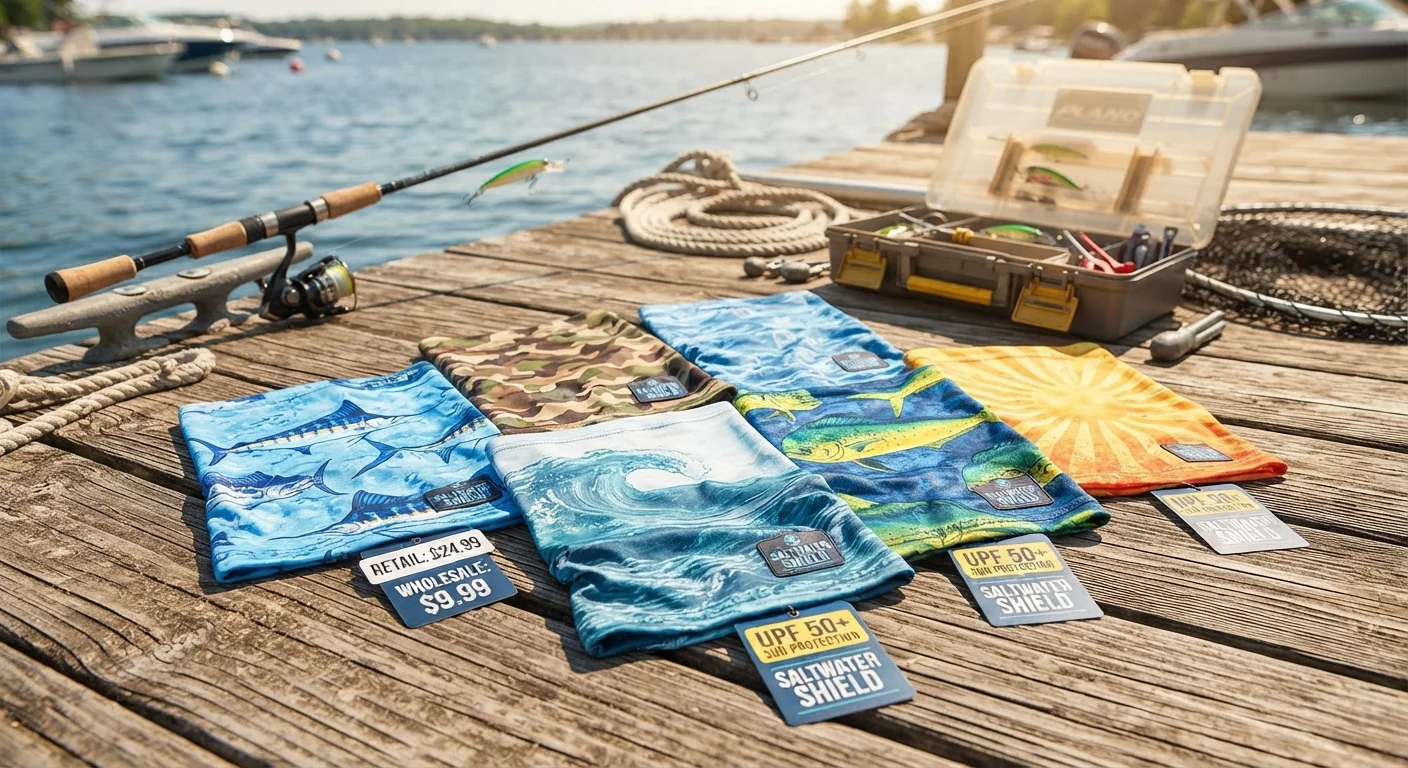
Every dollar here is negotiable. The range is built from real supplier quotes stacked component by component.
Base fabric cost by MOQ tier (UPF 50+ moisture wicking blend, undyed):
500 units : $1.20–$1.50 per unit
1,000 units : $0.85–$1.10 per unit
2,000+ units : $0.55–$0.85 per unit
Custom sublimation printing of fishing apparel (full bleed, angler-specific camo or brand logo) adds $0.30–$0.90 per unit , and the screen/setup fee gets cheaper per unit as volume climbs.
Trims, Labels & Packaging
A budget trims set for a branded neck gaiter runs:
Woven brand label: $0.10–$0.20
Care/content label: $0.05–$0.10
Hangtag + string: $0.15–$0.25
Total: $0.50–$0.90 per unit . Go premium with foil hangtag, secondary patch, or custom hardware, and you're at $2.00–$3.00 per unit .
Packaging follows the same split. A basic poly bag with a branded sticker lands at $0.40–$0.85 per unit . An elevated unboxing experience (tissue, printed mailer box) pushes that to $1.50–$3.00 per unit .
Shipping, QC & Fulfillment
QC inspection : $0.25–$1.00 per unit
Domestic shipping + duties : $0.50–$2.00 per unit
Fulfillment pick fee : $0.50–$1.50 per unit (single-SKU)
Two Realistic Stacks
Lean DTC stack : fabric/print $1.20 + trims $0.70 + packaging $0.55 + pick fee $0.60 + shipping $0.80 = $3.85 landed
Retail-ready stack : fabric/print $2.20 + trims $1.80 + packaging $1.70 + pick fee $1.00 + shipping $1.40 = $8.10 landed
Both leave healthy room against an $18–$24 shelf price.
MOQ & Payment Terms: Negotiation Leverage When You Order 500–3000 Units
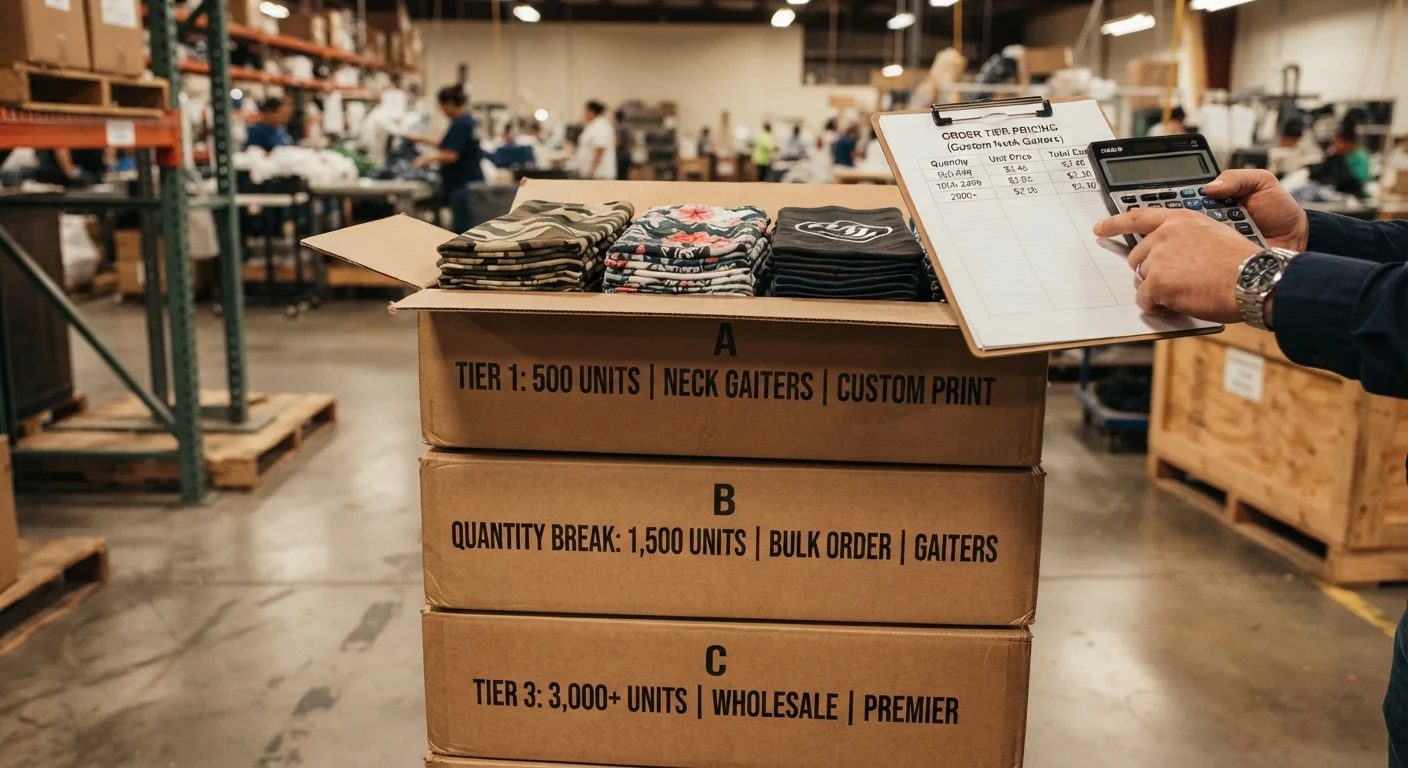
Factory MOQ quotes aren't fixed. At 500–2,000 units, you're in the medium MOQ band on Alibaba's 2026 sourcing structure: low is under 500, high is over 2,000. That middle band is exactly where bulk order neck gaiters get negotiated.
Ask for a tiered quote — 500, 1,500, 3,000 units. That single request forces them to reveal their actual cost cliffs.
A typical spread looks like this:
3,000 units @ $1.00
1,500 units @ $1.12–$1.20 (+12–20%)
500 units @ $1.25–$1.35 (+25–35%)
You're paying a premium to stay small. That premium is your entry fee into testing this fishing apparel add-on product line before you commit real capital.
Payment terms are your second lever. Standard is 30% deposit, 70% before shipment. Offer 50–100% upfront, and factories with thin working capital will drop MOQ requirements to earn that cash flow speed. Trial orders of 100–500 units get accepted roughly 70%+ of the time when you pair them with a written reorder commitment — say, full MOQ within 60–90 days.
If you want real volume security without locking up cash, structure a blanket purchase order: commit to 5,000 units over 12 months, released in 500–1,000 unit shipments. Negotiate MOQ first. Price and payment terms follow.
Supplier Sourcing: Three Channels for Fishing Neck Gaiter Wholesale & Custom Manufacturing
Three Fishing Neck Gaiter supplier types cover 90% of what fishing brands need here. Pick based on how much customization you want and how fast you need product in hand.
Channel 1: Direct OEM/ODM Fishing Apparel Factories
These are full-category fishing apparel factories that produce neck gaiters and sun masks. One Guangzhou factory typical of this channel starts MOQ at 50 pcs, while most suppliers want 500+. Samples take 7 days and bulk ships 15–20 days after approval. They stock 200+ performance fabrics, against the industry average of 20–30. You also get 3-stage in-house QC and ISO, OEKO-TEX, and BSCI certifications. Another factory type in this channel focuses on fishing only and offers four modes: OEM (your tech pack), ODM (their existing patterns, customized), private label (MOQ from 100 pcs), and tiered wholesale. Use this channel if you're building a real product line.
Channel 2: Specialized Neck Gaiter Manufacturers
These factories only make tubular fabric goods: gaiters, headbands, arm sleeves. Pricing starts around $1.50/pc with your logo printed and custom fishing clothing and Neck Gaiter background color. Some run dedicated seamless tube weaving machines, which matters for stretch and fit around the face. Others specialize in sublimation and offer free digital mock-ups within 24 hours. That works for camo patterns, fish-species graphics, or sponsor logos that need full-bleed printing.
Channel 3: Wholesale & Stock Distributors
Stock inventory, no MOQs, no development work. Blank seamless gaiters run $0.38–$0.40/pc at 100–200 units, dropping fast with volume. Use this channel to benchmark cost before you negotiate with a factory, or to test demand with zero minimum orders before committing to custom.
Procurement checklist : monthly production capacity, AATCC 61/16 colorfastness (minimum Grade 4), OEKO-TEX Standard 100, GRS if marketing sustainability, and BSCI audit status.
Profit Margin Analysis: How 4 Real Fishing Brands Use Neck Gaiters to Boost Gross Margin
The fishing neck gaiter market sits at $0.4 billion in 2025 and is projected to hit $0.7 billion by 2034, growing at a 6.2% CAGR. The real value of that growth curve is stacking a 75-80% margin accessory on top of a tackle business that clears 30-40%. Four fishing brands show how this works.
Buff CoolNet UV retails around $19 with COGS near $5, giving a 73.7% gross margin. It is the mainstream benchmark for sun protective gear for anglers. You don't need a premium brand name to hit that number. UPF 50+ fabric and moisture-wicking performance can do it.
Simms SunGaiter , a premium saltwater brand, sells at $40. Heavier fabric and multi-panel construction push COGS to $8-12. At $10 COGS, the margin lands at 75%. Simms uses this gaiter to offset its lower-margin technical gear. Waders and boots typically run 45-55%, so the gaiter pulls the brand's blended apparel margin closer to 60-65%.
GOT Sports Cooling Neck Gaiter is the budget play at $14 retail, with COGS around $2-3 at scale. That gives an 82.1% gross margin. Even on Amazon, where fulfillment fees eat 30-40% of that cushion, contribution margin stays strong. Sell direct via Shopify instead, and DTC margins can reach 65-85%.
SA Fishing uses multi-buy bundles priced $19.99-$24.99, with COGS around $4-5. That gives a 75-80% margin range. Bundling keeps landed cost per unit low. Contribution margin after marketing spend still clears the 20% threshold DTC brands need to scale.
The Blended Margin Math That Matters
A brand doing $700K in tackle at 35% margin and $300K in gaiters at 75% margin blends to 47% overall. Shift the mix to $500K/$500K, same margins, and blended gross margin jumps to 55%. That is a fashion-industry-healthy level, achieved by rebalancing revenue toward the accessory.
Four Functional Differentiators for Fishing Gaiters That Justify Premium Pricing Over Generic
Generic neck gaiters protect skin. Fishing-specific gaiters protect a cast. That distinction is worth 20-100% in pricing power, and it comes down to four differentiators anglers will actually pay for.
1. UPF Performance That Beats the Label
Most generic gaiters claim UPF 50+ and stop there. Anglers spend 6-8 hours in direct sun on open water — reflection off water doubles UV exposure versus land. Test your fabric against wet-condition UPF retention instead of dry-lab ratings. A gaiter that holds UPF 50+ after saltwater submersion and repeated wash cycles is a documented performance claim. That claim alone supports pricing 15-25% above unlabeled competitors.
2. Odor Control and Antimicrobial Treatment
Fishing gaiters get worn wet, sweaty, and unwashed for multi-day trips. Silver-ion or antimicrobial fabric treatment costs $0.10-$0.25 per unit to add, but it's the single most-requested feature in angler product reviews. Brands that skip this see return and complaint rates spike after week two of regular use. Skip the skip.
3. Face-Fit Engineering for Line-of-Sight
This is the differentiator most competitors ignore entirely. A generic gaiter bunches at the nose bridge, fogs sunglasses, and blocks peripheral vision when you're watching your rod tip for a strike. Angler-specific patterns use a lower nose seam and contoured cheek panels so the fabric doesn't ride up during a hookset. This single design fix is the reason Buff and Simms both moved to multi-panel construction instead of a single tube of fabric.
4. Grip-Compatible Fabric at the Chin and Neck
Sounds minor. It isn't. Anglers pull gaiters down to answer calls, drink water, or unhook fish, then push them back up mid-cast. Fabric that stretches out or loses shape after 10-15 pulls a day fails within a season. A tighter knit with 4-way stretch retention holds shape through hundreds of cycles — worth calling out on packaging, because it's the difference between a one-season product and a repeat-purchase item.
Stack all four, and you're selling a performance tool built for the exact motion pattern of casting, watching, and setting a hook.
Supplier Qualification Checklist & Negotiation Script for a 24-Hour Decision
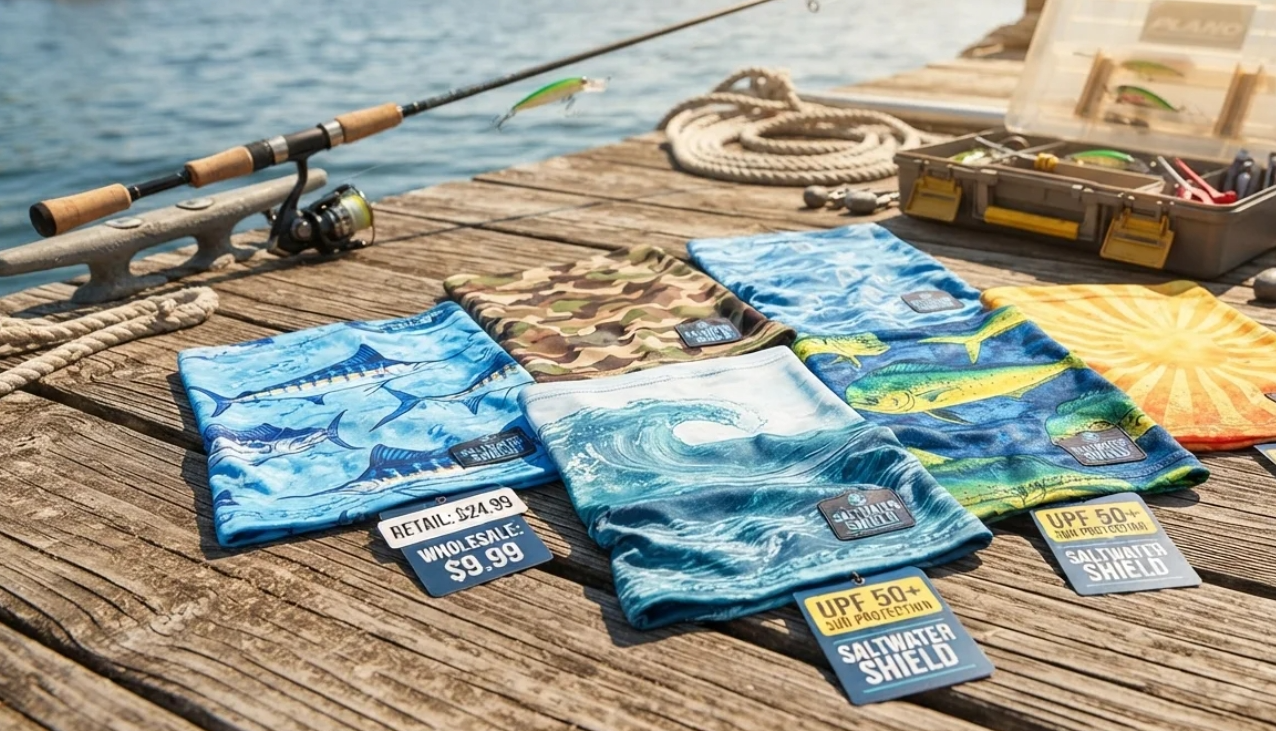
Most buyers spend two weeks vetting a supplier they'll order from once. That's backwards for a custom print fishing neck gaiter test run. Here's the compressed version: a hard checklist and a scripted call that gets you from cold outreach to signed PO in one business day.
The Pass/Fail Checklist
Run every quote through these gates before you negotiate a single dollar:
Certifications : OEKO-TEX Standard 100 and BSCI audit status. No certificate, no order.
Colorfastness : AATCC 61/16, minimum Grade 4. This proves your UPF 50+ fabric can hold its color through wash and wear.
Capacity : Monthly output at least 3x your forecast. That confirms they can handle a reorder without delay.
Lead time : Samples within 7 days. Bulk production within 20 days after approval.
References : Two contactable customers, ideally other outdoor sun protection accessories brands.
Payment flexibility : Will they drop the MOQ if you pay 50% to 100% upfront?
Score each 1 to 5. Anything below 3 on certifications or colorfastness is an automatic reject. Don't negotiate price with a supplier who fails fabric testing.
The Negotiation Script
Open direct: "We're qualifying suppliers for a 500 to 2,000 unit pilot, with a written reorder commitment inside 90 days if quality holds." That sentence alone signals you're serious and gets a real quote fast.
Then anchor: "Your quote is $1.20. Our benchmark at this volume is $1.00. Can you match that with a tiered discount at 3,000 units?"
Follow with the trade: "We'll pay 50% upfront instead of 30% if you drop MOQ to 500."
Close within two hours. Get unit price, lead time, and certification confirmation in writing before you hang up.
Conclusion
Neck gaiters and sun masks aren't a side product. In fishing apparel, few lines let you turn a $1,500–$4,500 investment (500–2,000 units) into 40–65% gross margins. The four brands we broke down are proving it in the market.
The barrier to entry is deceptively low. You already have the customer base, the brand recognition, and the sun-protection use case built into your core product. What you need is a supplier relationship and a decision framework. You now have both.
Here’s your next 24 hours. Pull the qualification checklist. Send it to two Custom Fishing Accessories suppliers from the sourcing channels we outlined. Request samples with your UPF 50+ fabric specs attached. Anglers are already buying sun protection somewhere. The only question is whether that margin lands in your pocket or a competitor’s.