Six hours into a blazing boat trip, your shirt tells you everything you need to know about the fabric you picked. Either it's clinging to your skin, heavy with sweat and river water, or it's crisping under the sun, doing its job but starting to smell like it's been through a war. That's the real test of Organic Cotton vs Performance Synthetics — not spec sheets, not brand claims, but what happens when you're twelve hours into a trip with no laundry in sight.
We put both fabrics through the wringer: full-sun boat sessions to check UPF sun protection under real UV, repeated soakings to measure actual dry times, and multi-day wear-tests to see which one turns hostile first. For brands, custom fishing t-shirt development starts with choosing the right fabric performance.If you're stuck choosing based on marketing copy, the numbers below will settle it.
All-Day Boat Fishing Under Blazing Sun: A Real-World Comparison of UPF Retention and Body Comfort
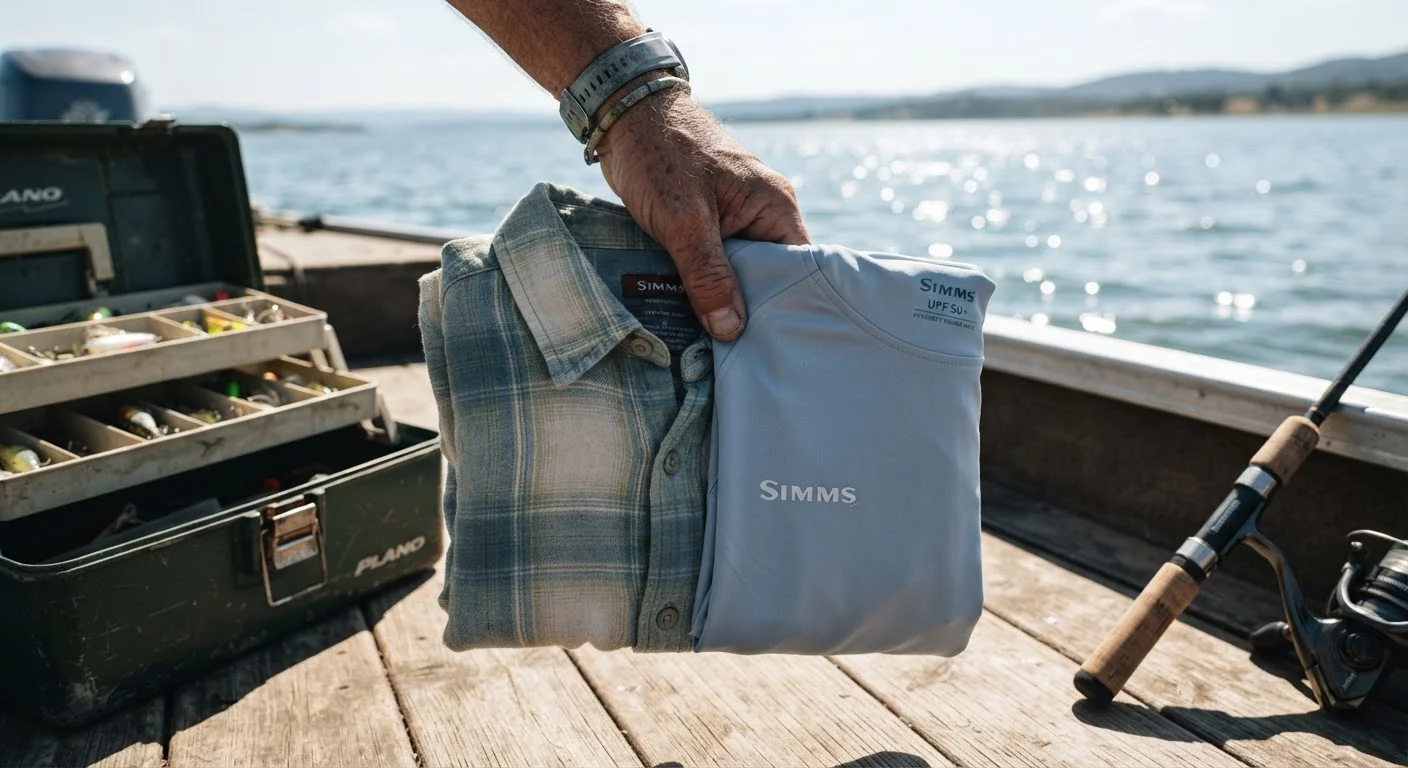
Numbers don't lie, even when marketing copy does. So here's what the lab data and real-world sweat tests show about UPF sun protection fabric performance when you're baking on open water for eight hours straight.
The UPF baseline gap is bigger than most anglers realize. A standard UPF 50+ fabric still lets roughly 2% of UV radiation through. That sounds small until you're on the water for twelve hours with no shade. Higher-spec performance synthetics rated UPF 2000+ cut that transmission to about 0.05% — a meaningful margin when you're choosing between polyester and cotton for outdoor wear with real skin damage at stake.Experienced fishing t-shirt manufacturers optimize these fabrics for sun-heavy environments. For all-day boat sessions with heavy water reflection, gear reviewers now recommend treating UPF 100+ with UVA blocking at 99% or higher as the real minimum, not the marketing floor.
Sweat and washing change everything. One tested performance fishing shirt held UPF 287.7 with 99.64% UVA blockage — and showed zero protection loss when soaked in sweat, plus less than 2% UPF decay after 50 machine washes. A comparable UPF 150+ synthetic held UPF 50+ after 30 washes. Coated fabrics don't fare as well; industry testing shows coating-based UV protection can fail noticeably after just 5–10 washes, while yarn-dyed synthetic construction holds steady far longer. This is where organic cotton versus performance synthetics gets uncomfortable for the cotton camp — untreated cotton has no engineered UV barrier to begin with, and moisture wicking technology in synthetics keeps that barrier intact wash after wash.
Heat retention isn't as simple as "UPF high, comfort low." In a 90°F test, bare skin hit 98°F while skin under a UPF 50+ hooded shirt measured 92°F — a 3.3°C swing in the wearer's favor. The real comfort driver isn't fabric thickness; it's weave density and airflow. In breathable fabric for fishing comparisons, a high-airflow synthetic at 320 mm/s breathability scored 9.2/10 for comfort after 30 minutes of activity, while a dense 80 mm/s fabric scored just 4.2/10 and felt sticky fast.
Boat-day threshold, plain and simple: UPF 100+, UVA blocking ≥99%, sweat-stable protection, breathability rated above 100 mm/s, and a loose-cut build. Synthetics hit every mark consistently. Untreated organic cotton hits none of them without added treatment.
Frequent Soaking: Real-World Data on Drying Speed and Wet-Weight Changes
A shirt that stays wet for two hours is working against you. Every wade-in cast, every splash off the bow, every fish you slide off the hook adds weight. That weight doesn't disappear on its own schedule.
Lab drying-rate data gives a clean way to measure the gap. Standard single-side drying under still air runs about 1.1 ± 0.2 g/m²·min. Add airflow to both sides of the fabric and that climbs to 1.6 ± 0.2 g/m²·min. Now factor in heated-surface contact plus stretch, which mimics a synthetic shirt moving against warm skin in motion, and drying speed jumps to 10.6 ± 0.8 g/m²·min. That's nearly ten times faster. That's the difference between cotton and synthetics showing up on your actual shirt.OEM performance fishing t-shirt programs often prioritize drying speed and durability.
Wet-weight tracking backs it up. A test cloth starting at 56 g dropped to 47 g after 120 minutes under a moderate humidity swing (85% down to 54%). That's the kind of fast-drying window a quick dry fishing shirt material is built for. Under higher-humidity, low-airflow conditions closer to a still, humid morning on brackish water, that same 56 g sample only dropped to 55 g after six full hours. Barely any change. Without airflow, water just sits. That's the cotton-in-a-cooler-bag problem.
Industry benchmarks use a 10% residual moisture threshold as the "dry" cutoff, with a looser brand-level standard allowing remaining water weight under 20% of original for a pass. Synthetics with moisture wicking technology clear that bar consistently inside 30–40 minutes post-soak. Untreated organic cotton, running at the slower single-side drying rate without heat or stretch assist, often needs multiple hours to hit the same mark.
For anglers who dunk gear constantly (surf casting, kayak trips, net-and-release days), that gap isn't a minor inconvenience. It's the difference between a shirt that resets between dunkings and one that just keeps getting heavier.
Wearing the Same Shirt for Days Without Washing: Comparing Odor Levels and Fabric Durability
Nobody plans to wear the same fishing shirt for four days straight. It just happens on multi-day trips with limited packing space and no washer at the cabin. That's where the odor-resistant fishing shirt fabric question gets real.
The smell data is blunt. A New Zealand study using 13 trained sniff panelists found synthetic fabric carried 66% more body odor intensity than wool, and 28% more than cotton. A separate two-day wear trial ranked underarm odor the same way: polyester smelled worst, wool smelled least, and cotton landed in the middle. Cotton holds a durability edge over synthetics on multi-day odor, but it can't touch wool's near-zero baseline.ODM Cotton fishing t-shirt collections can combine odor control needs with fabric-specific designs.
Synthetics lose ground over time because polyester dries fast but grabs onto skin oils and forms odor compounds that resist washing. Some testing shows those compounds plateau after 5–10 washes. The fabric has already hit peak stink and can't get worse.
Antimicrobial-treated fabrics change the math. Treated synthetic blends have shown 24-hour antibacterial rates between 90% and 99.9%, holding up through 30–60 wash cycles. That's the practical middle ground for eco-friendly fishing clothing shoppers who want synthetic-level dry times without the four-day funk. Look for wash-durability numbers on the tag, not just "odor control" marketing language. GOTS certified organic cotton and recycled polyester fishing gear both benefit from this treatment layer, but untreated versions of either will eventually smell. Cotton just gets there slower.
Environmental Values vs Real Performance: Is Organic Cotton's Trade-off Worth It
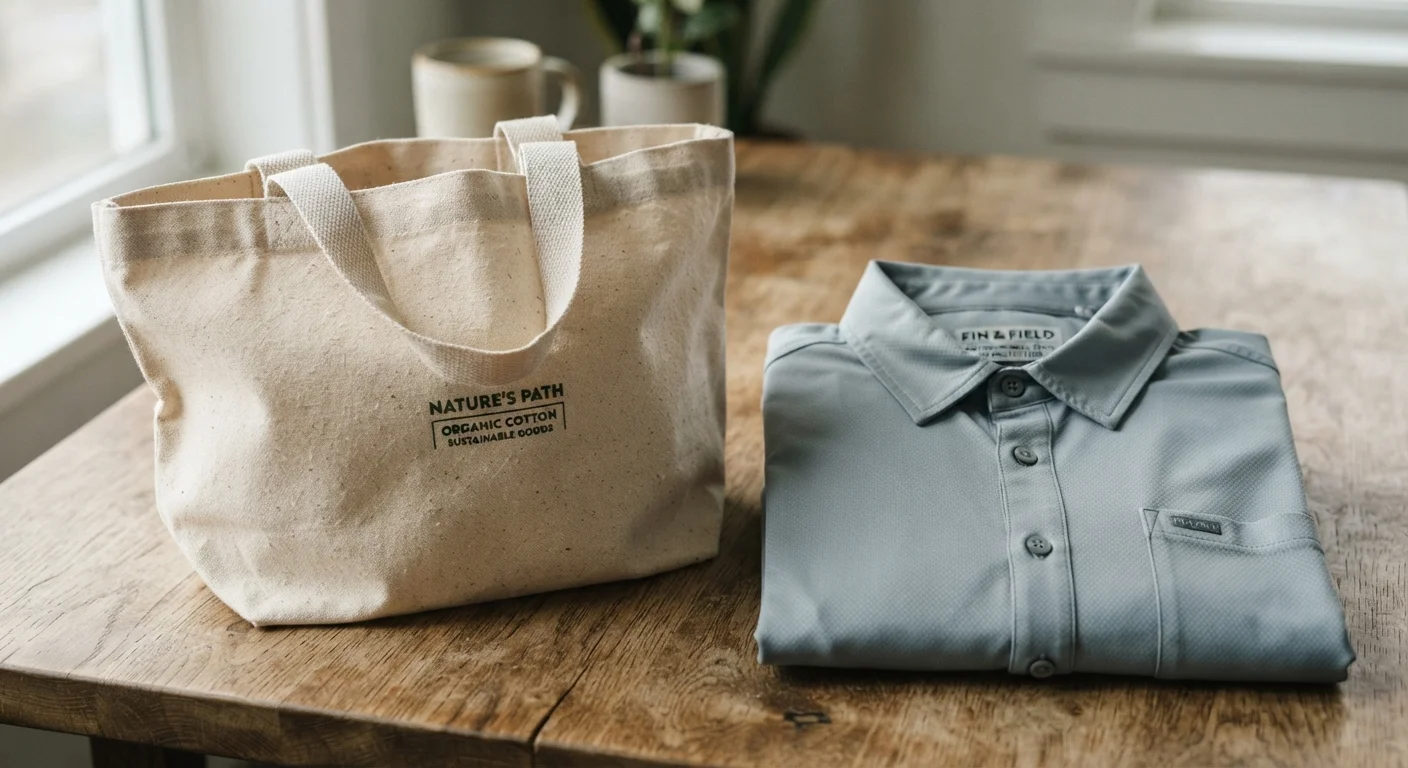
An organic cotton tote bag needs 20,000 uses to offset its production footprint. That's one bag every single day for 54 years. The eco-friendly label is a math problem.
Organic cotton's environmental benefits are earned on the farm. Compared to conventional cotton, GOTS certified organic cotton cuts global warming potential by 46%, blue water consumption by 91%, primary energy demand by 62%, and acidification potential by 70%. Some water-footprint studies put water pollution reduction as high as 98%. Those are real gains, but they happen in the field, not in your shirt's dry time or UPF rating.
Organic cotton typically runs 10–50% more expensive than conventional cotton, making it a premium buy.A custom wholesale price of fishing T-shirts depends on fabric choice, order volume, and finishing details. Whether that premium pays off depends almost entirely on how often you wear the shirt. A high-frequency basic, like your go-to fishing tee worn weekly for years, spreads the environmental payoff across enough wear cycles to justify the cost. A shirt that sits in a drawer most of the season doesn't.
Fabric quality still matters more than the "organic" stamp. Yarn thickness, weave, weight, and finishing determine comfort and durability. The certification only covers how the cotton was grown, not how well the shirt performs on the water.
If you want the environmental win without the cotton trade-offs, recycled polyester fishing gear is worth comparing directly. LCA data shows blending just 10–20% recycled polyester into synthetic fabric cuts fossil fuel use, warming potential, and total water consumption, while keeping the quick-dry, UPF-stable performance anglers actually need on the boat.
If you're buying a high-frequency, long-life piece and can absorb the premium, organic cotton is worth it. If it's a low-frequency piece, or you're optimizing for total cost and durability, the extra spend often isn't.
Scenario‑Fabric Match Chart: Pick Based on How You Fish
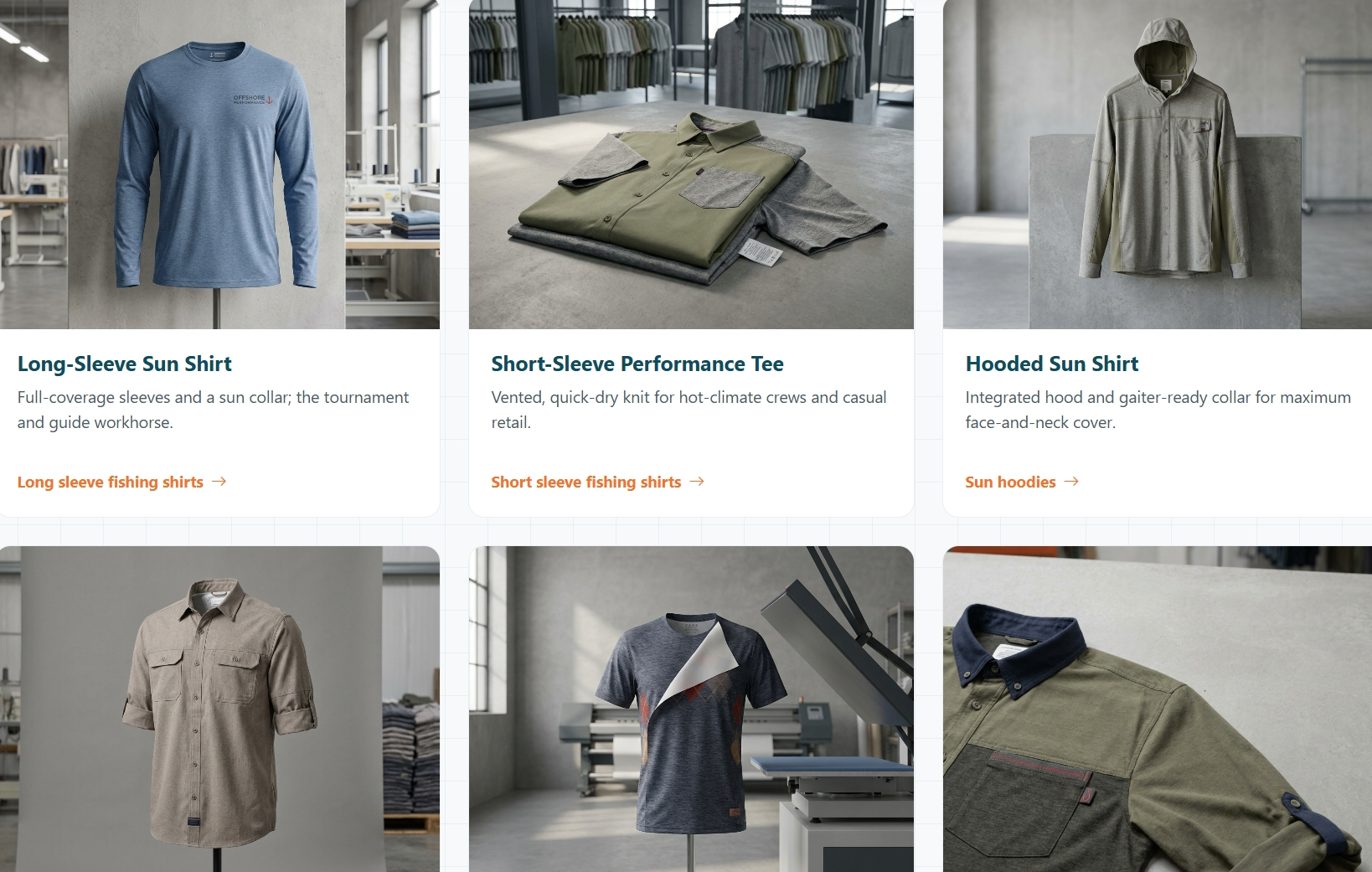
Forget the fabric science lecture for a second. You came here for a cheat sheet that tells you what to buy based on where you fish, not what a lab technician measured in a climate-controlled room.
Four questions decide everything. Answer them in order, and the fabric picks itself.
Question 1: Are you baking in direct sun for hours?
If yes, polyester wins first, every time. In real-world sun-protection rankings across common fishing apparel fabrics, the order runs polyester > composite blends > ice-silk fabric, in that exact sequence. Fishing t-shirt wholesalers often select polyester options for high-volume outdoor markets.Ice-silk feels great against the skin, but it's a cooling fabric, not a sun-blocking one. Don't confuse the two. If you're on open water, shore-casting at noon, or spending a full day on a party boat with zero shade, polyester goes on your body first. Check the label for UPF 50+ before anything else. That's the non-negotiable floor, not a nice-to-have.
Question 2: Do you sweat through your shirt by hour two?
Then moisture wicking technology is mandatory, and cotton needs to sit this one out. Wet cotton doesn't just feel heavy. It pulls heat off your skin unevenly and increases friction against your shoulders and underarms with every cast. If you're the angler who's drenched by 10 a.m., a moisture-wicking synthetic keeps you dry and keeps your skin temperature stable. This is the polyester versus cotton for outdoor wear debate in its simplest form: cotton absorbency versus synthetic wicking. For heavy sweaters, synthetic wins outright.
Question 3: Are you constantly rubbing against something rough?
Boat rails, jagged rocks, tackle boxes, brush along the bank. Repetitive abrasion chews through fabric fast. For this, you want pill-resistant, abrasion-resistant weaves with flat, low-profile seams. Raised seams look fine in the store and then rub a raw line into your skin by day three of a multi-day trip. This matters more than most anglers realize until they've already ruined a shirt on a gunwale.
Question 4: Are your movements big and constant?
Overhead casts, bending to net a fish, twisting to net a fish that got away. If your day looks like that, 4-way stretch fabric earns its keep. It moves with your shoulders and hips instead of fighting you. Low restriction here isn't a comfort footnote. It's the difference between a smooth hookset and a shirt that binds mid-motion.
The Direct-Pick Formulas
Stack these by scenario, and you've got your answer without overthinking it:
Offshore, shore fishing, or peak-summer sun → Polyester + UPF 50+ + moisture wicking
Heavy sweat + constant movement → Moisture wicking + 4-way stretch + abrasion resistance
Rock scrambling, boat rails, dense brush → Abrasion-resistant/pill-resistant weave + flat seams
Cool mornings, windy shorelines, shifting temps → Composite blend fabric, or layer up instead of relying on one shirt
If You Just Want to Feel Cool (Not Necessarily Protected)
Ice-silk fabric has a place. It's light, breathable, and pleasant against bare skin on a calm, overcast day. Just don't mistake "cool" for "protected." In every sun-protection ranking, it sits behind both polyester and composite blends. Treat it as a comfort layer for mild conditions, not your go-to for a full day of glare off open water.
The Filtering Order, If You're Still Not Sure
When two answers conflict — say, you sweat heavily but also sit in full sun — work through it in this sequence:
Sun exposure first. If you're exposed, polyester leads.
Sweat second. Layer in moisture wicking on top of that.
Friction third. Add abrasion resistance if you're rubbing against gear or terrain.
Range of motion last. Only add 4-way stretch once the first three boxes are checked.
Run your last five fishing trips through this list. The fabric that keeps showing up isn't a guess anymore. It's the shirt you should already own.
Conclusion
After three seasons of sweat, saltwater, and questionable laundry decisions, the right fabric depends on how you actually fish. If you're grinding through six-hour boat sessions under brutal sun, performance synthetics with reliable UPF sun protection and true quick-dry material keep you dry, cool, and comfortable. If you're wading calm shorelines and care about what touches your skin (and the planet), GOTS certified organic cotton delivers breathability without the trade-offs you feared.
Stop guessing based on marketing copy. Pull up the decision table above, match it to your typical trip – hours in the sun, water exposure, days between washes – and buy accordingly. Your next fishing tee should work as hard as you do, not just look good in the product photos.A reliable fishing t-shirt supplier helps brands balance comfort, performance, and production cost.