Every year, anglers pull 46,000 tons of discarded fishing nets and plastic waste from the oceans — then buy custom fishing shirts made from virgin polyester. That disconnect is worth a closer look.
The past five years have shifted things. rPET fabric technology and ocean-reclaimed fibers have grown up. The question is no longer whether recycled materials can hold up in technical fishing apparel. It's which specific fiber, construction, and certification combination delivers UPF 50+, salt-spray durability, and moisture management equal to conventional synthetics — and at what price.
Here's what you'll find below:
Fabric-by-fabric performance data
Real brand case studies
A sourcing checklist you can use today
This is a performance-first, procurement-ready breakdown. No fluff — just the data and decisions that matter.
Core Performance Demands vs Recycled Material Capabilities in Fishing Apparel
Fishing apparel is a punishment test disguised as clothing. Salt spray, reel friction, eight hours of direct sun, sweat that never dries — these conditions don't forgive weak fabric engineering. It doesn't matter where the fiber came from.
Recycled polyester has passed that test. Here's what the performance data shows.
UPF Protection: Inherent vs. Treated — A Critical Distinction
Tight-weave recycled polyester hits UPF 50+ (blocking ≥98% UV) through fiber density and construction — not surface chemistry. That distinction has a big impact over a product's lifespan.
AFTCO Bucket UVX shirt : 88% REPREVE Our Ocean recycled polyester / 12% spandex → UPF 50 , inherent protection
Patagonia Capilene Cool Daily : 50–100% recycled polyester → UPF 50+ , stable beyond 100 washes
Surface-treated UPF coatings : performance drops off after ~30 wash cycles
Procurement implication : Ask per formance fishing apparel suppliers directly — is the UPF inherent or treated? For fishing apparel, inherent protection from fiber density — or systems like AFBLOCK — is the specification worth writing into a contract. Nothing else holds up long-term.
Moisture Management and Weight Targets
Recycled polyester fishing shirts run 140–180 GSM . That's light enough for marsh and offshore heat, yet dense enough to hold opacity and durability. It's the functional sweet spot.
RepYourWater ECO50 Performance Shirt: 160 GSM , proven viable in field conditions
Engineering approach: tighter knit at high-UV panels (shoulders, hood), with a looser construction at body panels for airflow
Benchmark technologies — Patagonia's wicking systems, Columbia Omni-Wick™, Simms COR3™ — all hit this balance using recycled polyester bases
For high-stress zones like forearms and shoulders, target 180–220 GSM . Add 10–16% spandex content to absorb casting stress without breaking down the fiber.
Odor Control and Durability: The Multi-Day Requirement
Offshore charters and backcountry fly fishing put shirts through 2–5 continuous days of sweat, salt exposure, and rinse cycles. That's a hard odor control requirement. Sustainable fabrics handle it through PFAS-free, silver-free antimicrobial systems paired with strong mechanical wicking. Sweat gets pulled away at the fiber level before biofilm builds up.
Colorfastness benchmark : hold ≥4 Grey Scale grade after 20–30 saltwater-equivalent wash cycles. Solution-dyed recycled polyester beats low-impact dyed options here — especially on solid body panels under long UV exposure.
Here's the full performance target for recycled fishing fabrics:
Demand | Target Specification |
|---|---|
UPF | 50+ inherent, 100+ wash stable |
GSM (body) | 140–180 |
GSM (impact zones) | 180–220 |
Spandex content | 10–16% |
Odor control | PFAS-free, 24–48hr validated |
Colorfastness | ≥Grade 4, 20–30 cycles |
Recycled fiber hits every line on that table — as long as construction decisions are made with purpose.
Technical Breakdown of Recycled & Sustainable Performance Fibers
Five fiber types lead the sustainable fishing apparel space. Each one comes with a different set of trade-offs built into its chemistry. You're specifying fabric for a technical fishing shirt — those trade-offs matter in real ways.
Mechanical rPET: The Workhorse
Mechanical recycled PET — sourced from post-consumer bottles and flakes — is the high-volume option. The numbers are good, not perfect.
Tenacity : 3.8–6.5 g/den recycled vs. 4.5–7.0 g/den virgin. That's about a 75–90% strength retention rate . Abrasion resistance sits at 35,000–55,000 cycles against the virgin benchmark of 40,000–60,000.
For most fishing shirt applications — shoulder panels, body, hood — that gap is workable. Fiber density holds UPF. Knit construction controls wicking. In the spots that take the most stress — casting-load forearms, collar edges, cuff loops — you close the gap through construction, not chemistry.
The environmental case is straightforward:
- 30–45% lower carbon footprint (1.8–2.5 vs 3.0–4.0 kg CO₂-eq/kg)
- 20–35% energy savings in production
- 15–25% less water use
One benefit that doesn't get enough attention: 100% rPET knits show higher air permeability than virgin polyester equivalents. In humid, high-heat fishing spots — flats, mangroves, offshore tropics — that's a real functional advantage. It's not just a sustainability talking point.
Blend strategy for high-stress applications : 30–50% rPET with 50–70% virgin PET restores near-virgin tenacity. It also keeps GRS certification eligibility. This is an honest blend — not a purity claim, but a performance call.
Chemical Recycling: Near-Virgin Properties, Higher Cost
Mechanical recycling has a ceiling. Chain scission lowers intrinsic viscosity. Contamination limits fine-denier spinning. Chemical depolymerization solves both problems. It breaks PET down to monomer level and rebuilds molecular weight close to virgin.
The result: near-100% property recovery , better color consistency, and the ability to spin the 30–75D microfilaments that lightweight technical fishing shirts need. The trade-off is cost and process complexity. Right now, it's limited to programs with the volume and supply chain discipline to back it up.
You're building premium fishing apparel lines with fine-gauge knits and UPF 50+ inherent protection? Chemical rPET is the specification worth a closer look.
Regenerated Nylon (Net-Based Feedstock)
Post-consumer fishing nets — the same gear pulled from coastal clean-ups — serve as the feedstock for regenerated nylon 6 programs like ECONYL. The fiber goes through sorting, shredding, hot-wash decontamination, and controlled depolymerization before re-spinning.
Performance benchmark: ≥85–90% strength retention vs virgin nylon is the industry target. In practice, regenerated nylon 6 blended with virgin nylon 6.6 hits that threshold for high-tenacity applications.
The fishing apparel connection is direct. ECONYL-type fibers carry built-in story value for brands with an ocean conservation angle. Net-sourced traceability, documented collection sites, chain-of-custody GRS certification — that's a product story and a supply chain in one package.
One real limitation: color consistency is variable compared to virgin nylon. Ocean feedstock needs blending with conventional rPET flakes to stabilize IV and color range. Build that into your colorway planning from the start.
Ocean Plastic Blended rPET
This falls under mechanical rPET, but it deserves its own section. Ocean-recovered plastic — bottles, rigid fragments, net components — rarely goes through processing as a pure stream. Contamination and IV variability are too high for direct apparel-grade extrusion.
The practical reality: ocean plastic gets blended with standard rPET bottle flakes to hit target IV and contamination specs before pelletization. The resulting fiber carries real ocean-plastic content — verified through GRS chain-of-custody documentation — while keeping the spinnability that performance knits demand.
For procurement, ask for the ocean plastic fraction percentage and the certification documentation that backs it up. "Ocean plastic fabric" without a GRS certificate and a disclosed feedstock ratio is a marketing phrase. It's not a material specification.
Natural Fiber Blends: The Niche Case
Hemp/organic cotton blends with 20–30% recycled cotton content fill a specific corner of the fishing apparel market. These suit casual fishing shirts and pants where comfort and end-of-life biodegradability matter more than peak technical performance.
The data is clear about the limits:
- 10–20% lower tensile strength vs virgin natural fibers
- Stretch recovery depends on elastane addition or mechanical construction
- Moisture regain : cotton ≈ 8.5%, polyester ≈ 0.4% — blends can be adjusted for moisture buffering, but won't match synthetic wicking rates
For anything beyond casual fishing apparel, rPET or regenerated nylon stays the performance-first choice. Natural blends are a valid product category — just a different one.
The Finishing Layer: UPF and DWR on Recycled Fabrics
Two finishing decisions shape long-term performance on recycled fishing fabrics.
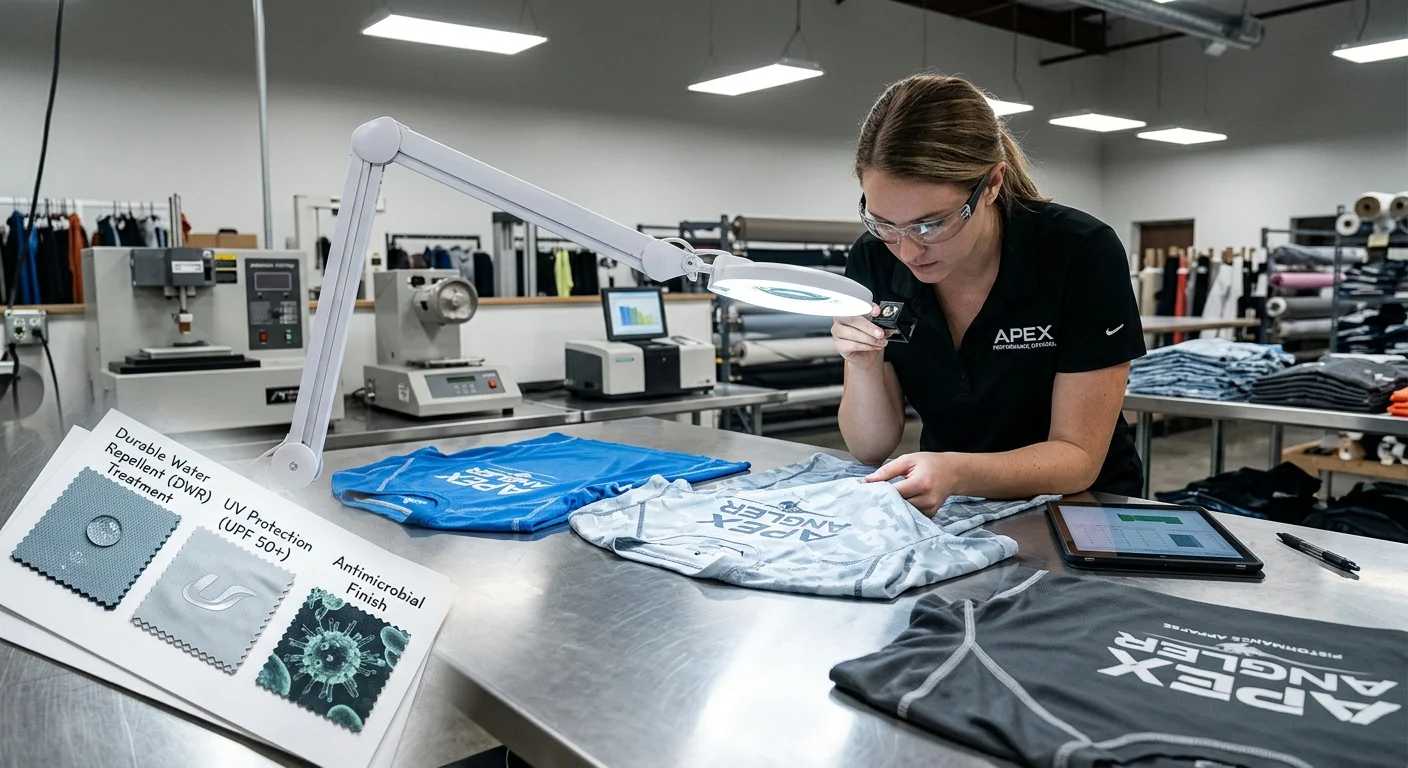
UPF : rPET keeps low moisture regain (0.4–0.8%) and hydrophobicity — the same properties that make virgin polyester a strong UV blocker. UPF enhancement on recycled knits comes from pigment load and fabric density , not fiber chemistry. TiO₂ in the yarn or finish, combined with tight-weave construction, gets you to UPF 50+ without surface treatments that break down with washing.
DWR : Non-fluorinated DWR performs the same on recycled vs. virgin polyester. Surface energy and fabric structure drive performance — feedstock origin doesn't. The rule that matters: outer face only . Inner-face DWR blocks the capillary channels that move sweat away from skin. On a fishing shirt built for eight hours of activity, that's a comfort failure you've designed straight into the finishing spec.
Zone-specific finishing fixes this. Apply tighter density and DWR on high-exposure panels. Keep inner-face capillarity intact on body zones. That's how recycled fabrics deliver both water-repellency and moisture transport at the same time.
Performance Comparison Matrix For Sustainable Fishing Apparel Fabrics
Four fiber families lead the sustainable fishing apparel space. Each one makes a different set of promises. The matrix below puts those promises against real performance data — so you can stop debating theory and start choosing materials.
Fabric Family | UPF Rating | Dry Time / Wicking | Tensile Strength | Saltwater Durability | Wholesale Cost Premium |
|---|---|---|---|---|---|
rPET / Recycled Polyester | UPF 50+ (inherent) | 15–20 min; 3× faster than cotton | ~63 MPa | Within 5–7% of virgin polyester | +22–35% vs conventional poly |
Recycled Nylon 6 (ECONYL / NetPlus) | UPF 40–50 (with finish) | 25–30% slower than rPET | Superior abrasion resistance | Strong; best-in-class for harsh wear | Premium tier; ~$120+ retail reference |
Ocean-Derived Recycled Blends | UPF 40–50 (with finish) | Within 5–7% of virgin poly | ~55–58 MPa; 8–12% below bottle rPET | Microfiber shedding lower than conventional poly | +22–35% vs conventional poly |
Bio-Synthetic Blends (Lyocell / Recycled Poly) | No verified UPF 50+ data | Best moisture dispersion; improved drape | Lower tensile — comfort-oriented construction | Not rated for heavy marine conditions | Premium sustainable positioning |
Reading the Matrix: Four Decisions, Not One
The numbers don't tell a single story. They tell four different ones. It depends on where and how the shirt gets worn.
rPET is the workhorse. It offers UPF 50+ inherent protection and the fastest dry time in the category. Tensile strength sits at 63 MPa — close to virgin polyester at 68 MPa. The cost premium is real at 22–35% above conventional polyester yarn. But the performance case for fly fishing, inshore flats, and hot-weather freshwater use is solid and consistent.
Recycled nylon wins on durability. It loses on moisture. Abrasion resistance and tensile strength beat polyester equivalents by a clear margin. But polyester dries 25–30% faster. For offshore work with heavy tackle contact, that tradeoff works. For an eight-hour humid-heat session on a kayak, it doesn't.
Ocean-derived blends carry a small but real tensile penalty. The data shows 8–12% lower tensile strength than bottle-sourced rPET. That's 22% lower than virgin polyester. It's not a deal-breaker — it's a spec decision. Brands building an ocean conservation story around verified feedstock and GRS chain-of-custody records can absorb that trade. Brands focused on abrasion life above all else should look elsewhere.
Lyocell blends fit a different category. Comfort, drape, moisture dispersion — they deliver on all three. Verified UPF 50+ and marine durability numbers? They don't. Place them in the casual or lifestyle fishing category. Keep them out of performance specs.
The Discipline-Specific Decision Rule
Cut through the details and four clear thresholds stand out:
Fly fishing / hot inshore : rPET — UPF 50+ inherent, fastest wicking, proven construction
Offshore / high-abrasion : Recycled nylon 6 — durability leads, moisture management is secondary
Kayak / high-sweat / humid climates : rPET — polyester's moisture advantage is the deciding factor here
Eco-positioned premium lines : Ocean-derived blends — use these when your brand story supports the modest tensile trade and your supply chain can confirm the feedstock source
The matrix gives you the starting point. The discipline rule gives you the filter. Together, they take five fabric options down to one specification worth putting in a contract.
Commercial Validation: Brand Applications & Market Feedback Data
Performance data is compelling. But it doesn't pay performance fishing apparel factory invoices — market response does.
Validation studies, OEM performance fishing apparel programs, and B2B adoption patterns all tell the same story about sustainable fishing fabrics at the commercial level. Here's what the data shows.
What Consumers Are Willing to Pay
The price premium question comes up in every sourcing conversation. The answer is consistent across multiple studies: 15–25% above comparable non-certified garments . The eco-credentials need to be verified and visible — that's the condition.
That tolerance maps to real MSRP bands brands have tested and confirmed:
Performance sun hoodies and UPF jerseys with recycled fibers and UPF 50+: $85–$140 retail
Technical outerwear with traceable recycled nylon: $180–$220 retail
Pre-order and deposit-based validation campaigns sharpen this picture further. Cold-traffic buyers — not friends, not social followers, but strangers — place deposits at these price points after seeing product pages. Brands treat that as a solid signal to move to full production. The benchmark: 3–5% of landing page visitors converting at a ~20% premium over conventional alternatives. That's strong demand confirmation.
Performance Acceptance in the Real Market
Field data from beta programs and OEM sustainable performance fabric fishing apparel retailer surveys points the same direction across multiple categories. Recycled-fiber fishing apparel, specified correctly, generates return rates below 3% — equal to virgin-fiber garment benchmarks.
That's not a small finding. Return rate parity means buyers aren't experiencing a performance gap. They're wearing GRS-certified rPET shirts for 30 days in saltwater and sun, then keeping them.
The certification effect on B2B reorder behavior is direct. Brands that share verified lab data with retail buyers — UPF 50+ confirmed across 20–30 wash cycles, saltwater colorfastness to ISO/AATCC standards — see measurable results:
Reorder cycles shorten by ~20%
Inventory turns improve from 3.0 to 3.6 turns per year
Retailer hesitancy drops once real-world test data replaces spec-sheet claims
OEM Production Economics at Scale
For mid-market brands entering sustainable fishing apparel, the production economics land at workable numbers — not perfect, but honest.
Variable | Benchmark |
|---|---|
MOQ (GRS-certified rPET or recycled nylon) | 300–500 units / color / style |
Recycled yarn input cost premium | ~3–7% above virgin material |
Net margin impact at scale (1,000+ units/style) | Cost-neutral |
Cost offset mechanism | Higher realized price + lower discounting on certified SKUs |
The 3–7% input cost increase sounds manageable — because at meaningful volume, it is. The higher price realization on GRS-certified lines absorbs the input difference. Brands aren't subsidizing sustainability. They're repricing it, backed by certification documentation and field-test data to justify the number.
The Beta Program Standard
Smart brands run a structured beta before committing to full production runs. The format is consistent across fishing apparel programs:
25–50 units of the new sustainable fabric construction
30–60 day field test with tournament anglers and charter crews
Quantitative feedback collected on: comfort, odor resistance, dry time, and perceived UPF performance
Defect and return incidents tracked against baseline (virgin-fiber equivalent) garments
Lab testing run in parallel: UPF classification, colorfastness to seawater, wash-cycle durability
The beta closes two gaps at once. It generates retailer-ready performance data that shortens reorder cycles. Plus, it surfaces fit, fabric hand, or sizing issues before they turn into a return-rate problem at scale.
Post-purchase email surveys at 30 days and review pattern analysis across the first 100 sales complete the loop. The findings feed sizing, copy, and assortment decisions for the next production run.
The commercial picture is clear: sustainable fishing fabrics are not a charity project subsidized by brand values. At the right volume, with the right certification stack and validated performance data, they compete on margin. They close faster in B2B channels. And they hold a return rate that conventional fabrics don't beat by default.
B2B Sourcing Checklist & Supplier Evaluation Framework
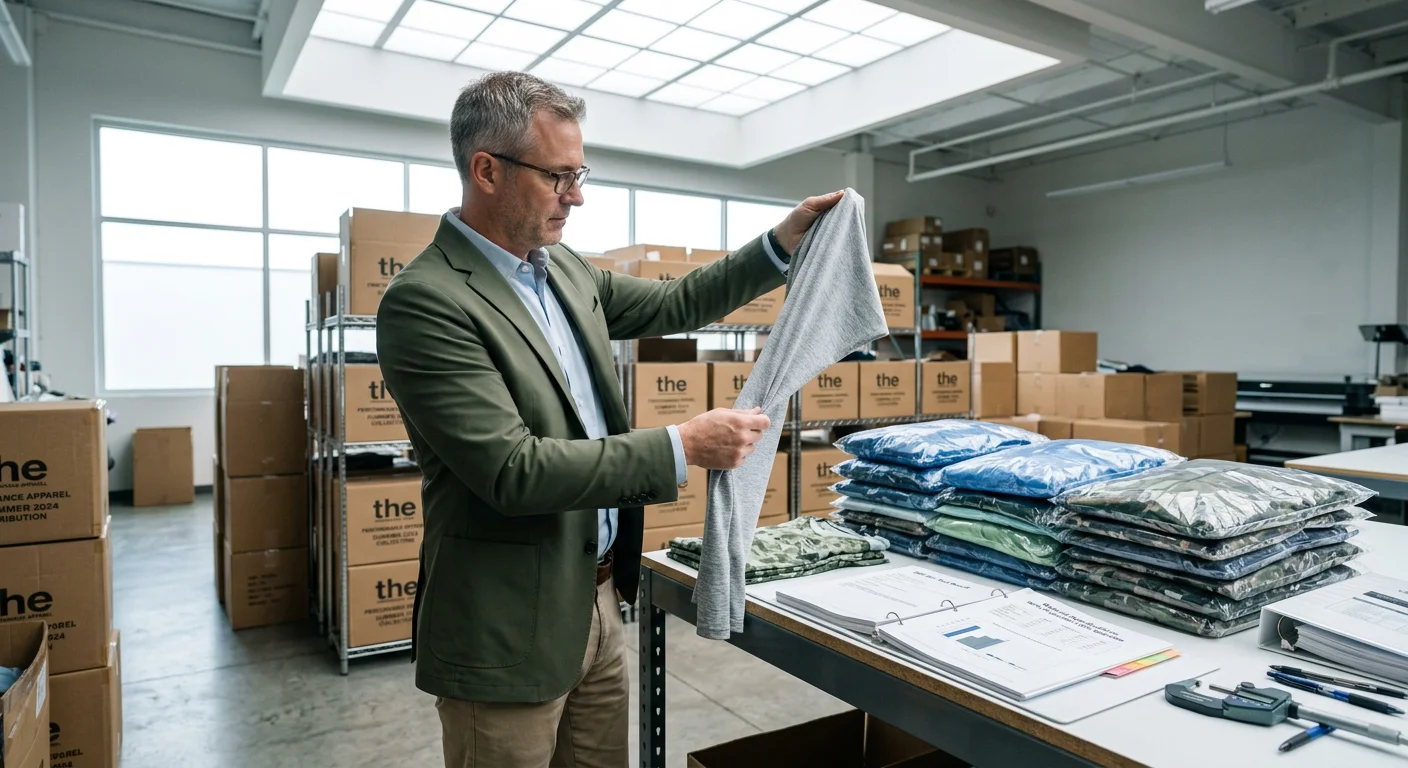
A sustainable fishing apparel line succeeds or fails on paperwork. Not fabric. Not fiber chemistry. Paperwork — and whether the custom fishing apparel supplier can produce it on demand.
Use this procurement framework as-is. Adapt the thresholds. Drop it into your RFQ templates. Score suppliers against each other with numbers instead of gut feelings.
Certification Verification: What to Ask For and How to Check It
A certification is only as good as the documents behind it. Here's the minimum to collect before a supplier moves past RFQ stage.
Global Recycled Standard (GRS)
- Confirm the fishing apparel supplier's scope certificate (facility + product category) through the certification body's live database — not a PDF they email you.
- For every production batch, require a Transaction Certificate (TC) that shows:
- Input type: post-consumer bottles, ocean-bound plastic, recovered fishing nets
- Recycled content percentage and whether it's PCR or pre-consumer
- Full chain-of-custody site list — collector, recycler, spinner, knitter, dye house, garment maker
- Cross-reference TC quantities against your POs and shipping documents. Volume inflation across multiple customer orders is a real risk.
OEKO-TEX STANDARD 100
- Require a current certificate with the relevant article number. New colors or styles need chemical compliance confirmation or fresh test reports.
- Check that all trims, prints, and coatings are covered. Any gaps need separate documentation. A shirt that passes chemical testing paired with a zipper that doesn't — that's still a problem.
bluesign
- Know the difference between a bluesign SYSTEM PARTNER — a facility-level accreditation — and a mill that uses a handful of bluesign-approved chemicals. The first carries far more weight.
- Request a chemical inventory excerpt. It should show what percentage of their dyeing and finishing chemistry carries bluesign approval. Score suppliers higher if that figure exceeds 80%.
Ocean Plastic & Net Feedstock Traceability
- For any supplier of customizable fishing clothing fabric claiming ocean plastic or recovered net content, collect cooperative IDs, recovery regions, partner NGO or cooperative documentation, and mass-balance records — input weight, output fiber weight, yield percentage, loss percentage.
- "Ocean plastic fabric" without a GRS certificate and a disclosed feedstock ratio is a marketing phrase. It's not a material specification. Don't accept it as one.
Performance Testing Standards: Embed These Into Your RFQ
Write these in as mandatory test methods with target values — not optional supporting data.
Performance Category | Test Method | Minimum Threshold |
|---|---|---|
Moisture management | AATCC 195 | OMMC ≥ 0.50; one-way transport index ≥ 500%; top-side wetting time < 3s |
UV protection | ASTM D6544 + ASTM D6603 labeling | UPF ≥ 50 (labeled "UPF 50+"); UPF ≥ 40 after 40 home launderings |
Pilling / abrasion | ISO 12947 (Martindale) | Knit tops: Grade ≥ 4 at 5,000 cycles; technical bottoms: ≥ 30,000 cycles without yarn break |
Saltwater durability (trims) | ASTM B117 salt spray | 72–96h with no red rust; no blistering at 4× magnification |
Dimensional stability | ISO 5077 / AATCC 135 | < 3% shrinkage length and width |
Colorfastness | CIELAB delta E | Solids: ΔE ≤ 1.5; heathers/space-dye: ΔE ≤ 2.0 |
These aren't aspirational targets. They're the exact thresholds that separate a return rate under 3% from one that costs you a retail relationship.
MOQ and Cost Structure: The Questions Most Brands Don't Ask
MOQ negotiations tell you more about a fishing apparel manufacturer than any certification document. Here's what to capture in every RFQ:
MOQ tiers by stage
- Greige fabric: 1,000–3,000 meters per construction is standard; lower if they carry standard yarn inventory
- Finished/dyed: broken down per color per fabric — 500m, 800m, 1,200m are common benchmarks
- Solution-dyed or dope-dyed constructions often carry 2–3× the MOQ of standard dyeing. Factor that into colorway planning.
Cost structure transparency
Ask suppliers to break pricing into line items — not a single per-meter figure:
- Base greige cost
- Dyeing and finishing cost (standard vs. low-liquor eco-process — the eco option runs +5–10%)
- Functional finish adders: wicking, anti-odor, UV absorber
- Recycled material surcharge: at volumes above 500,000 yards, the benchmark premium for rPET over virgin polyester runs +5–15% per kilogram . Get visibility into the actual recycled chip premium and GRS admin cost allocation as separate line items.
Yield-adjusted cost calculation
Request yield loss figures at every stage — knitting loss, dyeing first-quality yield, performance finish fallout. Then calculate your actual cost:
Effective cost = quoted price ÷ (1 − total loss %)
A mill quoting $3.80/meter with 12% combined yield loss costs more than a mill quoting $4.10/meter with 4% loss. The quoted number doesn't tell the full story.
Supplier Scoring Framework: Five Dimensions, One Decision
Score suppliers on a 1–5 scale across each dimension. The total tells you who gets the business.
1. Feedstock origin and traceability
Track volume percentage by recovery type — fishing net, ocean-bound bottles, municipal solid waste, post-industrial. Request the recovery partner list with addresses and NGO partnerships. Each year, pick 2–3 production orders for a full chain reconstruction audit — collector to finished fabric. Score on completeness and response time.
2. Dye house and wastewater compliance
Collect the most recent effluent test report (COD, BOD, TSS, pH, heavy metals). Confirm ZDHC or bluesign compliance where it applies. On facility visits, look at the actual ETP operation — not just the paperwork.
3. Lead times — sample to bulk
Benchmarks to write into your supplier scorecard:
- Lab dips: 5–10 working days
- Bulk production from PO to ex-factory: 45–75 days, depending on yarn lead time and construction complexity
4. Defect rate and SLA
Target ≥96–98% first-quality rate on knit goods. In your supply agreement, define the defect cap — if defects exceed 3%, the supplier absorbs re-make cost. Also set a claim resolution SLA: initial response within 5 working days, investigation report within 15, credit or re-make commitment confirmed from there.
5. Business continuity
Ask this straight out: Does the supplier have multiple dye houses? Multiple recycling partners? A single-source dependency on one recycler or yarn mill is a supply chain risk. Find out before you're 10,000 units into a production run.
Pre-Production Approval Gates
Gates prevent late-stage surprises. Run them in sequence.
Vendor qualification — certifications verified, audit passed, MOQ and costing accepted
Lab dips and handlooms — color and construction approved, ΔE and weight within spec
Performance proto — AATCC 195, UPF, shrinkage, pilling, and trim corrosion all pass on proto fabric
Size set / PP samples — fabric from the actual bulk line; validate hand feel and performance repeatability
Pre-shipment — inline bulk test reports confirmed, plus random third-party testing on 1–2 production lots
No gate closes, no gate gets passed. That discipline is what keeps a beta program's return rate under 3% — and stops it from turning into a post-launch customer service problem.
Future Trajectories in Circular Textiles For Technical Angling Markets
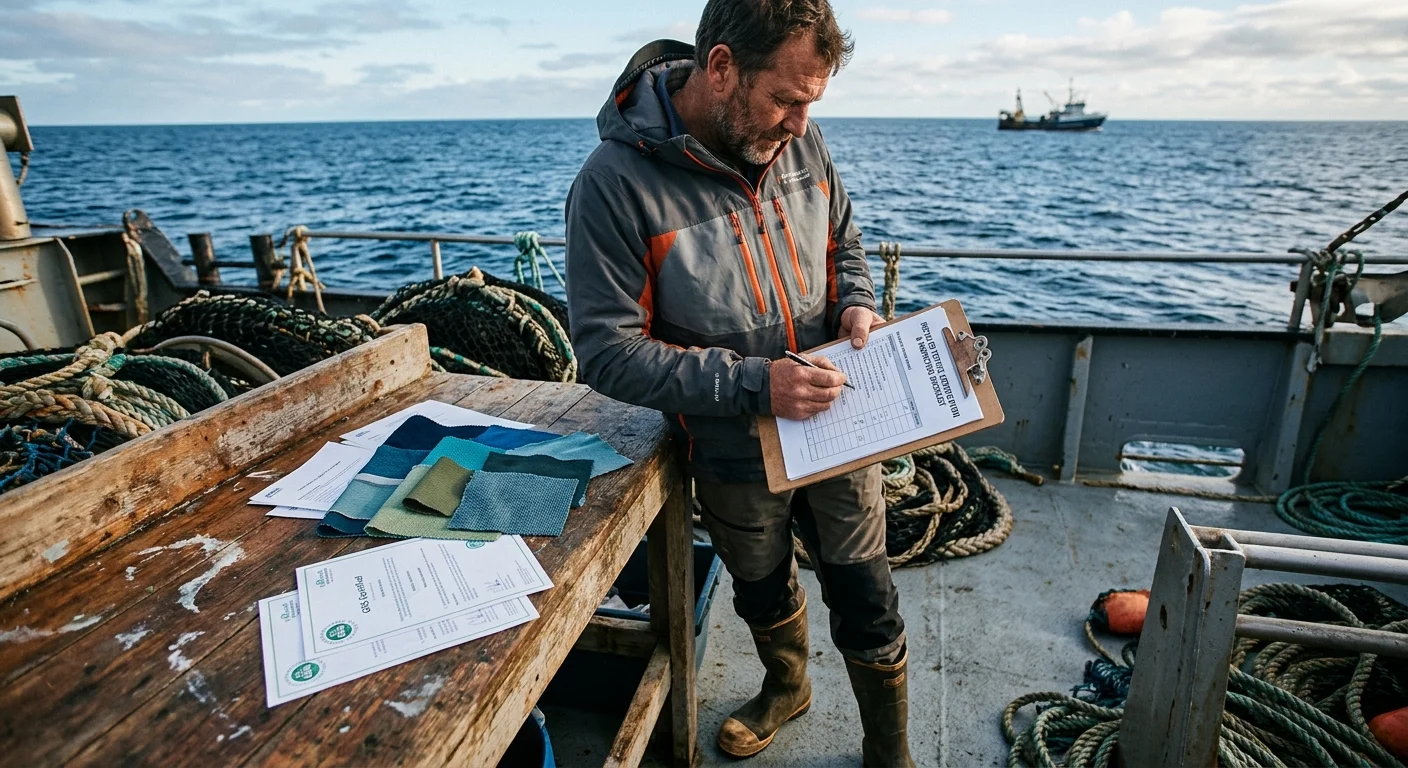
The regulations are coming. The real question is whether your supply chain is ready.
EU mandatory textile collection starts 2025 . Digital Product Passports become required by 2027 . Recycled content mandates — projected in the 20–50% range — are shifting from voluntary goals to baseline requirements. For angling brands, these aren't distant policy debates. They're procurement deadlines.
Four trajectories define where this market goes next.
EPR and take-back schemes will push mono-material design. Waders, shells, and base layers built from single-polymer rPET or recycled nylon 6 can be sorted and processed. Blended constructions can't. Design choices made in 2025 determine recyclability in 2030. It's that direct.
Digital traceability closes the greenwashing gap. By 2027–2030, technical angling apparel sold in the EU will carry QR or NFC identifiers tied to DPP data:
Recycled content percentage
Ocean-plastic feedstock origin
GRS chain-of-custody records
Blockchain lot-level tracking of rPET and recycled nylon 6 becomes a cost-driven necessity, not a choice.
Bio-based antimicrobial and eco-finish chemistry replaces silver and fluorinated systems. Chitosan-based and mineral-catalyst finishes are moving through technical textile R&D pipelines right now. They work with recycling systems. Conventional biocides don't.
Market scale confirms the direction. EU technical textiles are projected at ~6.1% annual growth to 2036 . North America holds 40% of circular fashion market share . By 2035, regional circular loops — local repair, take-back collection, mechanical and chemical recycling of mono-material performance fabrics — become standard infrastructure. Not a competitive edge. Just the baseline.
Brands that build mono-material construction, digital traceability, and EPR-compatible take-back into their supply chains now won't face a costly retrofit later. Build it in now, or catch up under pressure.
Conclusion
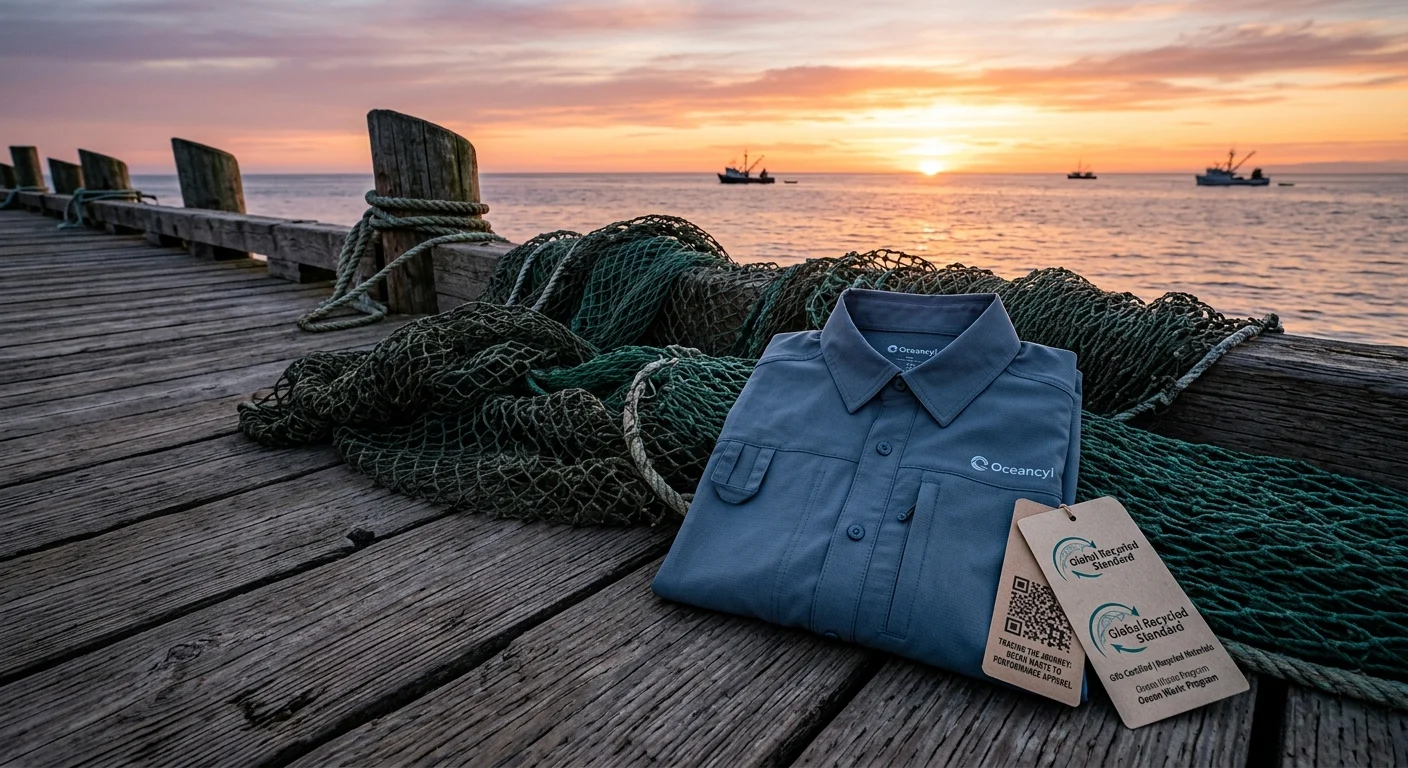
The data doesn't lie, and neither does the ocean.
Recycled performance fabrics — rPET, ocean plastic recycled fiber, reclaimed nylon — have moved past feel-good compromise. They're now a real technical choice. UPF 50+, sub-30-minute dry times, salt-corrosion resistance that outlasts a tide cycle. The performance gap has closed. A sourcing gap still exists. That gap is fixable.
Brands like AFTCO and Patagonia didn't wait for the industry to move. They proved that sustainability and fishability aren't competing values. They're the same cast.
Brand developers and procurement leads — the matrix, checklist, and case studies in this article are your starting point. Not inspiration. Instruction.
Make the call. Request GRS-certified swatches. Run your own salt-spray tests.
The angler who fishes these waters tomorrow wants to know you made the right choice today. Give them a good answer.