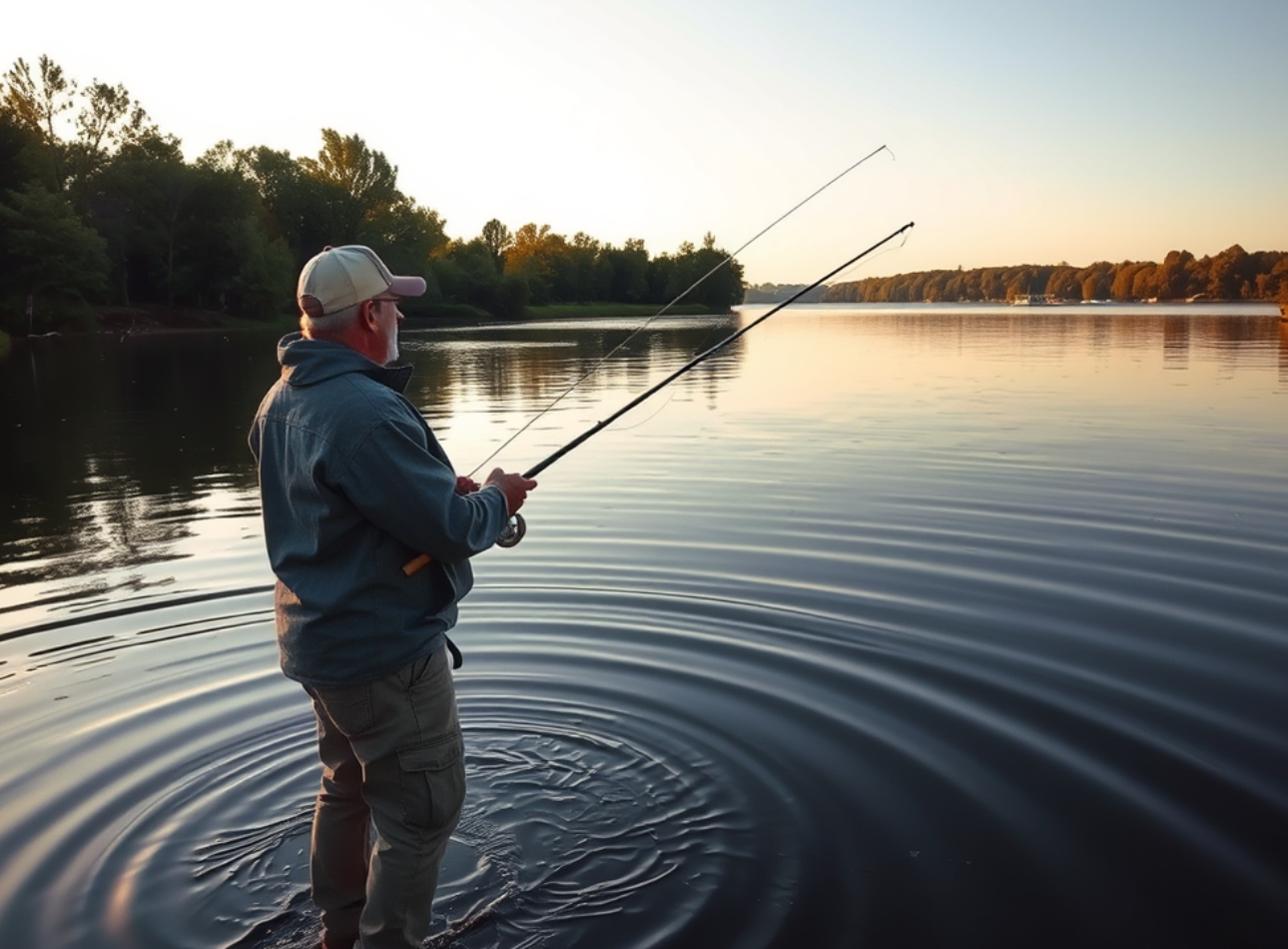
You’ve been there: standing waist-deep in a river, watching a trout you’d been stalking for twenty minutes dart away the moment you shifted your weight—because your “quick-dry” fishing pants had soaked through an hour ago and were clinging to your legs like a wet towel. Or maybe it was the sunburn on the back of your knees after a full day on the boat, courtesy of pants that promised UPF 50 sun protection but delivered closer to UPF 15.
There’s no single “best” fishing pant. There’s only the best fabric-and-fit combination for your specific water. This guide breaks down the real performance data behind nylon vs. polyester fishing pants, moisture-wicking technology, and the fabric percentages that actually matter—so you can match your gear to your game plan, not a marketing claim.For retailers, a reliable Performance Fishing Pants supplier can simplify fabric and fit sourcing.
Nylon (Nylon) vs Polyester (Polyester): Core Fabric Performance Measurement Comparison Table
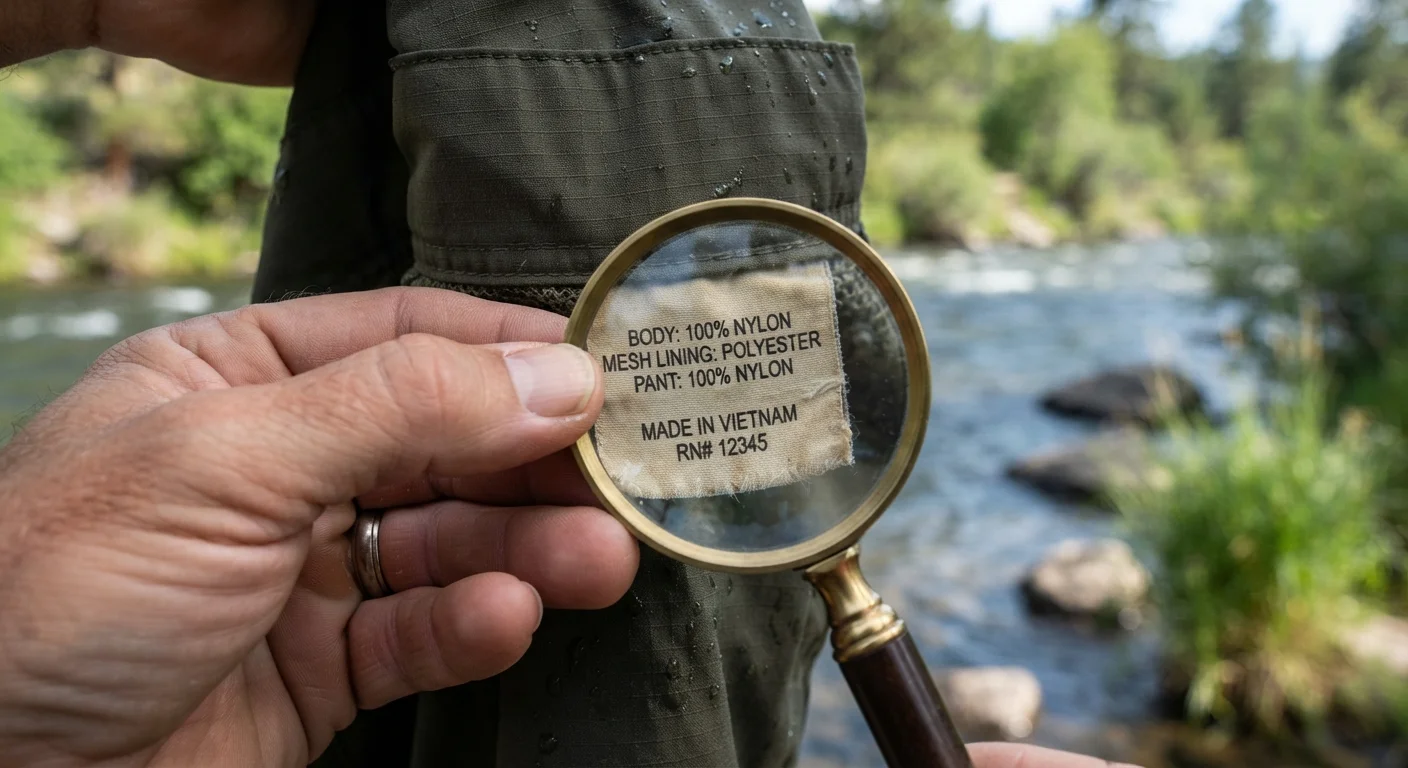
Every fishing pant label tells you the fiber content. Almost none of them tell you what that content means for your day on the water.
Strength and stretch. Nylon wins on raw tensile strength—6 to 8.5 grams per denier versus polyester's 4.5 to 6 g/D. That's a 20-30% strength advantage for nylon at the fiber level. Nylon also stretches further before breaking (30-50% elongation vs. polyester's 15-30%), which matters when you're climbing over a boulder or bracing against current. After 100,000 flex cycles, nylon loses about 12% of its strength; polyester loses 18-22%. Nylon holds up better to repeated bending and twisting—wading, crouching, casting all day.
Abrasion resistance. Nylon fabric survives 15,000-20,000 rub cycles in standard testing. Polyester taps out around 10,000-12,000. If you're dragging your legs across barnacle-covered rocks or gunwales, nylon's the tougher fabric.
Moisture and dry time. Polyester earns its keep here. Nylon absorbs 4-4.5% of its weight in water; polyester absorbs 0.4-0.8%. That's a 5-10x difference. In wet clothing tests, nylon gains about 7% weight when soaked; polyester barely budges at 0.8%. Dry time follows the same pattern—polyester dries 4-5 times faster than nylon.
UV resistance. Polyester retains 20-30% more strength under UV exposure. After 200 hours of sun testing, polyester holds 85% strength; nylon drops into the 70-80% range. For UPF 50 sun protection over long-term wear, polyester ages slower.
Metric | Nylon | Polyester |
|---|---|---|
Breaking strength | 6-8.5 g/D | 4.5-6 g/D |
Abrasion cycles | 15,000-20,000 | 10,000-12,000 |
Moisture absorption | 4-4.5% | 0.4-0.8% |
Dry speed | Slower | 4-5x faster |
UV strength retention | 70-80% | 85% |
Relative cost | ~2x higher | Baseline |
Four fishing trips, four different pants. That's precision. A guide who's spent fifteen seasons rotating between bonefish flats, steelhead rivers, and offshore charters doesn't reach for the same pair twice. Different water demands a different weave. Most experienced anglers don't skimp on quality. Their mistake is buying one "do-everything" pair that quietly underperforms in every scenario.
Match your water to your fabric blend.
The Matrix
Fishing Scenario | Priority Fabric | Fiber Blend Target | Recommended Fit |
|---|---|---|---|
Boat / Offshore | Ripstop nylon | Cotton under 10% | Straight-leg, reinforced knee, textured non-slip seat |
Wading / River | Polyester-nylon blend | 60/40 poly-nylon + 5-8% spandex | Convertible zip-off, articulated knee |
Tropical / Flats | High-UPF polyester | 90%+ poly, 0% cotton | Loose relaxed fit, vented gussets |
Cold-water / Steelhead | Nylon-poly + DWR coating | 70% nylon, 25% poly, 5% spandex | Slim-fit, water-resistant treated |
Surf / Saltwater wading | Quick-dry ripstop poly | 85%+ poly, 10-15% elastane | Above-knee short or convertible |
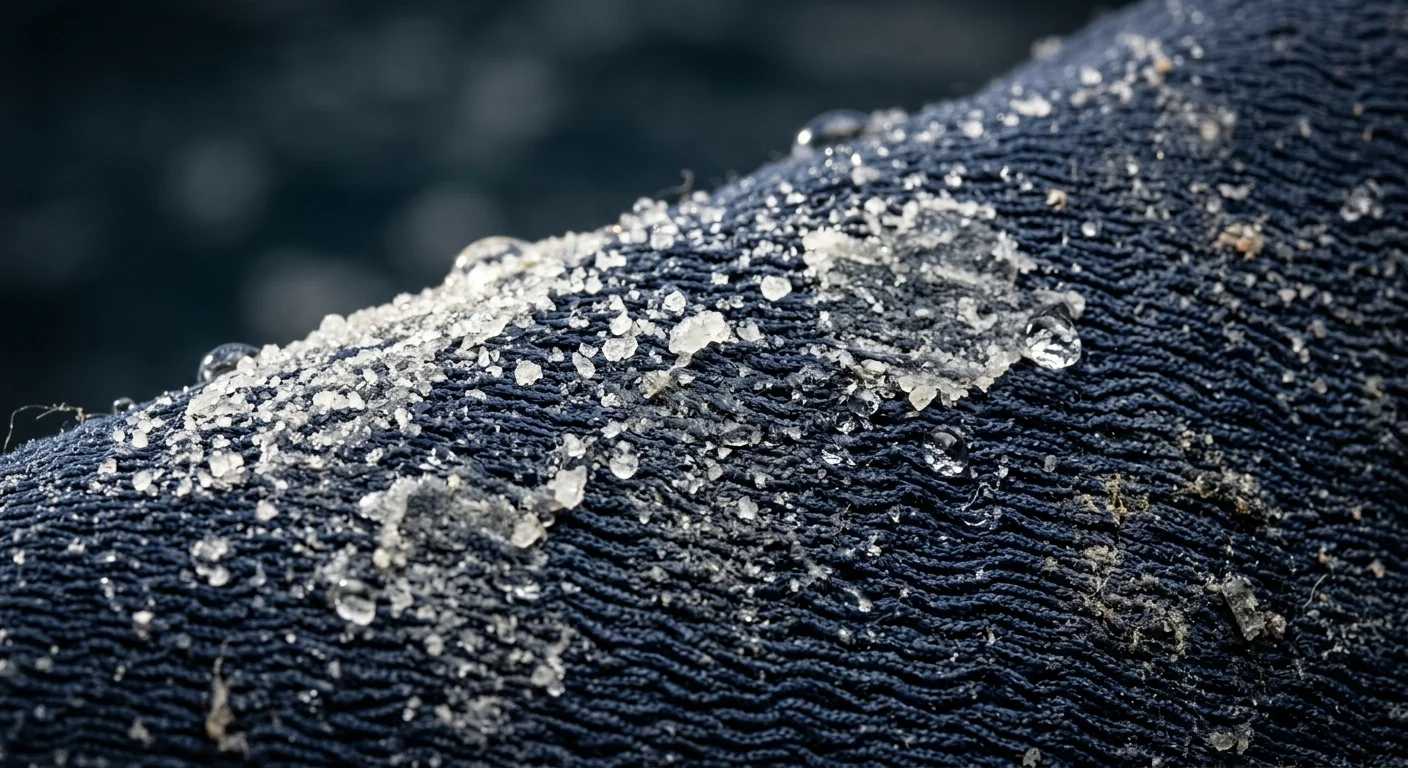
Cotton content is the tell that most anglers overlook. Cross 30% cotton and you're wearing a sponge the second water hits it. It absorbs, stays wet, and chafes against skin for hours. Fine for a shaded dock chair, but a liability when you're wading a river at sunrise.
Boat anglers need abrasion resistance more than speed-drying fabric. You're standing on a non-skid deck, not submerged. Ripstop nylon with a grippy seat wins here.
Wading anglers need fast dry time and real stretch. You're constantly in and out of the water, bending at the knee to cast, brace against current, and scramble over rocks. That's where polyester-nylon blends with built-in spandex justify the fishing pants price tag.
Tropical anglers fishing flats under eight hours of direct sun need UPF 50 sun protection above almost everything else. Sunburn ends a trip faster than bad casting ever will. Go high-poly, zero-cotton, loose and vented.
Match the water. Match the weave.
Fabric Composition Percentage Quick Reference: Which ratios are worth buying, and which ones are scams?
Fabric labels lie by omission. A tag can say "moisture wicking fabric" and still contain 25% cotton. Technically true, practically useless. Look at the numbers, not the marketing copy.
Buy these ratios:
- Polyester 80%+ with 10-20% spandex/elastane. This is the sweet spot for quick-dry outdoor clothing. It gives enough stretch for casting and enough polyester to shed water fast.
- Nylon 70%+ blended with 5-10% spandex. Ripstop fabric fishing gear built this way survives brush, rocks, and hook hangs without tearing at the seams.
- Nylon-polyester blends with 0% cotton. Zero is the goal for anything touching water.
Be cautious with these:
- Cotton above 15-20%, no matter what else is in the blend. It'll read "breathable fishing apparel" on the tag and feel like a wet towel on your legs by hour two.
- "Has spandex" with no percentage listed. Trace amounts (1-2%) do almost nothing for stretch. You want that number spelled out.
- DWR-treated claims with no polyurethane or wax coating specified. Water resistant fishing pants need an actual coating, not a marketing adjective.
Read ingredient order first. It's listed by weight, highest first. That tells you the fabric's real character before the small-percentage additives come into play.
Fit and Sewing: How Elasticity, Waist Measurement, Cuff Length, Inner Seam Length Affect Fishing Experience
Fabric gets all the attention. Fit is what determines whether you catch that fish or watch it swim away while you're busy fighting your own pants.
Stretch direction matters more than stretch amount. Four-way stretch fabric fishing shorts move with you in every direction—up, down, left, right. Two-way stretch gives in one direction only, and that's the direction that fails you mid-cast when you're lunging for a strike or crouching to net a fish. Test this before you buy: sit on a bench for five minutes. If the crotch tightens or the waistband digs in, that discomfort compounds over an eight-hour trip.
Waistband sizing rules that work: don't trust the size label alone. Match your waist, hip, thigh, and rise measurements against the fishing shorts sizing chart on the product page. Industry standard for semi-fitted pants runs 0-2cm of waist ease, 4cm+ of hip ease, and 0-3cm of rise ease. Too tight compresses your abdomen when you bend to grab a rod. Too loose slides down when you're wading against current.
Hem width solves two different problems. A straight or slightly flared hem with a side vent gives your calves breathing room if you're bulkier or need mobility. A tapered hem with an ankle cinch keeps fabric from snagging on boots or rocks during wading.
Inseam length prevents drag. Too short exposes skin when you crouch. Too long drags in mud and trips your stride. Aim for hem length that sits right at the ankle bone—not below it.
60-second fit test: squat once, sit for five minutes, take a long stride, walk three steps. Any pulling, digging, or dragging means the fit's wrong before the fabric even gets wet.
Self-Check: 5 Tests to See If These Pants Are Ship-Ready
Five minutes with the pants in hand tells you more than any product description ever will.
Test 1: Tape measure check. Lay flat, measure waist, hip, and inseam against your own body. Ignore the size tag. Tolerance should be ±0.5-1cm on waist and inseam. Wider than that, the fit's already compromised.
Test 2: Seam pull test. Grip the waistband, belt loops, pocket seams. Pull hard, hold ten seconds. Buttons and rivets should hold 50-90 newtons without popping a stitch.
Test 3: Zipper cycle test. Cycle it five times fast. Any sticking or self-unzipping means it fails mid-cast.
Test 4: Wet-rub colorfastness. Rub a white cloth dry, then wet, ten strokes each. Color transfer means dye bleeds onto skin all day.
Test 5: Label match check. Compare the fiber content tag against the listing. Mismatched percentages are a red flag for the whole batch.
Industry manufacturing reference: fishingapparelfactory.com
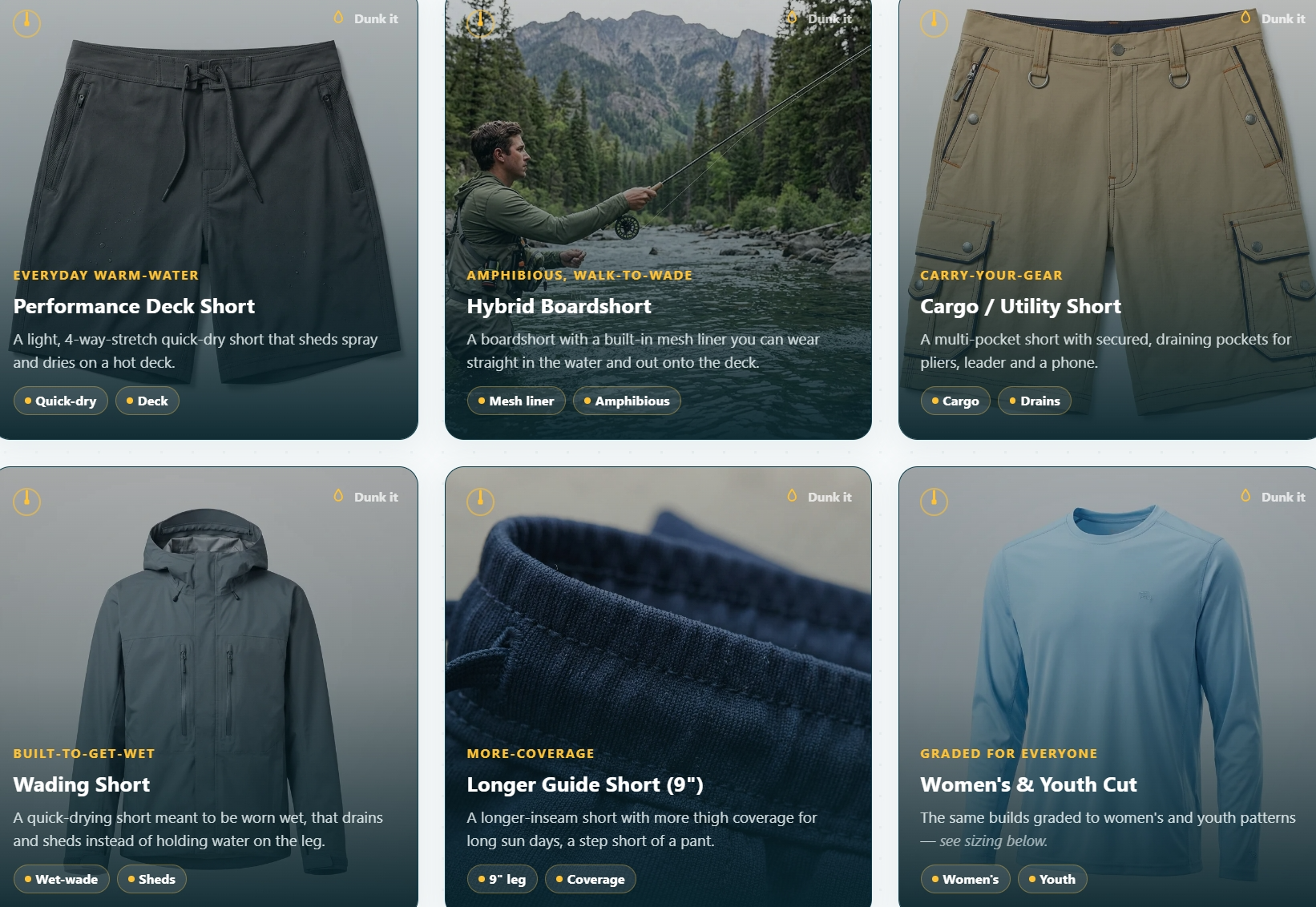
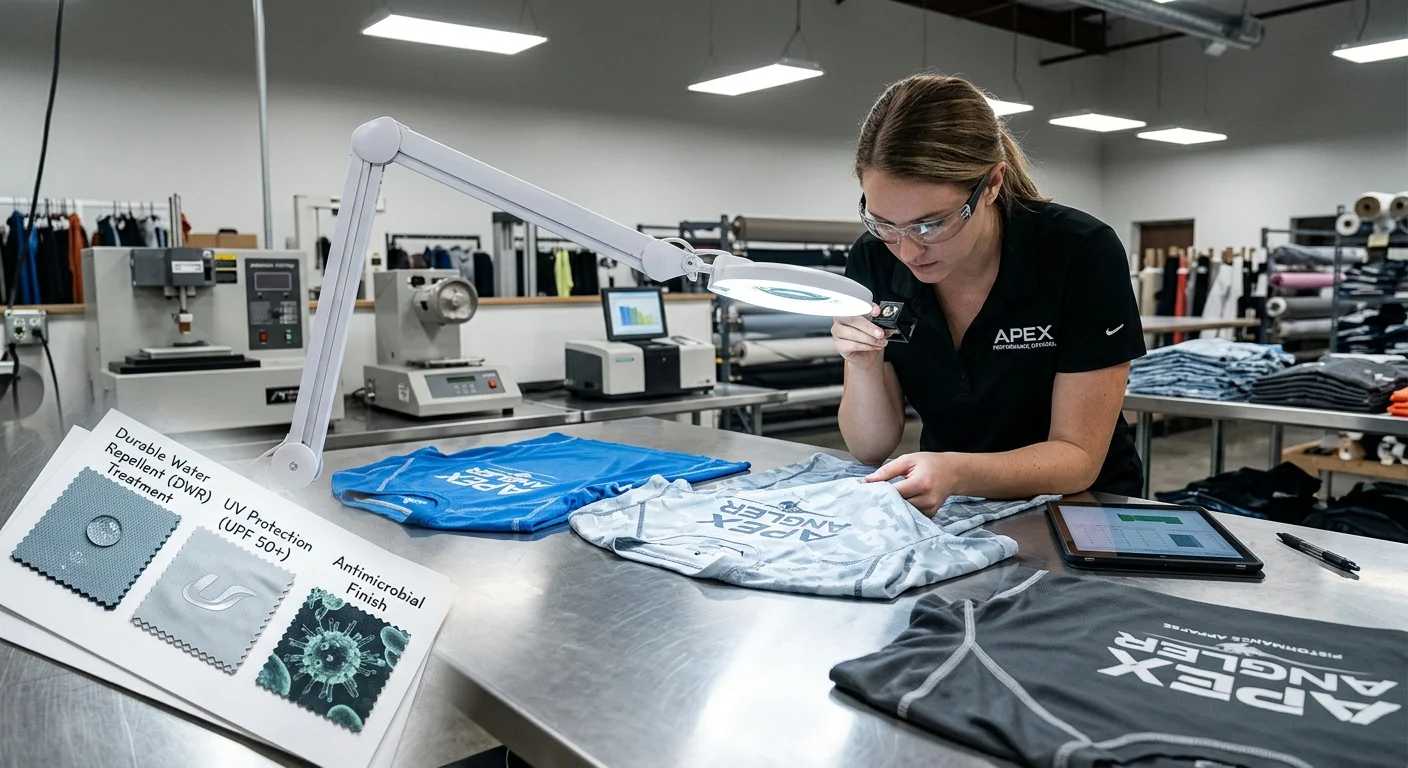
Curious where these fabric standards come from? Trace the supply chain back far enough, and you land at Performance Fishing Pants and shorts manufacturers like Runfish Apparel, the OEM fishing apparel factory behind fishingapparelfactory.com in Guangzhou. Their size-chart data confirms what the abrasion numbers already told you: polyester holds roughly 58% of the fishing apparel material market. They grade in 2-4cm chest increments across sizes for a reason—consistency matters more than marketing copy. North America's fishing clothing sector is growing at 6.1% CAGR, and shirts alone claim 45.5% of that share. Translation: the industry is voting with its production runs, and polyester keeps winning.
A Quick Reference Table for Fabric and Fit Combinations in 5 Common Fishing Scenarios
Pros who fish four different waters in a week carry four different weight classes of fabric. Grams per square meter (GSM) and yarn count dictate how a pant moves, breathes, and holds up long before brand name ever enters the equation.
Warm-weather wading, light tackle. Go with a low-GSM fabric in the 200-230 g/m² range with a yarn count of 30 or higher. It's thin, soft, and fast-drying. Fit it loose, with 8-12cm of chest/thigh ease, so you can scramble over river rock without binding.
Technical stream fishing, tight footwork. Stick with the same low GSM range, but tighten the fit. Add 3-4cm of extra room at the knee for the deep crouch-and-cast motion. Keep waist ease at 3-5cm max, since loose waistbands slide when you're climbing boulders.
Big-fish, multi-season fishing. Step up to a mid-weight fabric at 260 g/m² with a 20-24 yarn count. The blend holds structure for fighting fish while staying breathable across temperature swings. Chest ease jumps to 10-14cm because you need room to lean back hard when a big fish runs.
Competition or high-density fishing. Drop the ease. Keep chest at just 6-8cm and narrow the hem to prevent fabric flutter that snags line. Speed matters more than comfort margin here.
Rock and surf fishing. Max out GSM to 260-300 with a yarn count under 16. The fabric is thick and abrasion-resistant, built for sitting on wet stone. Add DWR coating and reinforced knee/seat panels.
UPF 30 vs. 50+: Labels, Protection and Return Policies Compared
UPF 30 lets through 65% more ultraviolet radiation than UPF 50. Not a typo. UPF 30 blocks 96.7% of UV, letting 3.3% through. UPF 50 blocks 98%, letting 2.0% through. That 1.3-percentage-point gap looks tiny on paper. On your skin, it's the difference between six hours of safe fishing and a burn by lunch.
Think of UPF as a multiplier on your skin's natural burn time. UPF 30 means 30 times longer than bare skin. UPF 50 means 50 times longer. If your skin burns in 10 minutes unprotected, UPF 30 gets you 300 minutes. UPF 50 gets you 500. On a full day of flats fishing under direct tropical sun, that extra 200 minutes is the difference between needing sunscreen backup and having a lobster-red neck.
The labeling law:
Fabric standards don't let UPF 50+ fishing apparel manufacturers print any number they want. Once a fabric tests above UPF 40 with UVA transmission under 5%, it can only be labeled "UPF40+." Cross UPF 50, and the label caps at "UPF50+" period. That "UPF 100" or "UPF 1000" claim on a product page? If the sewn-in tag reads "50+," the marketing number is decoration. Anything past UPF 50 delivers such marginal additional protection that standards bodies don't bother distinguishing it.
Your retail return checklist:
Tag says UPF40+ or UPF50+, but no test report exists. Request it. No lab documentation backing the number is grounds to question the claim.
Product page screams "UPF 1000" while the tag says "50+." Mismatch. That's marketing inflation, not measured performance. Valid grounds for a "not as described" return.
Listing confuses SPF with UPF. SPF measures sunscreen. UPF measures fabric. If a "sun protection" pant only lists SPF with no UPF number, it wasn't tested as fishing apparel at all.
Third-party testing shows actual UPF under 30. That fabric doesn't meet the baseline for "effective sun protection," full stop. Non-compliant.
Claims to block 99% of UV, but tag says UPF30. UPF 30 mathematically maxes out at 96.7% blockage. Ask for the test data, or treat the 99% figure as fiction.
For your tropical or offshore trip, aim for UPF 50+. If you're spending eight hours under direct sun on open water, that rating keeps you from getting burned.
Wading vs. Boat Fishing Pants: Quick-Dry and Drainage Differences
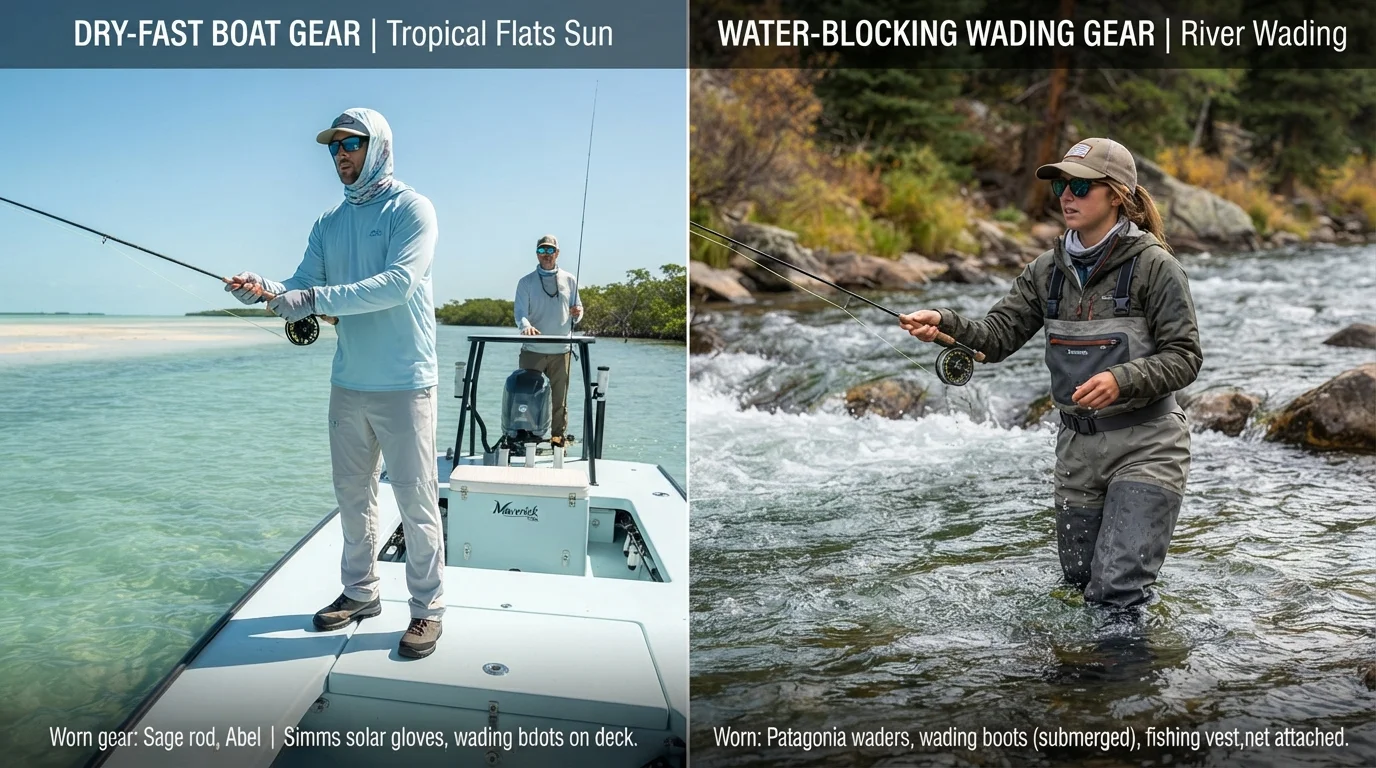
Waders and boat pants solve two different problems, even though both get labeled “quick dry technology outdoor clothing” on the shelf. One keeps water out entirely. The other lets water in, then hustles it away fast. Confuse the two and you’ll end up cold, wet, or both.
Waders: the zero-tolerance approach. Wading gear assumes you’re standing in the river for hours, so the design goal is total exclusion: no entry at all. The outer shell runs 150‑300 g/m², built for surface abrasion resistance more than breathability. Underneath, a waterproof membrane (PVC, rubber, or coated film) handles the real work, rated at 5,000‑20,000 mmH₂O hydrostatic pressure. High‑end breathable versions push past 10,000 mmH₂O. Seams get heat‑taped or high‑frequency welded. Industry tolerance allows fewer than 1 leak point per 1,000 cm of seam. That’s zero. Standard wader height runs 110‑130 cm, chest‑high, built for water depths up to half your body height. Once you climb out, the outer shell surface‑dries in 30‑90 minutes; full internal dry‑through takes 2‑4 hours, since sweat vapor has to escape through a breathable membrane rated at 5,000‑20,000 g/m²/24h. Full setup with boots: 1.0‑2.5 kg. Heavy, but that weight buys you the security of standing in current without a drop reaching your skin.
Boat gear: the fast-flush approach. Boat decks get soaked constantly with spray, rain, and fish blood, and nobody’s pretending otherwise. The design goal shifts entirely: don’t block water, evacuate it. Decks slope 1‑3% toward drain holes (25‑50 mm diameter, 4‑8 per boat), channeling water to bilge pumps rated 500‑1,500 GPH. That’s 1,900‑5,700 liters per hour of clearing capacity. Clothing follows the same logic. Instead of waders, anglers wear 100‑200 g/m² polyester quick‑dry shells or soft‑shell jackets. These are thinner and lighter, and go from soaked to dry‑feeling in 20‑60 minutes rather than hours. Boat shoes carry 10‑30 drain holes per shoe, emptying standing water in minutes.
Factor | Wading Version | Boat Version |
|---|---|---|
Design goal | Zero water entry | Fast water exit |
Fabric weight | 150‑300 g/m² | 100‑200 g/m² |
Waterproof rating | 5,000‑20,000 mmH₂O | N/A (surface repellent only) |
Dry time (full) | 2‑4 hours | 20‑60 minutes |
Total weight | 1.0‑2.5 kg | Lightweight, unrated |
If you’re standing in a river, buy for containment. If you’re standing on a deck, buy for evacuation. Grabbing wading gear for a boat trip means carrying extra weight, getting hot, and solving a problem you don’t have.
Long-term durability and easy maintenance: Which fabrics can withstand three peak seasons?
Three fishing seasons means roughly 70-80 machine washes if you're washing weekly. Most fishing pants don't survive that math. They look fine on the rack, then fall apart by season two—pilling at the thighs, fading at the knees, seams popping loose. You need to check specific wash-cycle and abrasion thresholds before you buy.
Martindale abrasion is the number that matters. Light shirts need 10,000+ cycles. Commuter pants and athletic wear need 20,000-30,000. Outdoor jackets and heavy-use pants need 40,000-50,000+ at 9 kPa load. High-denier polyester and nylon taslan fabrics—150D twill stretch composites, 300D oxford weaves—routinely hit 50,000 cycles without failure. That's the baseline for gear that needs to survive three seasons of hard wading and boat decks.
Colorfastness tells you if your pants still look decent in year two. Look for soap-wash fastness (ISO 105-C06) rated 4+ and rub fastness (ISO 105-X12) rated 3-4+ wet and dry. Below that, dye bleeds onto skin and fades unevenly within a season.
Seam and tear strength set the failure point. Aim for seam strength above 180 N (ISO 13934-2), tear strength 25-80 N, and tensile strength 300-600 N per 5cm. Pants below these numbers tear at stress points—crotch, knee, pocket seams—exactly where fishing puts the most strain.
Wash-cycle performance retention is the real durability test. Waterproof-breathable composites should retain 70%+ of their original hydrostatic rating and breathability after 50 machine washes. Appearance—no pilling, no major fade—should hold a 3-4 rating (AATCC EP1) through 30-40 washes. If a product page doesn't mention wash-cycle testing at all, assume it hasn't been tested past a handful of washes.
Cotton-blend functional fabrics fade fast. T/C blends with oil-repellent or anti-static treatments lose most of their functional coating after 30 washes—about 4-7 months at weekly laundering. The base fabric survives longer, but the performance treatment doesn't. Treat these as one-season performers, not three-season investments, unless you're fine with the coating disappearing by summer's end.
Buy synthetic-first, treatment-light. Polyester and nylon hold dimensional stability wash after wash. Cotton and rayon blends shrink, sag, and lose shape. Skip heavy resin finishes that wear off after a few washes—they're the first thing to fail, long before the base fabric does.
Conclusion
There's no single best fishing pant, only the right fabric and fit for your water. A 90% nylon blend with UPF 50 will save your skin on a flats boat, but drown you in sweat if you're bushwhacking a mountain stream. Match the material to the mission.For bulk programs, request a custom wholesale price for Performance Fishing Shorts based on fabric and order volume.
You now have a working knowledge of moisture wicking fabric tech, a percentage cheat sheet for spotting cotton-heavy imposters, and a five-point self-test you can run in your driveway before wetting a line.
Pull up the scenario matrix, run the splash test on what's already in your closet, and buy your next pair with certainty.