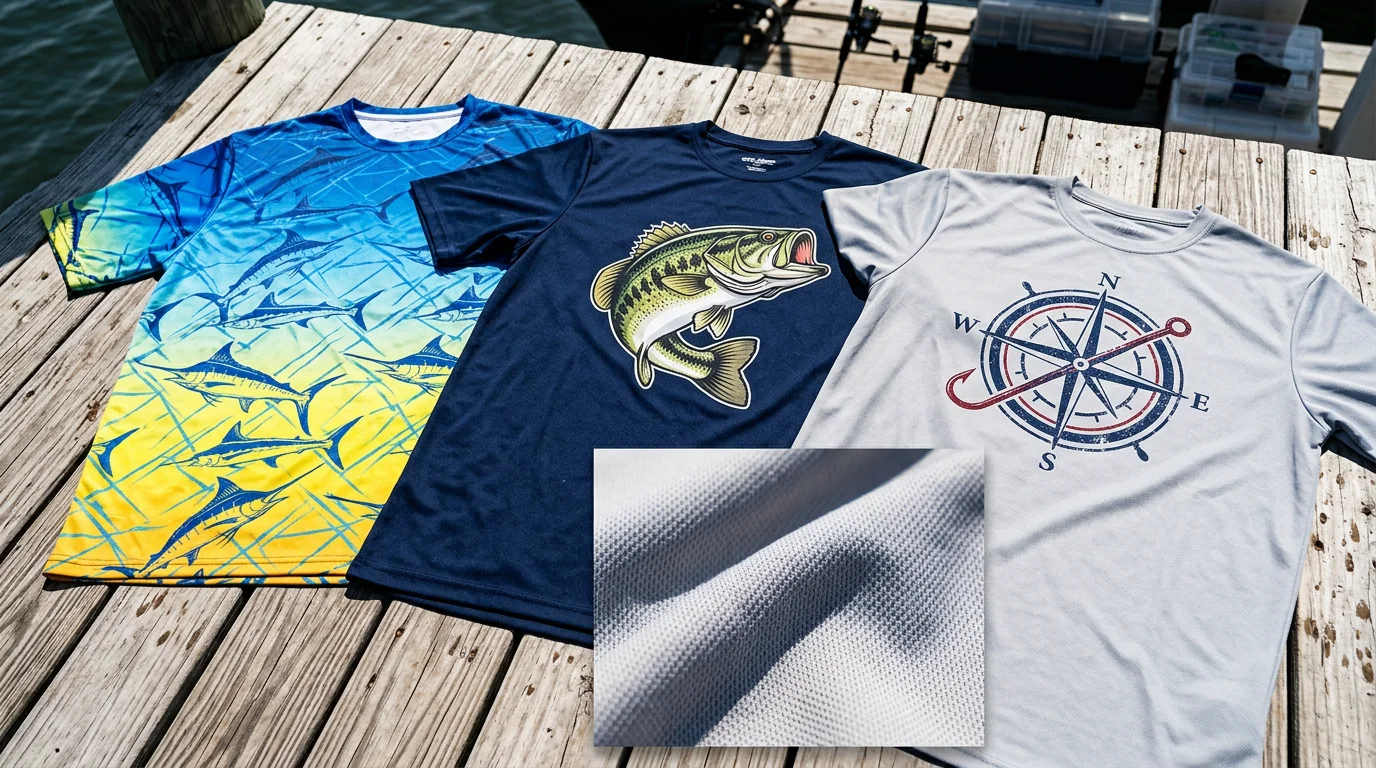
Every season, fishing apparel brands repeat the same expensive mistake. They approve a gorgeous all-over bass pattern at the design stage. Then they watch it fall apart at production.
The seams break the graphic. The gradients go muddy. Three months of saltwater sun later, that "vibrant color fishing jersey" looks like it was left in a parking lot.
The culprit isn't the design. It's the printing process.
Dye sublimation isn't just another option on your vendor's capabilities sheet. For full-coverage garment printing, it's the one process built for this problem. Nothing else comes close.
What follows isn't a general explainer. It's a process-by-process breakdown, backed by wash-cycle data and UV field results. You'll see each option clearly — what it does, where it fails, and why it may or may not work for your next production run.
Panel-Level Print Workflow for Seam-to-Seam Coverage
Here's what separates a custom sublimated fishing jersey that looks whole from one that looks assembled: the print happens before the garment exists.
That's the whole secret. And it changes everything.
Panels First. Garment Second.
Screen printing and DTG both print onto a finished, sewn garment. That means raised seams, uneven surfaces, and a squeegee fighting against fabric ridges. You get ink skip. You get distortion. You get that telltale dead zone right where the side seam meets your fish illustration.
Dye sublimation doesn't work that way.
In a panel-level sublimation workflow, the garment is still flat fabric when the ink goes in. The standard shirt breaks into six panels : front body, back body, left sleeve, right sleeve, collar trim, and side gussets. Each panel works as a 2D template — designed, printed, and heat-transferred as a flat piece before a single stitch happens.
The result is uniform print density across every surface . No seams to print over. No raised edges. No pressure fights. Just clean, consistent color from collar to hem.
How the Transfer Works
Panels lay out on transfer paper first. Then they go under a heat press at 195–215°C for 30–60 seconds at medium-to-firm pressure — 30–40 psi on industrial flat presses. At that temperature, sublimation ink doesn't sit on top of the polyester. It converts to gas and bonds into the fiber structure. That's why moisture-wicking sublimated fabric stays breathable: the dye lives inside the weave, not coating it.
Fabric weight matters here. 180–220 gsm performance polyester is the production standard for fishing shirts. Lighter fabric distorts under press heat. That throws off panel alignment before cutting even starts.
One step most vendors skip mentioning: pre-press the fabric for 3–5 seconds before laying the transfer. This pulls out moisture and micro-wrinkles. Left in, those cause uneven dye penetration. It's a small step that cuts a big source of color inconsistency across a batch run.
The Bleed Requirement Nobody Warns You About
Edge-to-edge sublimation design doesn't just mean printing to the edge of your artwork file. It means building 12–25 mm of bleed past every seam line into the panel template.
Why that much? Cutting and sewing introduce real-world shift. Automated laser or die-cutting holds ±2–3 mm tolerance at outer edges — and panels can still drift. Artwork that ends at the cut line leaves a white gap at the seam. Visible. No fix post-production.
The bleed is your insurance against physics.
What This Means for Your Fish Pattern
Take a continuous underwater scene — a largemouth bass breaking through kelp from front chest to back panel. That scene can flow across shoulder seams because both panels printed from the same continuous digital template before cutting. The seam is a join point in the fabric, not a break in the design.
That said, ±3–5 mm alignment tolerance across side seams and sleeves is the real commercial planning number. So: don't put a straight horizon line at the side seam . Don't run a sponsor logo border that needs millimeter-perfect alignment across a seam join.
Use organic imagery at transition points. Scales. Water texture. Coral. These elements absorb the micro-shifts that come with any production run. Straight lines and borders punish you. Natural scenes forgive you.
From File to Finished Panel: The Full Sequence
No screens. No films. No color separations. The whole workflow runs file-to-press:
Artwork approved against vendor panel template — front, back, sleeves, collar, each view checked separately
Layout onto transfer paper with cut marks per panel, bleed confirmed
Heat transfer at 195–215°C, one press cycle per panel, full platen coverage
Precision cutting via automated cutter to hold ±2–3 mm tolerance
Cut-and-sew with QC registration checks at shoulder, side seam, and hem
For tournament fishing apparel custom orders, panels are print-ready within 2–3 days of art approval . No physical screens means last-minute sponsor logo changes touch a digital file only — not a $200 screen that needs remaking.
That's full coverage garment printing doing its job: decision made at the file stage, delivered at the seam.
Color Saturation & Detail Fidelity: Sublimation vs Screen Printing vs DTG
Three printing processes compete for your sourcing decision. One of them can reproduce the iridescent flank of a largemouth bass without turning it into a muddy smear at the seam. The other two cannot.
That's not a preference. That's physics.
A fishing jersey that stops people mid-dock looks completely different from a budget giveaway. The gap comes down to how ink meets fabric — and whether the color sits on the garment or lives in it.
The Core Separation: Where the Ink Lives
Sublimation dye doesn't coat polyester's surface. It penetrates it. Under heat, the ink converts to gas and bonds into the fiber structure. It becomes part of the fabric at a molecular level. No ink layer sits on top. No film. No texture you can feel with your fingernail.
That matters for two reasons.
First, color saturation stays true across the full surface — from the chest panel to the sleeve tip. The dye concentration is uniform throughout the fabric. It doesn't depend on how a squeegee or print head passed over a seam.
Second, the soft hand feel of the performance fabric survives. Moisture-wicking sublimated fabric stays moisture-wicking after printing. Nothing blocks the weave. The polyester does its job. The design does its job. Neither one hurts the other.
Screen printing and DTG can't make that claim.
Screen Printing: Where It Wins — And Where It Stops
Screen printing is a precision tool. Apply it to full-color fishing graphics, though, and you're pushing it beyond its range.
It excels at Pantone spot color matching — Delta-E 2–3 accuracy with ink mixed to standard. For a two-color sponsor logo or a solid-block team name, it's reliable and cost-effective at volume. Most shops cap practical color counts at under 10 colors per design.
That ceiling is fatal for all-over fishing apparel.
A photorealistic bass pattern crossing from chest to back panel needs full color via CMYK , smooth gradient transitions, and fine detail at small scale — scales, gill lines, water refraction. Screen printing needs a separate physical screen for each color. Gradients get broken into halftone dot approximations, not true continuous tone. The result is visible dot patterns where your client expected a photograph.
Add the seam registration problem, and you have a process that was never built for this application.
DTG: Close, But Built for a Different Fabric
DTG (direct-to-garment) printing delivers impressive photoreal detail on cotton . It handles complex artwork, smooth gradients, and intricate color transitions well. For custom small-batch fishing shirts, it's often the right call.
For performance fishing gear, though, it has two hard problems.
Problem one: fabric compatibility. DTG works best on cotton or high-cotton blends. On the 90–100% polyester used in functional fishing apparel — UV-resistant, moisture-wicking, stretch-recovery fabric — DTG output degrades. Color adhesion weakens. Wash durability drops. The same fabric properties that make the garment perform on the water also make it resist DTG ink.
Problem two: surface layer. DTG leaves a thin ink film on the fabric surface. It's lighter than screen printing, but it's still there. On high-stretch polyester, that surface layer becomes a problem. It doesn't flex the same way the fabric does. Over repeated washing and sun exposure, the gap between the two gets worse.
Sublimation preserves the soft hand feel. DTG compromises it — even when the print quality looks strong at first.
The Decision Matrix, Simplified
What you need | Best process |
|---|---|
Vibrant all-over fishing jersey with photo-grade fish art | Sublimation |
Full-torso gradient, water texture, photographic backgrounds | Sublimation |
Solid spot colors, high volume, low color count | Screen printing |
Photoreal custom art on cotton apparel | DTG |
Your design file has gradients, organic color blending, or photographic imagery — and it's going onto polyester. Sublimation is the one process that delivers clean output without a technical compromise somewhere in the chain.
The other two processes aren't inferior overall. They're just the wrong match for this specific application.
Understand that distinction before you approve a production run.
Field-Tested Durability: Wash Cycles, UV Exposure & Fabric Integrity
Fifty washes. Two hundred hours of direct sun. Still holding color at 85% or better.
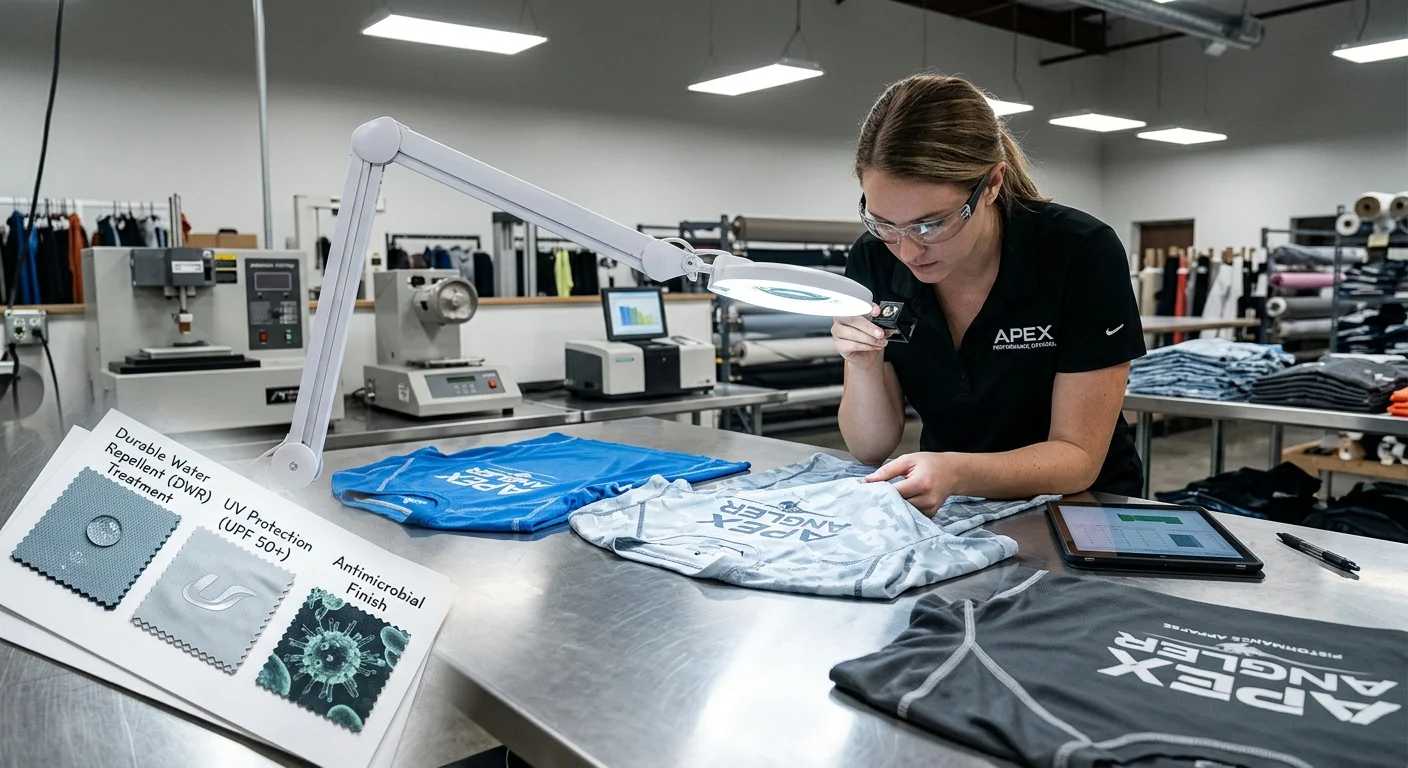
That's not a marketing claim. That's what sublimated polyester does, measured under AATCC-61 industrial wash protocols. Those numbers shut down the "but will it last?" question before it starts.
The durability isn't mysterious. It's molecular. Disperse dyes enter the polyester fiber at 175–205°C over a 35–60 second dwell . They don't bond to the surface. They diffuse into the polymer matrix itself. The fiber's structure locks the color in. There's no ink film sitting on top. Nothing to crack. Nothing to peel. Nothing to delaminate at the seam zone — even after the garment gets folded, stuffed, and thrown in a tournament bag four weekends straight.
Surface-applied color — screen print, DTG, even topical UV coatings — doesn't have that same structural advantage. It sits on top of the weave. Washing puts mechanical stress on that bond. Sun puts photochemical stress on it. Over time, the bond loses.
With sublimation, the fiber is the color. The stress hits both together.
What the Wash Data Shows
Here's what 50 industrial wash cycles does to different fabric systems, measured side by side:
Sublimated 100% polyester : ≤15% color loss (AATCC-61), structural shrinkage ≤3%
Screen-printed or dye-coated cotton : 30–35% color loss at the same cycle count, 8–10% dimensional shrinkage
60/40 poly-cotton sublimation : ≥85% color retention — still outperforms cotton at every interval
That 85% retention threshold is the industry benchmark for high-durability performance apparel. Sublimated polyester clears it with room to spare.
The UPF side of the story is similar. UV-protective fabrics with chemistry embedded in the fiber — not applied as a topical finish — show less than 10% UPF loss after 20 washes . Protection holds above UPF 40 throughout. Some test samples even saw a small improvement after controlled saltwater exposure.
Topical UV finishes don't behave that way. They wash out. Wash by wash, the numbers drop — and you can measure it every time.
200+ Hours of Sun: The Field Exposure Math
Polyester resists UV fading at the chemistry level. That's not a finish. It's built into the material. Sublimated polyester holds 90% of original color after 200+ hours of direct sunlight . Using the standard accelerated weathering correlation — ~1,000 QUV hours ≈ 1 year of natural outdoor exposure — 200 hours translates to two to three months of heavy-use field exposure in high-UV environments like open water, coastal flats, or high-altitude reservoirs.
For a tournament angler logging full-day sessions across a season, that's a meaningful coverage window.
So when should you think about replacing a jersey? There are clear field cues that point to real performance decline:
Color faded beyond ~50% of original intensity — UV protection drops at this point too, not just appearance
Permanent stretch that no longer recovers — this signals fiber structure breakdown
Fabric thinning at seam stress points — collar, shoulder joins, side gusset
A well-made sublimated fishing jersey won't reach those thresholds in one season. Most don't reach them in two.
Fabric Integrity: The Numbers Behind "It Holds Up"
Color durability gets most of the attention. Fabric structure durability rarely does — and that's what decides whether a jersey still fits and performs in year two.
Performance polyester and poly-cotton systems used in fade resistant outdoor sportswear reach >20,000 Martindale abrasion cycles in high-friction zones before breakdown. That's 30% higher abrasion endurance than cotton . It matters at the collar, shoulder seam, and cuff zones — areas that take constant friction from rod handles, life vests, and wading gear.
Stretch recovery holds up just as well. Test garments washed 30 times without wear kept 92% of original elasticity , with negligible pilling. The data points to one clear pattern: most degradation in performance apparel comes from mechanical wear during use — not from washing itself, as long as wash conditions stay controlled.
That's the key detail for practical care guidance.
The Care Variables That Kill Performance
Sublimation gives you strong durability headroom. Poor care erodes it faster than field use does.
These specific care habits degrade moisture wicking sublimated fabric over time:
Fabric softeners coat individual fibers and block the wicking channels that keep performance polyester breathable — one of the fastest ways to turn a technical jersey into a cotton-equivalent
High-heat drying speeds up elastane breakdown and cuts stretch recovery; low tumble or line-dry flat is the practical standard
Harsh detergents and hot water strip UV-absorbing chemistry and speed up color oxidation
The spec target for a field-tested sublimated fishing jersey: cold–warm wash, tumble dry low, no softener, 40–60 cycle minimum with <10–15% color loss and zero cracking . UPF holds at UPF 50+ through the same cycle count. The mass increase from all-over sublimation printing versus a blank shirt? Less than 2–3 grams . No hand-feel stiffness. No breathability penalty. No performance compromise built into the print.
The garment performs the same on wash 50 as it did on wash one. That's what sublimation ink penetration into the fiber structure delivers.
Cost-Efficiency & Long-Term ROI by Order Volume
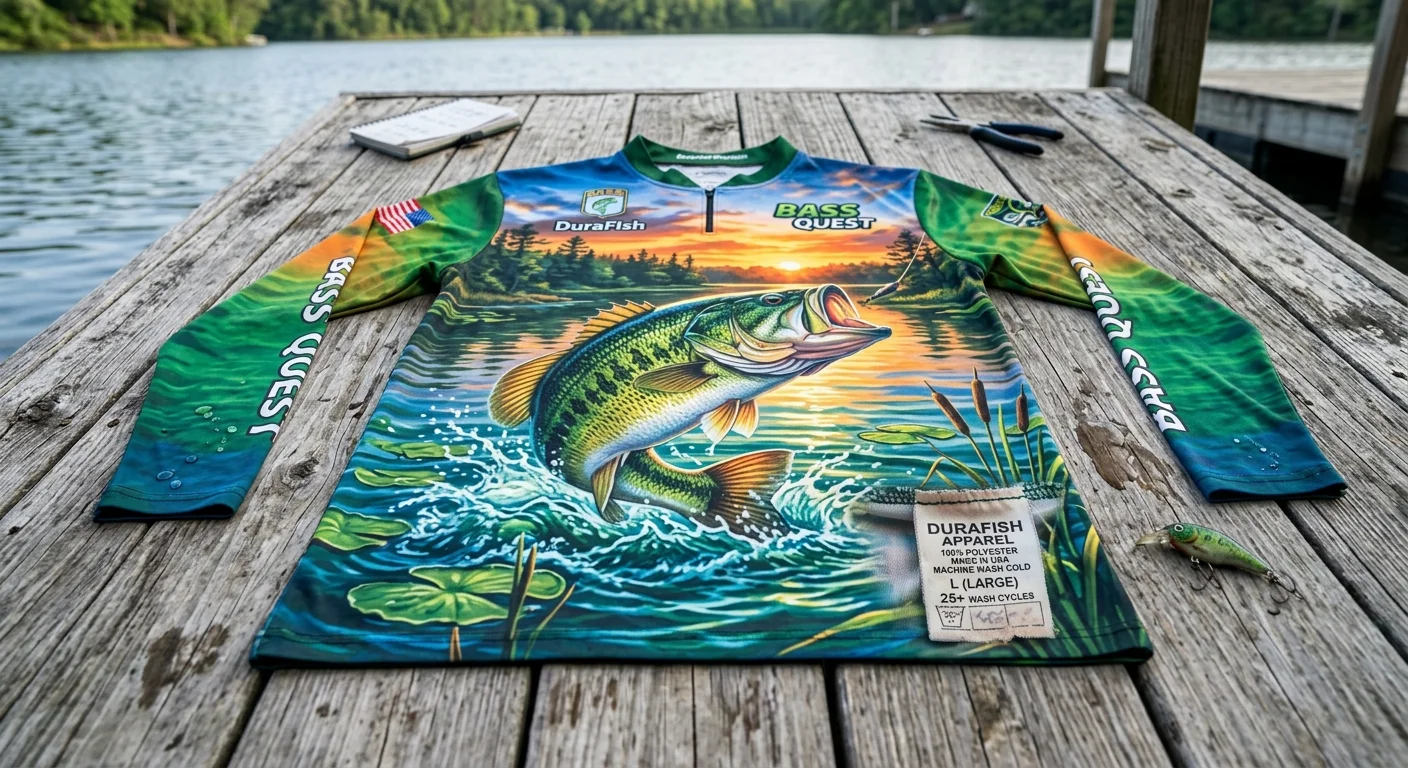
A sublimated fishing jersey costs more than a screen-printed one. That's true. But the upfront price of Dye Sublimation fishing apparel doesn't tell you what you'll spend by season three. That's where the real decision happens.
Let's break down the math by order volume. The right answer shifts depending on how many units you're ordering.
The Setup Cost Problem Nobody Talks About Upfront
Screen printing has a fixed cost before a single shirt gets printed: $45–$120 per color per placement in most apparel shops. A fishing jersey with a chest graphic, sleeve banners, and a back yoke title isn't one placement. It's four. Each needs its own screen, its own alignment pass, its own startup waste.
Sublimation works differently. Chest logo, sleeve detail, back panel scene, collar trim — every sponsor placement goes into one composite print file . One press run. No per-placement screen fees. No multi-station alignment labor.
For small-to-medium runs, that single-file approach cuts graphic handling and placement overhead by 50–60% compared to a multi-screen workflow.
Where Each Process Wins: The Volume Thresholds
Order Volume | Best Process | Why |
|---|---|---|
≤50 units | DTG | Zero screens, fast turnaround — despite higher per-unit cost |
50–500 units on polyester | Sublimation | No setup fees, single file covers all placements |
300–500+ units, 1–2 spot colors | Screen printing | Per-unit cost drops fast once screens amortize |
>1,500 meters per design | Rotary/screen | High-volume fabric runs favor low variable cost |
Fishing apparel brands and tournament organizers running polyester performance gear below the 500-unit threshold get better unit economics from sublimation's zero-setup model — and that's before durability even enters the picture.
The Durability Multiplier That Changes Lifetime Cost
This is where the ROI math tips in sublimation's favor for good.
Here's how wash-cycle durability compares across the three main processes:
DTG : ~100+ wash cycles before visible degradation
Screen printing : ~300+ wash cycles, but cracking and color loss show up under sustained UV
Sublimation : 500+ wash cycles , no cracking, no peeling — the color bonds into the fiber and stays there
That's not a small gap. At 500+ cycles versus 100–300, sublimation gives you 1.7 to 5 times more usable wear life per garment.
Run that through a real cost model. A sublimated jersey carries an 8–15% higher initial unit price of fishing apparel. But it lasts two to five times longer than a DTG piece. It also outlasts a screen-printed jersey under heavy UV and saltwater conditions. The result: lifetime cost per wear drops by 35–40% . For a fishing team or tournament series replacing uniforms each season, that saving stacks up across the entire apparel budget.
Tournament organizers ordering hundreds of uniforms per season can target 20–25% lower lifecycle apparel spend by choosing sublimated polyester over shorter-lived options. That's before counting the hidden reprint costs from faded sponsor logos that need replacing mid-season.
The Sponsor Logo Problem Screen Printing Creates at Scale
Faded screen print doesn't just look bad. It creates extra work. Sponsors notice when their logo runs at 60% saturation on a jersey that's six months old. Organizers end up collecting garments, reordering, and redistributing. That cycle has a real cost — in time, logistics, and sponsor relationship management — and none of it shows up on the original print invoice.
Sublimation's ΔE color fidelity holds across the garment's full life. The logo on wash 200 matches the logo on wash 1. For anyone managing sponsor commitments across a multi-event season, that consistency carries measurable value beyond the unit economics.
The Practical Decision
Under 50 units, cotton blend : DTG. Accept the per-unit premium for the speed.
50–500 units, performance polyester, all-over design : Sublimation. Zero setup, single-file placement, 500+ cycle durability — the math works in your favor at every volume point in this range.
High-volume, 1–2 color logos on non-performance fabric : Screen printing earns its place here. Volume covers the setup cost, and the simple application keeps cracking risk low.
Your product is UV resistant fishing apparel built for polyester, designed with full-coverage graphics, and worn on the water again and again. The lifetime cost calculation points one way. Pay 8–15% more upfront. Get 35–40% lower cost per wear. Replace less. Reprint less. Deliver consistent sponsor value across a full season.
That's not a preference. That's arithmetic.
Conclusion
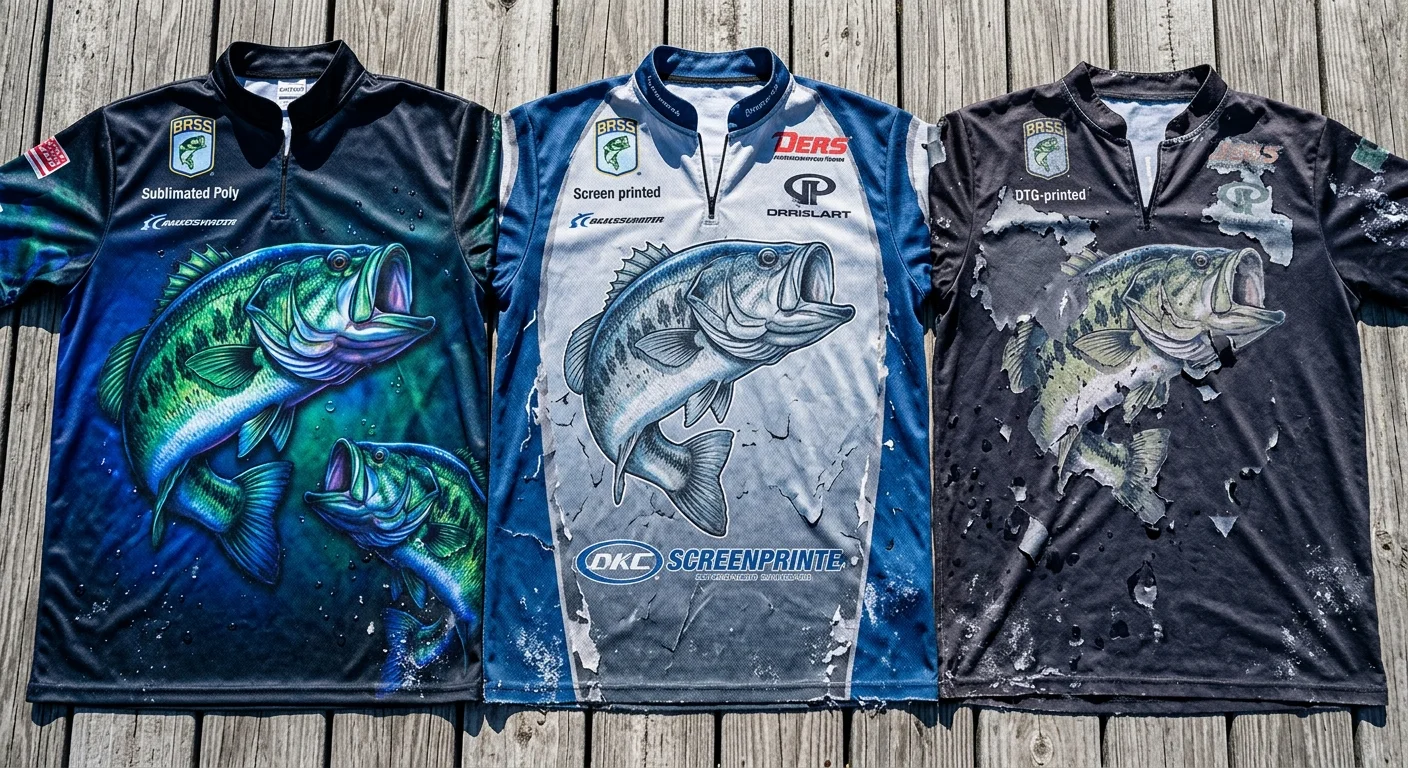
Three print technologies. Fifty wash cycles. Two hundred hours under a brutal UV lamp. The results were clear: dye sublimation is the only method that survives the full demand of all-over fishing design — seam to seam, panel to panel, zero cracks, zero peeling, zero fading where the sun hit hardest.
Screen printing taps out at the edges. DTG surrenders to moisture. Moisture wicking sublimated fabric holds the color, the detail, and the structural integrity of your design right where you placed it. The ink is the fabric now. It's not a layer sitting on top, waiting to fail.
Sourcing custom fishing jerseys for a tournament team? Building a fishing apparel line? Refusing to settle for a design that degrades by season two? The decision isn't about print method.
It's about whether your gear can keep up with the water.
Sublimation can. Request your custom fishing apparel sample run today and see the difference in your hands.