Your nose starts leaking the second the wind hits double digits below freezing, and you're standing in the gear aisle wondering if a $15 fishing neck gaiter will cut it, or if you need the full balaclava treatment. The answer depends on what you're doing. A fleece neck gaiter that feels perfect on a brisk commute will leave your ears screaming on a chairlift. A balaclava built for subzero skiing might fog your glasses solid on a 40-degree run. This is a scenario-by-scenario breakdown of how each performs when you're breathing hard, sweating, and fighting real cold wind. By the end you'll know which one earns a spot in your gear bag and which one just looks good on a store shelf.
Neck Gaiter vs Balaclava: Quick Comparison for Cold Wind and Winter
Factor | Neck Gaiter | Balaclava |
|---|---|---|
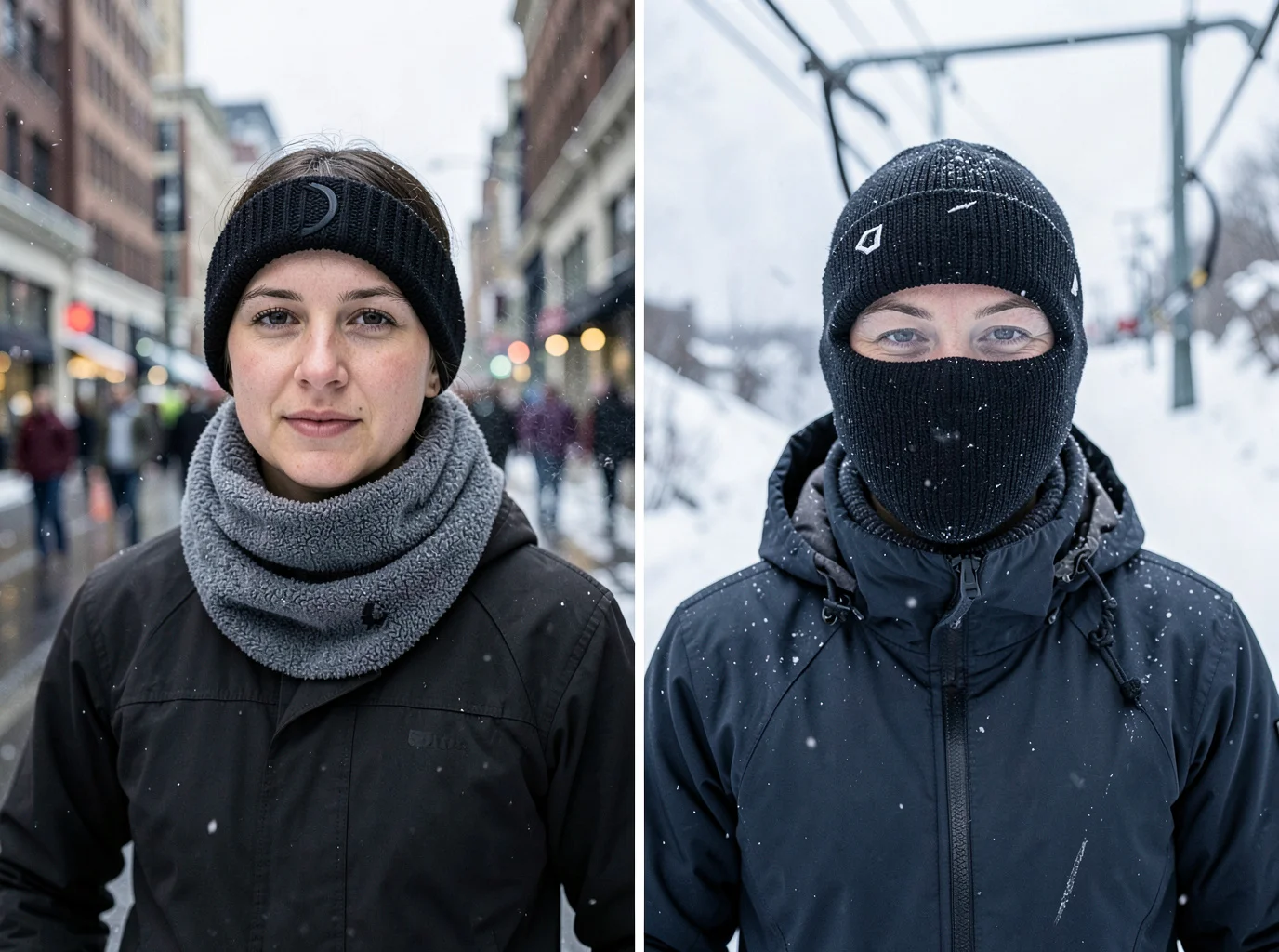
Coverage | Neck, chin, optional nose/mouth. Ears and forehead stay exposed. | Head, ears, neck, chin, most of the face. |
Cold-wind protection | Solid for drafts and moderate wind. | Seals ears, cheeks, chin, back of neck for full wind-chill defense. |
Warmth | Moderate; fleece handles 20°F (-7°C). | Highest warmth; built for sub-25°F (-4°C). |
Ventilation | Pulls down fast when you're overheating. | Traps more heat; mesh panels cut eyewear fog. |
Helmet fit | Thin merino slides under easily. | Needs a low-profile, helmet-specific cut. |
Price | Fleece versions under $10 of fishing neck gaiters. | Fleece/knit also cheap; technical shells cost more. |
Quick decision rules:
Above 25°F or high-output exercise → neck gaiter, merino or breathable synthetic.
Below 25°F with wind, skiing, snowmobiling, chairlifts → balaclava with ear coverage.
Standing still in the cold for a while → balaclava wins on retention.
Weather keeps swinging → gaiter, because you can drop it in two seconds.
Wearing glasses or goggles → pick whichever has a mesh breathing zone, not raw fleece over the nose.
How Coverage and Wind Protection Differ in Real Wear
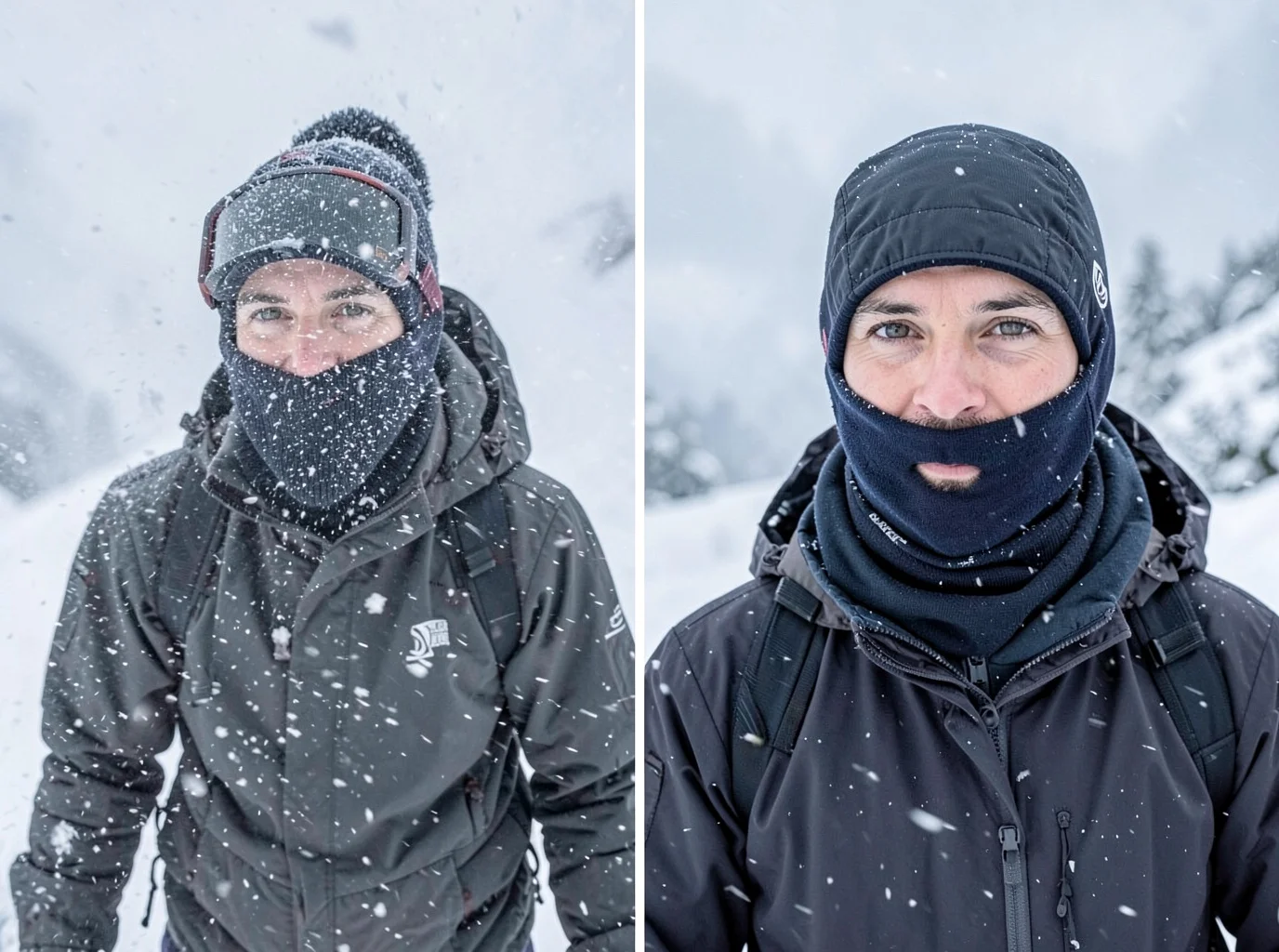
Coverage and wind protection aren't the same thing, and mixing them up is how people end up disappointed by expensive gear. Coverage is just square inches of skin hidden under fabric. Wind protection is whether air actually gets blocked once it hits that fabric. A balaclava can cover your entire head and still let wind rip through if the knit is loose. A thin gaiter can out-perform it if the fabric itself resists airflow.Brands can develop custom Fishing Neck Gaiters for cold-weather collections.
Fabric performance here comes down to air permeability, measured in CFM under standard textile testing. Lower CFM means less air gets through.
CFM Range | What It Feels Like | Fabric Type |
|---|---|---|
0–5 CFM | Essentially windproof | Membrane shells, tight-weave windproof face masks |
5–20 CFM | Wind-resistant, some airflow | Softshell-style neck tubes |
20+ CFM | Breathable, wind noticeable | Lightweight synthetic gaiters |
60+ CFM | Wind passes right through | Standard fleece neck gaiter |
That's why a "fleece neck gaiter" can feel colder than expected on a gusty day. Fleece typically runs 60+ CFM. It's warm by trapping body heat, not by blocking wind.
Gaps matter just as much as fabric. On a gaiter, the usual leak points are the nose bridge and the gap where it meets your collar. On a balaclava, wind sneaks in around the eye opening and wherever the ear panel doesn't seal tight to your jaw.
Quick test: hold the fabric against your lips and blow. If air passes easily, so will wind. This won't catch collar or seam leaks, but it's a fast gut-check before you buy.
Skiing and Snowboarding: Balaclava or Double-Layer Neck Gaiter?
Resort skiing is a chairlift at 10°F with 30mph wind, followed by a sweaty bootpack, followed by a groomer run where you're moving fast enough to generate your own wind chill. No single piece of gear handles all three perfectly, but one of these two comes closer than the other depending on what your day looks like.
Coverage is the first fork in the road. A balaclava seals your head, ears, neck, and most of your face. A double-layer neck gaiter covers your neck and lower face, full stop. Wholesale Fishing Neck Gaiters and Balaclavas suit outdoor retail programs.It doesn't replace ear or head protection, so if you're riding a lift in a storm with your hood down, the gaiter leaves gaps a balaclava wouldn't.
Warmth favors the balaclava , especially on severe cold days, storm days, and long lift rides where you're sitting still and losing heat fast. But a double-layer gaiter can close that gap for most resort conditions when it's built right. The Danish Endurance Thermal Merino Wool Neck Gaiter is a solid example of this spec done right, with 80% merino wool and 20% polyamide on the outside and a 100% recycled polyester polar fleece inner layer.A specialized fishing apparel manufacturer can customize fishing neck gaiters fabric weights.
Ventilation flips the advantage. Balaclavas trap more heat and moisture, which gets uncomfortable fast on uphill skinning or repeated hike-to-ride laps. A gaiter pulls below the chin or comes off in seconds.
Helmet fit is where cheap balaclavas fail. Bulk under a helmet changes the fit, creates pressure points, and can push the helmet upward. Look for flat seams and a thin, snug cut. Stretch or midweight tube gaiters slide under most helmets without issue.
Quick Picks by Day Type
Most resort days, mixed temps: midweight stretch gaiter
Storm days, exposed alpine terrain: thin, helmet-compatible balaclava
Touring or high-output laps: gaiter, for faster venting
Windburn-prone cheeks: balaclava with a Polartec Wind Pro-style panel
If you only buy one, go with the gaiter for versatility. If you ski in genuinely brutal cold, carry both.
Running and Winter Commuting: When a Neck Gaiter Works Better
A scarf unravels. A balaclava traps heat you don't need yet. A neck gaiter does neither. It stays put against your skin, pulls up over your mouth when the wind bites, and drops back down the second you start overheating. That flexibility is exactly why it wins for running and commuting, where your activity level swings every few minutes.
Match the weight to your effort, not just the temperature. Fabric weight (grams per square meter) tells you more than the thermometer does:
Under 200 g/m² – high-output running or mild commutes, roughly 30°F and up
200–280 g/m² – the all-around winter running/cycling range, holding up to about 15°F
280 g/m²+ – slow commuting, transit stops, sub-freezing waits
The Ridge Merino gaiter layers two 180 g/m² panels into a 360 g/m² shell with moisture-wicking and odor resistance built in. Minus33's Kodiak goes heavier still, at 400 g/m² brushed merino, rated for active use at 0°F and below.
Skip cotton entirely. It holds sweat, stays damp, and stops insulating the moment you're breathing hard. Polyester fleece dries fast for runners. Merino wool handles repeated commutes better. It absorbs up to 30% of its weight in moisture before it feels wet, and it doesn't start smelling after day three.
If cold air makes you cough, pull the gaiter over your nose and mouth during hard breathing. It pre-warms and humidifies the air before it hits your lungs. That matters if exercise-induced bronchoconstriction is already an issue for you.
Wearing glasses? Avoid thick fleece sitting directly under the lenses. Go mesh-panel or lighter-weave instead, or you'll be wiping fog every quarter mile.
For stop-and-go commuting , like waiting for a bus or walking the last ten minutes, a 200–280 g/m² or double-layer gaiter beats an ultralight running version. You're not generating heat standing still, so the fabric has to do more of the work.
Subzero and Extreme Cold: Which One Provides More Protection?
Occupational safety standards draw a hard line here, and you'll want to know it before you grab whichever one's on top of the gear bin. Cold-environment classification generally starts below -5°C, but extreme cold kicks in below -20°C, or any temperature paired with strong wind, wetness, or hours of exposure. That distinction matters because it changes which piece of gear actually does the job.
The wind factor changes everything. 40°F air with a 35mph wind feels like 28°F on exposed skin. That's the difference between a gaiter working fine and frostbite risk on your cheeks. A windproof outer layer beats adding another thin layer underneath something wind-permeable, every time.
Below -20°C, a balaclava is the only sensible choice:
Full coverage matters more as exposure time increases. Standing on a chairlift or working outside for hours means your ears, cheeks, and the back of your neck are losing heat the entire time, not just during gusts.
Low-activity situations lose more heat. If you're not generating body heat through movement, fabric has to do all the insulating work. A gaiter alone leaves too much skin uncovered for that.
Wet conditions compound the problem. Snow, sweat, or any moisture against exposed skin accelerates heat loss. A balaclava covering the full face buys you margin a gaiter can't.
A neck gaiter still earns its spot when conditions are less severe: temps only slightly below freezing, continuous movement, brief exposure, low wind, dry conditions. That's commuting to the train, not standing at a trailhead in a storm.
The real test is the insulation rating paired with wind resistance. A thick balaclava with a loose knit fails in extreme cold just as fast as a thin gaiter does. Check the fabric's wind resistance and coverage together.
Cycling and Helmet Fit: Balaclava Coverage vs Gaiter Flexibility
Helmets don't tolerate bulk well. Add too much fabric under the shell and you're fighting pressure points, a rocking helmet, or pads that no longer sit flush against your head. That's the trade-off between balaclava coverage and gaiter flexibility.
The crown is the deciding factor. A balaclava covers it; a gaiter leaves it bare. That works well for freezing, windy rides where ears and cheeks need full protection. It doesn't if the fabric is thick. Aim for a top panel around 0.3–0.5mm. Fabric at 240 GSM or higher can add 2–3mm across the crown, enough to lift the shell or cause uneven pad contact.
A balaclava should fit snug and wrinkle-free, with no seams or folds over the forehead, a face opening clear of your eyes and mouth, and ears and neck covered without dragging the helmet backward. Most adult sizing fits 21–24 inch head circumference — check the chart before buying.
Gaiters skip this problem. The crown stays open, so helmet pads stay undisturbed. Look for 4-way stretch, flat-lock seams, and roughly 16×9.5 inches of fabric (17.7 inches for extra neck coverage).
Criterion | Balaclava | Neck Gaiter |
|---|---|---|
Helmet-fit risk | Higher if thick | Lower, crown stays clear |
Best use | Sustained cold, exposed ears | Variable weather, frequent venting |
Before riding, put the fabric on first, then the helmet. Check it sits level, doesn't rock, and straps keep their "V" shape. Road and gravel helmets need thin, seamless layers. Half-shell MTB helmets have less room, so go minimal. Full-face helmets tolerate thin-to-medium thickness without losing padding contact.
Glasses and Goggles: Which Face Covering Fogs Less?
Fog happens because warm breath has nowhere to go but up, straight into your lenses. Neither a neck gaiter nor a balaclava is immune, but the fix depends on what's sitting on your face underneath.
Goggles beat glasses on fog resistance. Properly fitted goggles with high airflow and a fishing gear factory anti-fog coating outperform ordinary glasses almost every time, especially once you're moving or sweating under a face covering. Glasses leave gaps around the eyes, which is exactly where warm exhaled air escapes and condenses on cooler lenses.
If you wear prescription glasses under goggles, that's the worst combination for fog. Two lens surfaces trapped in one warm pocket means more condensation, not less. Fix this with OTG (over-the-glasses) goggles that have anti-fog treatment on both lenses, top-and-bottom venting, and roughly 15–20mm of internal depth so your glasses aren't pressed flush against the goggle lens.
For the gaiter itself, mesh panels over the nose beat raw fleece every time glasses are involved. Fleece redirects breath upward into the lenses; mesh lets it escape forward and down.
Water-based anti-fog coatings last up to 10 times longer than solvent-based ones in humid conditions — worth the upgrade if you're out in wet snow often.
Breathability, Moisture, and Comfort During High-Intensity Activity
Your body ramps up vapor production fast once you push the pace. At rest, you're putting out 60 mL of water vapor per hour. Moderate exercise pushes that to 450 mL/hour. Go hard, and it jumps to 840 mL/hour. That's the gap between a gaiter that feels fine on a walk and one that's soaked through ten minutes into an interval session.
Fabric choice decides how fast that moisture leaves. A 2025 activewear study measured drying rates across common blends:
100% cotton: 0.67 mL/h
Cotton/viscose/elastane blend: 0.92 mL/h
Cotton/polyester 50/50: 0.90 mL/h
Wool/polyester blend: 1.16 mL/h
Polyester/nylon/elastane: 0.66 mL/h
Polyester alone doesn't win. Knit structure and airflow matter as much as fiber content. Cotton soaks up more liquid but holds onto it, so it stays cold and clammy against your face long after you've stopped moving.
Air permeability is the metric worth checking if the label gives you one. ASTM D737 testing reports this in L/m²/s, and performance gear targets 100+ L/m²/s alongside 1,000+ g/m²/24h moisture-vapor transmission. Look for construction details that back this up, including zoned mesh at the mouth and jaw, a two-layer build with a wicking inner face and spreading outer layer, and flat seams so damp fabric doesn't chafe your chin on mile six.
Three fast purchase decisions: wind, activity, and face fit
Wind exposure comes first, then activity type, then face fit. Skip a step and you'll end up back in the return line.
Wind first. Check the forecast's wind speed, not just temperature. Under 15mph with mild cold, a standard fleece neck gaiter handles it. Past 20mph, or any exposed ridge, lift line, or open road, you need a windproof face mask rated under 10 CFM, or a balaclava with a tight-knit shell. Wind breaks cheap gear fastest.
Activity second. High-output movement (running, skinning, cycling) needs venting you control, so gaiters win. Low-output exposure (standing, belaying, lift rides, spectating) needs full coverage that doesn't rely on your body heat, so balaclavas win.
Face fit third. Run the same 10-second shake test you'd use on goggles. Pull the fabric up, move your head side to side, talk, breathe hard. If it slides down your nose or gaps at the jaw, that's not your size. A balaclava's face opening should clear your eyes without pinching; a gaiter's top edge should sit above your nose bridge without sliding.
Common Misunderstandings About Neck Gaiters and Balaclavas
People assume these two are swappable, that "face covering for cold weather" means grab whichever's closest. They're built differently. A gaiter is a stretchy tube, reconfigurable around your neck or face. A balaclava is shaped, fixed to cover head, ears, and most of your face at once.
Bigger isn't automatically better. Full hood coverage traps more heat and fogs eyewear faster, and it can crowd a helmet or respirator seal. For high-output activity, that extra fabric works against you.
Breathable doesn't mean suffocating, either. Front vent holes and mesh panels exist specifically so a balaclava full face coverage design doesn't trap every breath against your mouth.
Conclusion
No single option wins between a neck gaiter and a balaclava. You just need the right tool for your wind speed, activity, and face shape. Layering under a helmet, running in moderate cold, or need quick on/off flexibility? A fleece neck gaiter wins. Facing subzero temps, full-force wind, or gaps at your nose or ears? The balaclava's full coverage is worth the warmth-to-breathability trade-off.
Don't buy based on marketing claims about "ultimate warmth." Buy based on three filters: wind exposure, workout intensity, and whether you wear glasses or goggles. Run your scenario through the decision table above before checking out. That's the difference between gear that sits in a drawer and cold wind protection you'll reach for every single morning this winter.